Buying Guide
The best extended-life camera batteries are not one universal format. A security camera may use a proprietary rechargeable pack, while another accepts standard AA cells. Action cameras often use compact internal batteries, and some outdoor systems can run from an external power bank. Start by identifying the camera model and the battery compartment or connector. Then compare the documented fit, voltage, capacity, charging method, and environmental specifications.
Match the battery to the camera
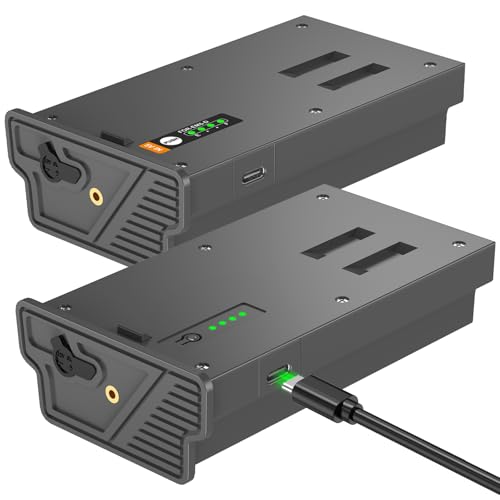
Compatibility should be the first filter. The Arlo Extended Battery and Housing names several Arlo Pro, Ultra, and Floodlight families, while the Loqdivr and Aiobuvr packs are designed for Blink Outdoor 4. Those products should not be treated as interchangeable. The GeeKam pair is also model-specific; its listing says the rounded-edge design is not compatible with every action camera and directs buyers to a compatibility table.
Standard AA cameras offer more flexibility, but the camera still needs to accept the chosen chemistry. The EBL, Energizer, and Granicell products are lithium AA cells, whereas the Maxfree set is a rechargeable lithium AA system. Confirm the camera manufacturer’s battery guidance before substituting rechargeable cells for disposable batteries.
Compare capacity carefully
Capacity figures are useful within a similar format, but they do not guarantee a specific operating time. The Loqdivr pack lists 6800mAh, Aiobuvr lists 6000mAh, and the YOLOtek JUICEBANK lists 7800mAh. These are different designs serving different cameras, so the numbers should be treated as specification clues rather than direct runtime promises. The Maxfree cells use a 3600mWh rating, while the GeeKam batteries list 1350mAh at 3.7V each.
For disposable AA options, EBL lists 3700mAh for both its 12-pack and 20-pack. Energizer and Granicell do not provide a comparable numerical capacity in the supplied evidence, so their evaluation relies more on format, storage, leak, and temperature information. In practice, a larger pack gives more replacements, not necessarily more power per cell.
Decide between rechargeable and disposable power
Rechargeable packs can reduce the need to keep replacement cells on hand. The Arlo unit, Loqdivr pack, Aiobuvr pack, YOLOtek JUICEBANK, Maxfree system, and GeeKam batteries are rechargeable designs or rechargeable-oriented products according to their listings. Maxfree is a particularly complete reusable system because it includes a charger and charging-status indicators. Loqdivr and Aiobuvr include USB-C charging cables.
Disposable lithium AAs remain useful when a camera is designed around standard cells or when long storage is important. EBL lists up to 25 years of shelf life, Energizer lists up to 25 years, and Granicell lists a 10-year shelf life. These products are convenient for emergency reserves, but they must be replaced after use rather than recharged.
Consider weather and temperature details
Outdoor camera users should look for explicit environmental information instead of assuming every battery is weather-ready. Loqdivr and Aiobuvr describe weatherproof designs and list operation from -4°F to 113°F. The EBL products provide the broadest stated range at -68°F to 140°F, while Energizer and Granicell list -40°F to 140°F. The YOLOtek product includes rainproof port-protection material, but the supplied evidence does not provide a full operating-temperature rating.
A weather specification applies to the battery product as described; it does not automatically make the camera installation weatherproof. Check the camera enclosure, cable routing, and mounting position separately. Also confirm that the battery housing can close properly and that the connector or compartment remains protected.
Check charging and installation requirements
Charging convenience can matter as much as capacity. Maxfree includes an eight-slot case with LED status indicators and states three-hour charging for all eight cells. Loqdivr also lists three-hour charging, while Aiobuvr confirms rechargeability but does not provide a charging-time figure. The Arlo product is a dedicated housing-and-battery assembly, so it is a different buying decision from a loose replacement cell.
The YOLOtek JUICEBANK is intended for external mounting and includes several mounting pieces, making it more suitable for action-camera rigs than a pocket-sized internal spare. Before choosing an external design, check whether the camera can remain connected while recording and whether the added pack fits the planned mount.
Use pack quantity strategically
Pack size should reflect the number of cameras and how often access is possible. The Energizer two-pack is convenient for a single compatible camera, while EBL and Granicell provide larger AA reserves. The GeeKam two-pack gives an action-camera owner a spare and a replacement. Larger disposable packs can be useful for multiple installations, but rechargeable systems may be more practical when the camera is easy to access for charging.
Method and limitations
This is a specification-based comparison using public listing data, not a hands-on test and not a summary of customer opinions. Editorial scores use a published weighted formula: camera compatibility clarity (25.0%), capacity and runtime potential (25.0%), power-type and usage flexibility (15.0%), weather and temperature readiness (15.0%), rechargeability and storage utility (20.0%). No rating, review, purchase, or popularity information is used in the public criteria scores. Where a listing lacks a measurement, the guide does not infer one.
Final Recommendation
Loqdivr Blink Outdoor 4 6800mAh Battery Pack ranks first overall in this specification-based comparison under the published weighted criteria.
Its certified fit, named camera support, rechargeable XL battery, and housing make the use case clear. For Blink Outdoor 4 owners, the Loqdivr 6800mAh pack is the leading specification-aligned dedicated alternative, while Aiobuvr provides a similar weather-oriented rechargeable design.
Among the top extended-life camera batteries for standard AA devices, Maxfree is a particularly complete reusable system because its eight cells arrive with a charging case and status indicators. EBL’s lithium AA packs are better suited to disposable replacement reserves and broad temperature conditions. The Energizer two-pack is a compact option, and Granicell adds a larger pack with documented storage and temperature details. For action cameras, YOLOtek is the external-power choice for supported setups, while GeeKam is the more conventional spare-battery pair for select models.
The best extended-life camera batteries choice ultimately depends on the camera’s documented battery format. Verify the model and voltage first, then choose between a dedicated rechargeable pack, an external power bank, rechargeable AA cells, or disposable lithium AAs.
Frequently Asked Questions
What should I check before buying the best extended-life camera batteries?
Confirm the exact camera model, battery shape, voltage, connector, and whether the camera accepts rechargeable cells. Dedicated products such as the Arlo Extended Battery and Housing, Loqdivr pack, and Aiobuvr pack list specific camera families, so their compatibility should not be generalized.
Are rechargeable batteries better for camera use?
They may be more convenient when the battery is easy to remove or recharge regularly. Maxfree includes a charging case, while Loqdivr and Aiobuvr include USB-C charging cables. Rechargeable products can be less suitable when the camera requires disposable lithium AAs or when long-term shelf storage is the priority.
Which selected batteries are intended for outdoor conditions?
Loqdivr and Aiobuvr list weatherproof designs and a -4°F to 113°F operating range. EBL, Energizer, and Granicell list temperature ranges for their lithium AA cells. YOLOtek includes rainproof port-protection material, but buyers should still protect the camera, connector, and cable routing.
Do higher capacity numbers guarantee longer camera runtime?
No. Capacity depends on the battery format, camera power draw, recording settings, network activity, and temperature. The listed 6000mAh, 6800mAh, and 7800mAh products serve different camera systems, so their figures should not be used as a direct runtime comparison.