Buying Guide
Reflector bulbs are shaped to direct light rather than spread it uniformly in every direction. That makes the best reflector led bulbs useful for recessed cans, track heads, flood fixtures, and accent lighting, but the right choice depends on the bulb shape, base, beam, and intended brightness. The listings in this comparison include MR16, PAR16, PAR20, PAR30, PAR30L, R20, and BR30 formats, so checking the existing bulb before ordering is essential.
Match the reflector shape
Start with the letter-and-number designation printed on the old bulb or fixture documentation. BR30 and R20 models are commonly used for broader flood-style coverage. The Satco S9621 documents a 105-degree beam, while the Satco S9630 specifies a 107-degree spread. Those angles are useful when the goal is even illumination across a room rather than a concentrated accent.
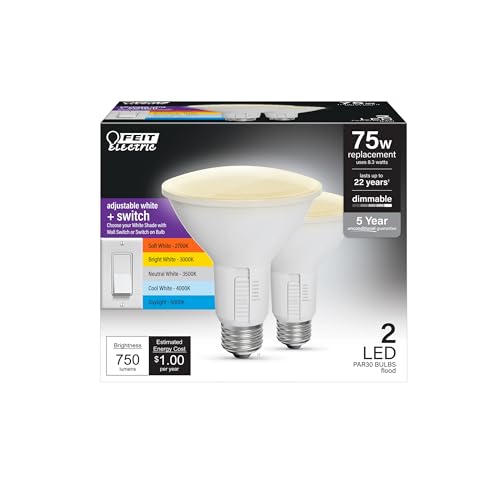
PAR bulbs are generally more directional in the supplied examples. The Bioluz LED PAR30 and Feit Electric Enhance PAR30L both specify 40-degree beams, making them better suited to spotlighting or directing light toward a surface. The PAR30L listing also describes a long-neck design for recessed cans and deep fixtures. A long-neck bulb can be a better mechanical fit in a deep housing, but dimensions still need to be checked against the fixture.
Smaller fixtures call for smaller formats. The Feit Electric PAR20 is intended for a more compact reflector size, while the Maelsrlg PAR16 is a small long-neck spotlight. The Feit Electric MR16 is different again because it uses a GU10 base. MR16 and GU10 describe related but not interchangeable details: the lamp shape does not by itself confirm the socket. Confirm both the format and base.
Choose the right base and fixture connection
The selected products document either E26 medium bases or a GU10 base. E26 is used by the BR30, R20, PAR30, PAR30L, PAR20, and PAR16 examples in this list. The Feit MR16 uses GU10 and is described for track, recessed, and landscape fixtures. Do not assume an E26 bulb can replace a GU10 lamp, or that a GU10 bulb fits a medium-base socket.
Also compare the bulb length and diameter with the fixture opening. The selected products range from the compact Feit MR16 to larger BR30 and long-neck PAR30L models. A bulb can have the right electrical base but still fail to fit behind a trim ring, inside a can, or under a fixture cover. The listing for the Feit PAR30L specifically calls out deep fixtures, while the Feit MR16 listing emphasizes compact dimensions.
Decide between broad flood and focused spotlight light
Beam angle is one of the most useful specifications when it is supplied. A wider beam, such as the 105-degree and 107-degree figures listed for the Satco BR30 and R20, is appropriate for general coverage. A 40-degree beam, documented for the Bioluz PAR30, Feit PAR30L, and Maelsrlg PAR16, concentrates light more narrowly and can work for artwork, counters, displays, or directional task areas.
Brightness should be considered alongside beam width. The Feit BR30 100W-equivalent model lists 1400 lumens, the highest documented output among these selections. Several PAR30 and BR30 choices list 650 to 750 lumens, while the Feit MR16 lists 450 lumens. A lower-lumen compact bulb may work well in a small track head but may not provide enough general illumination for a large room.
Select color temperature and color rendering
Color temperature affects the appearance of a room. The Satco S9630 uses 2700K warm white, and several selected models use 3000K, which is generally suited to comfortable residential lighting. The Bioluz LED PAR30 is listed at 5000K daylight, a cooler setting that may suit work areas or applications where crisp light is preferred.
Selectable-color bulbs add flexibility. The Feit Electric PAR20, PAR30, BR30, and R20 models with 5CCT features document settings ranging from 2700K to 5000K. These can be useful when the same bulb may move between rooms or when a fixture’s final use is not yet settled. The Feit MR16 documents three adjustable white-light options rather than five.
CRI is another relevant specification. CRI90+ appears on the Feit PAR20, PAR30, BR30 100W-equivalent, MR16, and PAR30L listings; the Bioluz product lists 90 CRI. These claims indicate a focus on color rendering, which can be useful for displays, kitchens, artwork, and task lighting. The Satco R20 lists 80+ CRI, which may still be adequate for general ambient lighting but provides a less elevated color-rendering specification than the CRI90 choices.
Check dimming and outdoor suitability
Most selected products document dimming compatibility, but fixture and dimmer compatibility should still be confirmed. The Feit models describe smooth dimming, and several specify a 10%-to-100% range. Satco also lists dimmable operation for its BR30 and R20 models. Dimming behavior can depend on the installed control, so the product’s compatibility statement is a starting point rather than a guarantee for every setup.
For exterior or damp locations, use a model with a relevant listing. The Feit Electric Enhance PAR30L is described as damp rated for indoor or outdoor use. The Bioluz LED PAR30 is described for outdoor flood lights and indoor spotlights and lists UL, FCC, RoHS, and Title 20 compliance. Always follow the fixture’s location rating as well as the bulb documentation.
Compare efficiency, life, and pack size
The evidence includes several stated lifespans, from 17,000 hours for the Feit BR30 six-pack to 25,000 hours for multiple Feit, Satco, and Maelsrlg models. A longer rated life may reduce replacement frequency, particularly in hard-to-reach recessed fixtures, but it is a manufacturer specification rather than an independent test result.
Wattage and equivalent incandescent ratings help frame energy use. The Feit PAR20 lists 5W for a stated 50W equivalent, the Feit PAR30 lists 8.3W for a stated 75W equivalent, and the Feit BR30 six-pack lists 7.2W for a stated 65W equivalent. Compare those figures with the brightness you need rather than selecting by wattage alone.
Pack size matters when replacing several bulbs. Six-packs from Feit and Satco suit multi-fixture projects, while two- and four-packs work for smaller groups. A single fixture may be better served by a smaller pack, especially when testing fit or color before outfitting an entire room.
Final Recommendation
Feit Electric BR30 100W Equivalent 5CCT LED ranks first overall in this specification-based comparison under the published weighted criteria.
Feit Electric BR30 100W Equivalent 5CCT LED is the first overall specification-based choice in this comparison.
The final choice among the best reflector led bulbs depends on the documented features that match your intended use.
Feit Electric PAR30 5CCT LED, 75W Equivalent combines a familiar PAR30 format, five color settings, CRI90+, dimming, a 25,000-hour rating, and a five-year warranty. For the highest documented brightness, choose the Feit Electric BR30 100W Equivalent 5CCT LED. For broad coverage, the Satco S9621’s 105-degree beam is a clear match; for a concentrated beam, the Bioluz LED PAR30 or Feit Electric Enhance PAR30L align with spotlight use.
Among the top reflector led bulbs, base and housing compatibility should determine the final decision before color or pack size. Choose the Feit MR16 only when a GU10 connection is required, and consider the Feit PAR20 or Maelsrlg PAR16 when a smaller reflector format is needed. Warm 2700K or 3000K models suit relaxed spaces, while 5000K daylight and adjustable 5CCT models offer more control for work areas and changing room needs.
Frequently Asked Questions
Among the best reflector led bulbs, what are reflector LED bulbs used for?
Reflector LED bulbs direct light forward and are commonly used in recessed cans, track lighting, flood fixtures, and spotlights. The best reflector led bulbs vary by beam angle: the selected Satco R20 and BR30 models document wide beams, while several PAR models document 40-degree beams for more focused illumination.
Is PAR30 the same as BR30?
No. PAR30 and BR30 are different reflector formats, and their physical shape and light distribution may differ. The selected PAR30 examples include 40-degree spotlight beams, while the Satco BR30 S9621 lists a 105-degree beam. Confirm the fixture’s required bulb type and available clearance before buying.
What base does a reflector LED bulb use?
Many selected reflector bulbs use an E26 medium base, including the PAR20, PAR30, PAR16, BR30, and R20 examples. The Feit MR16 uses a GU10 base. Check the socket as well as the reflector shape because similar-looking bulbs may use different connections.
Are selectable-color reflector bulbs worth considering?
They can be useful when a fixture may need different lighting moods or when you want to match several rooms. The Feit PAR20, PAR30, and BR30 models document five settings from 2700K to 5000K. A fixed-color bulb may be simpler when you already know that warm or daylight lighting is preferred.
Can reflector LED bulbs be used outdoors?
Only use a bulb when its supplied documentation and the fixture support the location. The Feit Electric Enhance PAR30L is described as damp rated for indoor or outdoor use, and the Bioluz LED PAR30 is described for outdoor flood lights. Location ratings should be checked before installation.