Buying Guide
The best steel pipe cutters are not interchangeable: a cutter made for thin tubing may not be appropriate for heavy-wall pipe. Start by identifying the material and outside diameter, then check whether the listing states a wall-thickness limit. The products in this comparison range from a dedicated heavy-wall steel model to compact stainless-tube cutters and multi-piece kits.
Match the cutter to the steel application
For conventional steel, stainless steel, galvanized pipe, or iron pipe, the clearest material documentation matters most. The RIDGID 32820 Model 2-A is the most directly targeted option because its listing names steel, stainless steel, and heavy-wall steel. The Godora Professional 1-3 Inch Pipe Cutter is also explicitly listed for galvanized and iron pipe, but its range starts at 1 inch.
For thinner material, several tubing cutters are more appropriate on paper. The IWISS CT-532 lists thin-walled steel and stainless tubing, while the FLZOSPER cutter lists thin stainless steel. VORXEON also specifies thin-wall steel. These descriptions do not establish that any model handles every steel grade or wall thickness, so buyers should compare the stated application with the actual pipe before ordering.
Check diameter and wall-thickness limits
Capacity is one of the easiest specifications to compare. The Godora cutter covers 1 to 3 inches, while the RIDGID 31803 65S covers 1/4 inch to 2-5/8 inches. RIDGID 32820 covers 1/8 inch to 2 inches. The FLZOSPER, TOLESA, and MECHCLAW options also document ranges reaching 2 inches.
A wide diameter range does not automatically mean heavy-wall capability. MECHCLAW specifies stainless tubing with a wall thickness below 0.08 inch, and KNIPEX states a maximum wall thickness of 5/64 inch, or 2 mm. Those limits make the products easier to evaluate: they are documented for particular tubing conditions rather than being universal steel-pipe tools.
Choose the right cutting mechanism
Traditional rotating cutters require the tool to travel around the tube. Bearing-supported designs appear throughout this selection. RIDGID 31803 uses 12 individual bearings and a stainless-steel wheel with bearings in the hub. IWISS uses a six-roller tracking system and ball bearings, while MECHCLAW uses dual rows of ball-bearing rollers. These features are documented design elements intended to support tracking and adjustment; they are not independent performance-test results.
The VORXEON set takes a different approach with a ratcheting design, four-layer bearing, and quick-release mechanism. A ratchet may be worth considering when the user cannot rotate a conventional cutter through a full arc. KNIPEX uses a QuickLock mechanism, a preset scale, and a spring-loaded cutting wheel for positioning. These controls are especially relevant when working around obstructions.
Consider access and working space
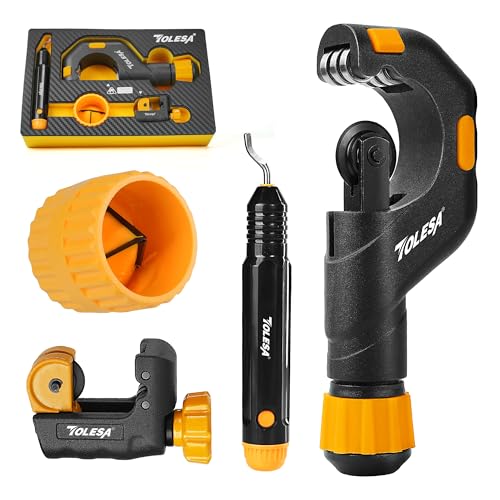
Compact access is a separate buying criterion from diameter. KNIPEX is specifically described as having a minimal cutting radius and is intended for confined spaces. The VORXEON set describes a quick-release ratchet design for renovation and repair work. The SHALL and TOLESA sets add mini cutters for smaller tubing and restricted areas.
A mini cutter is useful only within its own capacity. SHALL documents a 1/8-to-7/8-inch mini cutter, while TOLESA lists a 1/8-to-3/4-inch mini cutter. These tools can complement a larger cutter, but they should not be treated as substitutes for a heavy-wall steel model.
Decide whether a set is worthwhile
A single cutter is usually the more focused choice when the pipe size and material are known. A set can make more sense for mixed service work. SHALL includes a heavy-duty cutter, mini cutter, deburring tool, and inner-outer reamer. TOLESA includes a main cutter, mini cutter, deburring tool, and pipe reamer. VORXEON includes a deburring tool and spare blade.
Deburring and reaming tools are relevant because cutting can leave an edge that needs preparation before assembly. The supplied listings document the inclusion of these tools, but they do not provide independent test results about the finished edge or connection.
Review construction and replacement features
Construction details help distinguish tools with similar ranges. RIDGID 32820 is described as heavy duty and includes a lifetime warranty against defects in material or workmanship. RIDGID 31803 has a 12-month warranty. KNIPEX lists no warranty in the supplied specifications, so that factor should be verified separately if it matters.
Replacement components can also affect maintenance. IWISS includes two replacement blades, VORXEON includes a spare blade, and MECHCLAW documents a replaceable alloy-steel blade. RIDGID 31622 is not included in the ranking because its listing focuses on copper, brass, aluminum, and thin-wall conduit rather than steel pipe, illustrating why material evidence matters more than a familiar cutter format.
Final recommendation
RIDGID 31803 65S Stainless Steel Tubing Cutter ranks first overall in this specification-based comparison under the published weighted criteria.
RIDGID 32820 Model 2-A is the highest-scoring returned product and the first overall specification-based choice among the best steel pipe cutters. Its explicit steel, stainless-steel, and heavy-wall steel coverage is the clearest match for the category, and its 1/8-inch to 2-inch capacity covers many general pipe sizes.
Choose Godora Professional 1-3 Inch Pipe Cutter when galvanized or iron pipe from 1 to 3 inches is the priority. Choose RIDGID 31803 65S for a wide stainless-tubing range and a detailed bearing-based design. KNIPEX TubiX S is the more access-focused pick for smaller stainless pipe in confined areas.
For thin-wall work, IWISS, FLZOSPER, VORXEON, and MECHCLAW provide documented steel or stainless-tubing coverage, but their listings should be checked against wall thickness. SHALL and TOLESA are the top steel pipe cutters to consider when one purchase should also cover mini cutting, deburring, and reaming.
Frequently Asked Questions
What should I verify before buying the best steel pipe cutters?
Verify the pipe material, outside diameter, and wall thickness. A listing that says steel may refer to thin-wall tubing rather than heavy-wall pipe. RIDGID 32820 explicitly names heavy-wall steel, while KNIPEX and MECHCLAW provide narrower wall-thickness information. Also check whether the cutter can fit around the pipe in the intended workspace.
Are stainless-steel tubing cutters suitable for steel pipe?
Only when the supplied specifications match the pipe. RIDGID 31803, KNIPEX, and IWISS list stainless-steel applications, but their documented capacities and wall limits differ. Stainless tubing language alone does not prove suitability for thick structural or heavy-wall steel pipe.
Is a mini pipe cutter useful for steel work?
A mini cutter can be useful for small-diameter or restricted-area tubing when its material and capacity are suitable. SHALL and TOLESA include mini cutters, and KNIPEX emphasizes a minimal cutting radius. These compact tools are not replacements for a larger cutter when the pipe exceeds their stated range.
Some do. SHALL and TOLESA include deburring and reaming tools, while VORXEON includes a deburring tool. Other products, such as RIDGID 32820 and RIDGID 31803, are presented as individual cutters. Review the listed contents if edge preparation is part of the job.
Which cutter design is best for limited rotation space?
Look for a compact or ratcheting design. KNIPEX documents a minimal cutting radius and QuickLock adjustment, while VORXEON describes a ratcheting mechanism and quick-release design. Conventional long-shank tools such as RIDGID 32820 may be better suited to open working areas and heavier pipe applications.