Buying Guide
The best metal pipe cutters are selected by matching the documented range and construction to the material and access conditions of the job. Product listings often use “tube,” “tubing,” and “pipe” differently, so compare outside diameter rather than relying only on a nominal pipe label. A cutter rated to 2 inches outside diameter is not automatically suitable for 2-inch nominal pipe, and thin-wall tubing has different requirements from heavy iron or galvanized pipe.
Start with outside diameter
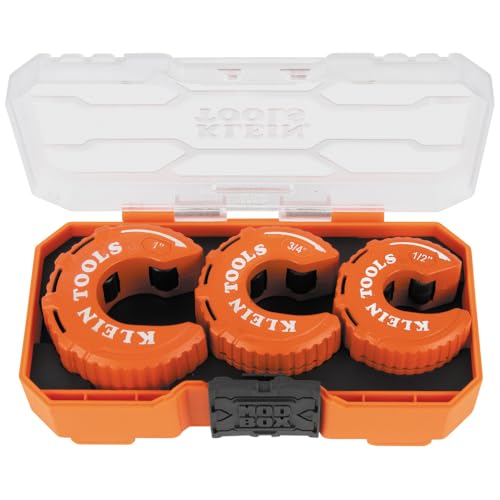
Capacity is the first filter. The RIDGID Model 101 covers 1/4 to 1-1/8 inches, while the Klein 50048 set handles three fixed copper sizes: 1/2, 3/4, and 1 inch. These are more specialized than broad-range cutters, but a narrower design can be appropriate when the tubing size is known.
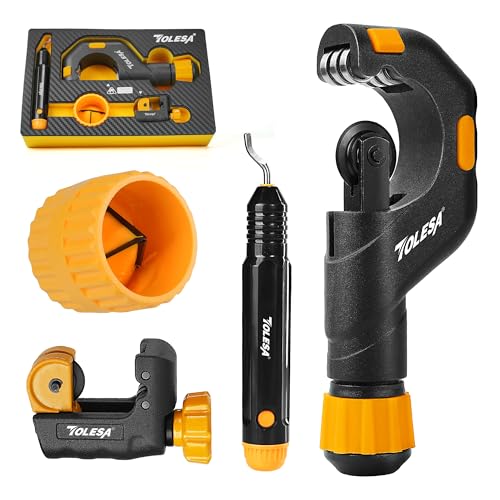
For a wider range, the SEDY, TOLESA, MECHCLAW, and XUNTUI options reach 2 inches in their larger configurations. Steelman reaches 2-1/2 inches, and Godora covers 1 to 3 inches. Larger-capacity tools may require more clearance, so check the intended application before purchase.
Match the material
Material coverage varies significantly. RIDGID Model 150 lists copper, brass, aluminum, and thin-wall conduit. The RIDGID 40617 Model 101 lists hard and soft copper, aluminum, brass, and plastic. The 35S listing establishes a stainless steel cutter wheel, but it does not provide the same detailed list of compatible pipe materials, so its most specification-aligned documented evidence concerns construction and cutting guidance rather than universal metal compatibility.
MECHCLAW and XUNTUI are more explicit about thin-wall stainless tubing. XUNTUI also cautions against cast iron, thick-wall steel, and thick-wall stainless pipe. Those exclusions matter: a large outside-diameter range does not mean the tool is appropriate for every metal wall thickness. Godora is more clearly targeted at iron or galvanized pipe from 1 to 3 inches.
Some selected tools also include plastic capability. Steelman provides a separate plastic-cutting blade, while SEDY and TOLESA mention PVC among supported materials. Use the blade and material guidance supplied for the specific cut rather than assuming one wheel works equally well on every pipe type.
Consider feed and roller design
A tubing cutter advances a wheel against the tube as the tool rotates around it. Control depends on how the listing describes the feed, rollers, and adjustment point. The RIDGID 35S uses six individual bearings and a contoured frame intended to assist alignment. RIDGID Model 150 uses an enclosed feed screw, grooved rollers, and an ergonomic X-CEL knob. MECHCLAW documents dual rows of ball-bearing rollers, while TOLESA and XUNTUI document six-roller designs.
These features are useful specification signals, but they are not a substitute for hands-on performance evidence. They indicate how the tool is intended to track and adjust. Follow the supplied gradual-feed guidance for XUNTUI: place the tube correctly, rotate the cutter, and tighten incrementally instead of applying excessive pressure in one step. This is particularly relevant for thin-wall tubing, which may deform if over-tightened.
Choose the right access design
Close-quarters tools are valuable around walls, fittings, and other obstructions. RIDGID Model 101 is explicitly designed for tight spaces, and the Klein 50048 set is described as ultra-compact. The SEDY and TOLESA kits also include mini cutters for smaller or restricted areas. By contrast, Godora’s 15-inch length and Steelman’s 12.2-inch length may be less convenient where clearance is limited, even though both offer larger capacity.
A compact cutter is not automatically the right choice for every job. If the pipe is large, galvanized, or outside a small cutter’s intended range, prioritize material and capacity first. Access should narrow the choice only after the tool is confirmed as suitable for the pipe.
Look for maintenance features
Replacement and cleanup features can reduce interruptions. RIDGID Model 150 includes a spare cutter wheel and a tool-free wheel-change pin. The SEDY and TOLESA kits include deburring equipment, while XUNTUI includes a spare cutting wheel and HSS deburring blade. MECHCLAW documents a replaceable blade. These details are useful when a cutter will be stored in a working toolbox rather than used only once.
Integrated reaming is another practical distinction. RIDGID Model 150 has a fold-away reamer, and TOLESA combines cutting, deburring, and reaming in its kit. If the work requires a prepared internal edge after cutting, an included reamer or deburring tool can reduce the need to carry another tool. The supplied evidence does not establish the result of any particular cut, so the feature should be treated as equipment availability rather than a performance guarantee.
Final recommendation
XUNTUI 3/16- to 2-Inch Tubing Cutter Kit ranks first overall in this specification-based comparison under the published weighted criteria.
XUNTUI 3/16- to 2-Inch Tubing Cutter Kit is the first overall specification-based choice in this comparison.
Among these best metal pipe cutters, XUNTUI combines a broad 3/16- to 2-inch range with explicit thin-wall metal-tubing limits, six rollers, a documented SKD11 wheel, and included deburring components. For broad coverage, TOLESA and MECHCLAW also reach 2 inches, while Godora is the specialist for 1- to 3-inch iron and galvanized pipe. Choose XUNTUI when explicit thin-wall tubing limits and included deburring components are useful. These are top metal pipe cutters for different documented use cases, not a claim that one tool suits every pipe material or size.
Frequently Asked Questions
Confirm the pipe’s actual outside diameter, material, and wall thickness. Then check whether the listing explicitly supports that combination. XUNTUI distinguishes outside diameter from nominal pipe size and excludes thick-wall steel and cast iron. A 2-inch capacity should therefore be read alongside the product’s material limitations.
Which selected cutter is intended for a large pipe range?
Godora lists a 1- to 3-inch range and names iron and galvanized pipe among its applications. Steelman reaches 2-1/2 inches, while SEDY, TOLESA, MECHCLAW, and XUNTUI reach 2 inches in their larger configurations. Larger-capacity tools may require more clearance than compact tubing cutters.
Which option is designed for tight spaces?
RIDGID Model 101 and the Klein 50048 set are explicitly described for restricted or ultra-compact work areas. The SEDY and TOLESA kits also include mini cutters, which may help when a larger cutter cannot be positioned easily.
Do these cutters work on stainless steel?
The evidence is not uniform. XUNTUI explicitly supports thin-wall stainless tubing and recommends cutting fluid, while MECHCLAW lists stainless tubing with a wall-thickness limit. SEDY’s cutter set includes a stainless-steel deburring tool, but that does not by itself establish stainless-steel cutting compatibility. Check the individual listing before using a cutter on stainless material.
It is useful when the cut edge must be prepared for a repair or installation. SEDY, TOLESA, and XUNTUI include deburring equipment, and RIDGID Model 150 has a fold-away reamer. The presence of that feature makes the kit more self-contained, but the supplied data does not support a universal claim about the final edge produced by any cutter.