Buying Guide
The best stereo headphone amplifiers are easier to compare when the signal path is considered first. A desktop DAC amp, a portable analog amp, and a multi-output distribution unit may all carry the same broad product label, but they solve different connection and monitoring needs. Start by identifying the source, the headphone plug, the number of listeners, and whether the unit must travel.
Match the amplifier to the source
The Fosi Audio Q4 is the most flexible selected desktop design for digital sources because its listing names USB, optical, and coaxial inputs. It also provides RCA and 3.5mm outputs, so it can sit between a computer, television, or other digital source and headphones, powered speakers, or another amplifier. The 24-bit/192kHz specification and tone controls are useful when source compatibility and basic adjustment matter.
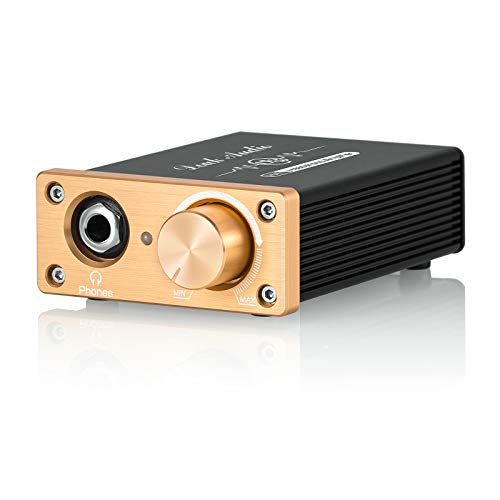
The Douk Audio U3 takes a simpler analog route with RCA input. That makes it a natural fit for a desktop source that already has an analog line output. Check that the source provides the correct 3.5mm connection before selecting one of these designs.
Headphone impedance is one of the clearest specification differences in this group. The Fosi Audio Q4 lists 16–200Ω, and the Douk Audio U3 specifically describes compatibility with several high-impedance headphone examples. These figures are listing claims, not independent measurements, but they provide a useful first filter.
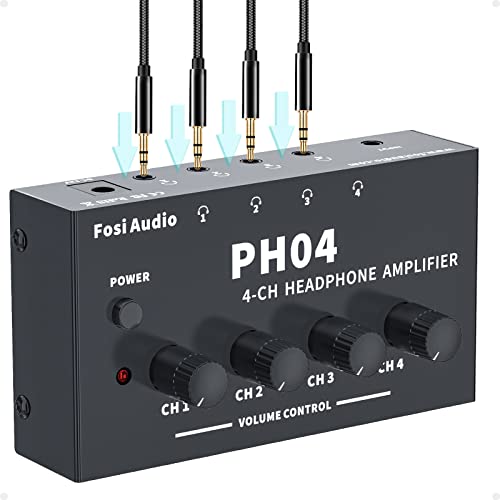
Plug size matters just as much. The Douk Audio U3 and ART HeadAMP4 document both 6.35mm and 3.5mm connections. The Bolanle PH800 lists eight outputs of each size, and the STABCL S-800 supports 1/4-inch and 1/8-inch plugs. The Fosi Audio PH04 uses 3.5mm outputs and requires an adapter for 6.35mm headphones. Confirm the required adapter before connecting studio headphones.
Decide how many listeners need separate control
A single personal amplifier is appropriate when one listener needs additional drive or source flexibility. A distribution amplifier is better when several people must monitor the same signal. The Behringer MICROAMP HA400 and Fosi Audio PH04 each provide four outputs with separate level controls.
For larger groups, the ART HeadAMP4 supplies eight outputs across four stereo channels. Use a separate mixer or interface when listeners need different source mixes.
Consider monitoring modes and visual feedback
Mono/stereo switching can be helpful in rehearsal and live monitoring systems. The TONALUXE 222T, Bolanle PH800, STABCL S-800, and JCANOL P1 document mono or stereo functions. The Coda IEM-Pro also lists mono, dual-mono, and stereo mix options, plus a limiter for personal in-ear monitoring. These are distinct from ordinary headphone distribution because they are designed around personal monitoring mixes and stage connections.
The TONALUXE 222T adds six-segment LED meters for all eight channels, rear inputs, and front and rear outputs. That makes it the most installation-oriented option in this group. Its 1U rack format is worth planning for before selection.
Portable versus desktop power
Portable models in this comparison use rechargeable batteries and 3.5mm analog connections. Battery capacity and stated runtime should be considered alongside charging requirements and the number of cables needed.
Desktop and distribution models use external power supplies. The Fosi Audio Q4 includes USB-related cables and is designed for compact desktop placement. The Behringer HA400 and Fosi Audio PH04 list 12V adapters, while the larger multi-channel units require more deliberate cable management. Choose the power arrangement that matches where the amplifier will be used rather than treating portability as a universal advantage.
Review the controls and physical layout
Gain selection can help match a portable amplifier to different listed impedance ranges, but the supplied evidence does not establish a particular sound result. The Douk Audio U3’s socketed op amp is a specialized feature for users who want an adjustable circuit platform.
For shared monitoring, the most important layout feature is independent volume control. Metal construction is listed for several models, including the Q4, Douk Audio U3, ART HeadAMP4, STABCL S-800, and portable units. Treat those descriptions as construction evidence, not as proof of long-term durability.
Final Recommendation
TONALUXE 8-Channel Headphone Amplifier ranks first overall in this specification-based comparison under the published weighted criteria.
The final choice among the best stereo headphone amplifiers depends on the documented features that match your intended use.
Fosi Audio Q4 is the highest-scoring returned product and the first overall specification-based choice for listeners who need a compact desktop unit with multiple digital inputs, tone controls, and both headphone and line outputs. Among the top stereo headphone amplifiers, it has the most versatile documented desktop connectivity in this selection.
Choose the eSynic Rechargeable 16–600Ω model instead when broad impedance coverage and battery operation are more important than digital inputs. For four-person monitoring, the Fosi Audio PH04 and Behringer HA400 offer clear output layouts with independent controls. Match the final selection to the source, connector sizes, channel count, and documented headphone range.
Frequently Asked Questions
What should I look for in the best stereo headphone amplifiers?
Start with source inputs, headphone impedance coverage, connector size, output count, and power method. A desktop listener may need USB, optical, or coaxial inputs, as documented on the Fosi Audio Q4. For group monitoring, prioritize independent output controls and the number of headphone channels.
Are all headphone amplifiers suitable for several listeners?
No.
Do I need an adapter for 6.35mm headphones?
It depends on the amplifier. The ART HeadAMP4, Douk Audio U3, Bolanle PH800, and STABCL S-800 document both 3.5mm and 6.35mm connections. The Fosi Audio PH04 lists 3.5mm outputs and states that a 3.5mm-to-6.35mm adapter is needed for larger plugs.
What is the difference between mono and stereo monitoring modes?
Stereo carries separate left and right channels, while mono combines the program into a single-channel monitoring arrangement. The TONALUXE 222T, Bolanle PH800, STABCL S-800, and JCANOL P1 document mono/stereo functions. Such a switch can be useful when the monitoring source or stage setup calls for a different channel arrangement, but it does not replace a mixer for creating separate mixes.
Is a portable headphone amplifier better than a desktop model?
Neither format is universally better. Desktop models such as the Fosi Audio Q4 provide more source and output options, while distribution amplifiers provide several listener outputs. Select the format that fits the source, headphone load, channel count, and intended location.