Buying Guide
The best transom-mount trolling motors are selected by matching the motor to the boat, water, shaft depth, and available battery system—not by thrust alone. This comparison uses supplied listing specifications and feature descriptions; it does not represent hands-on testing or a summary of customer opinions.
Start with boat size and operating water
Thrust is the first screening factor. The selected range runs from 40 lb on the Intex model to 86 lb on the Newport L-Series. A 55 lb motor appears repeatedly because it covers a broad group of kayaks, inflatables, and small fishing boats, but the listing alone cannot determine the correct thrust for every hull. Boat weight, passengers, gear, wind, current, and water conditions affect the practical match.
The 86 lb L-Series is the only selected model documented at 24V and is aimed at a higher-capacity setup. It requires two 12V deep-cycle batteries. By contrast, the NV-Series, X-Series, Kayak Series, VEVOR, and other 55 lb models use 12V systems. Confirm the boat maker’s transom capacity and battery requirements before choosing a motor.
Water type also matters. The Traxxis, Endura Max, and Endura C2 are specified for freshwater. The Newport NV-Series, L-Series, X-Series, and Kayak Series list saltwater-oriented construction or use. VEVOR lists freshwater and saltwater compatibility, while the AQUOS Haswing listing includes a sacrificial anode and encapsulated electronics. These specifications help narrow the category, but they do not replace proper saltwater cleaning and storage.
Choose the shaft length carefully
A shaft that is too short may not place the propeller at a useful depth, while an unnecessarily long shaft can be awkward on a compact transom. The selected models document shaft lengths from 24 to 42 inches. The Newport Kayak Series has the shortest listed shaft at 24 inches, making it a targeted option for kayak-oriented installations. The AQUOS Haswing, with its 26-inch adjustable shaft, is another compact option, and the NV-Series and VEVOR models list 30-inch shafts.
The X-Series and Endura C2 each use a 36-inch shaft. The L-Series uses 40 inches, and the Traxxis and Endura Max each use 42 inches. These figures are product specifications, not a universal sizing rule. Measure the distance from the mounting surface to the water and consider the boat’s typical load and chop. A model with adjustable depth or tilt can make installation easier, but it cannot compensate for every transom height.
Compare tiller and remote control designs
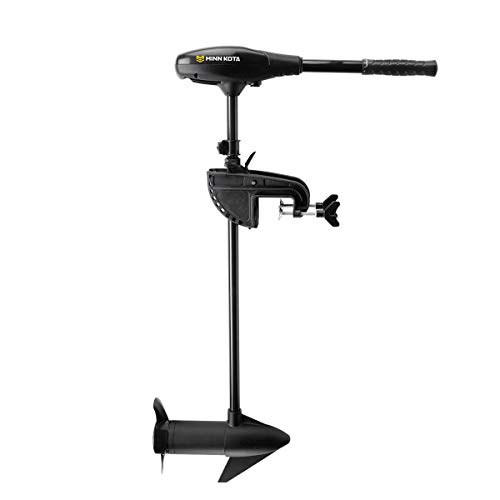
Manual tillers remain the primary control style in this group. Telescoping handles appear on the Traxxis, Endura Max, NV-Series, X-Series, Kayak Series, VEVOR, and Endura C2. The Traxxis adds 45-degree tiller tilt, 6-inch extension, steering-tension control, and ten deployment positions. The other Minn Kota models use a 6-inch telescoping tiller and lever-lock bracket.
Speed ranges are also useful for comparison. The Newport, Intex, VEVOR, and Endura C2 listings specify five forward and three reverse speeds. This provides more adjustment than a simple fixed-speed setup, though actual boat speed depends on the hull and conditions. The AQUOS Haswing is the outlier with wireless remote control, a stated 164-foot range, and a 0-to-85-degree tilt range. Choose that design when remote operation is more important than a conventional tiller.
Electric motors require battery planning beyond the motor purchase. The NV-Series recommends one 12V deep-cycle battery and lists a 50-amp circuit breaker. The L-Series requires two 12V deep-cycle batteries and also lists a 50-amp breaker. VEVOR states that 12V motors require one 12V battery, but its listing does not provide the same level of circuit-protection detail.
Battery indicators are documented on the Traxxis, Endura Max, NV-Series, X-Series, VEVOR, Endura C2, and Intex models. The Intex adds dry-operation and overload indicators, while the Newport NV-Series specifies a five-LED meter. The Kayak Series listing does not mention a battery meter, so buyers prioritizing at-a-glance monitoring may prefer another option.
Digital Maximizer power management is specifically documented on the Traxxis and Endura Max. That feature uses variable-speed operation to help conserve battery power, according to the listings. It should be treated as a documented feature rather than a guarantee of a particular runtime.
Consider propeller and construction details
Propeller design can influence intended use. The Endura Max and Endura C2 list a Power Prop designed for heavy vegetation. The Newport NV-Series, L-Series, X-Series, and VEVOR models describe three-blade propellers, with the Newport listings connecting that design to low-end torque. These statements describe manufacturer-listed features; they are not independent performance findings.
Construction details vary. Minn Kota’s selected models list composite shafts and reinforced composite brackets. Newport’s models mention fiberglass composite or aluminum shafts and corrosion-resistant magnesium, zinc, or stainless-steel hardware. AQUOS lists a cast aluminum shaft, sacrificial anode, encapsulated electronics, and a separated motor-fin design for propeller protection. VEVOR lists an aluminum alloy shaft and sealed waterproof aluminum motor head.
Final Recommendation
Newport L-Series 86 lb, 40 in. ranks first overall in this specification-based comparison under the published weighted criteria.
Newport L-Series 86 lb, 40 in. is the highest-scoring returned product and the first overall specification-based choice.
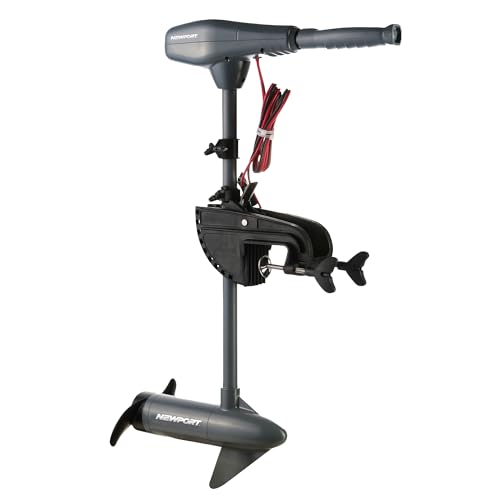
For shoppers comparing the best transom-mount trolling motors, the L-Series fits a boat that can accommodate its 86 lb rating, 24V setup, 40-inch shaft, and two-battery requirement. Its saltwater-oriented hardware, adjustable mounting, LED battery meter, eight speed settings, and two-year warranty provide a broad documented feature set.
Minn Kota Traxxis is a strong alternative for freshwater users who prioritize manual control. Its combination of 55 lb thrust, 42-inch shaft, one-hand stow, ten deployment positions, adjustable steering tension, tilting and extending tiller, battery meter, and Digital Maximizer gives it a complete documented control package. It is specified for freshwater, so coastal users should focus on saltwater-oriented choices such as the Newport X-Series or NV-Series.
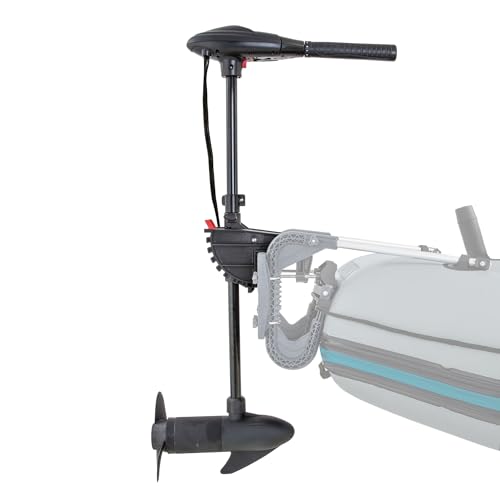
Among the top transom-mount trolling motors, the Newport L-Series is a suitable choice when 86 lb thrust and a 24V system fit the boat. The AQUOS Haswing stands apart for wireless operation, while the Newport Kayak Series is a targeted option for a short 24-inch shaft. For an inflatable boat, the Intex model has explicit compatibility information for several Intex boats. Verify transom dimensions, water type, battery voltage, and shaft depth before ordering.
Frequently Asked Questions
What are the best transom-mount trolling motors for kayaks?
The Newport Kayak Series is a selected option because it lists a 24-inch fiberglass shaft, 55 lb thrust, a telescoping handle, and extended battery cables. The AQUOS Haswing, with its 26-inch adjustable shaft, is another option when remote control is a priority. Shaft fit still depends on the kayak’s transom and mounting height.
Is higher thrust always better?
No. Higher thrust can be useful for a larger or heavier boat, but it also needs a suitable battery system and transom. The 86 lb Newport L-Series requires two 12V batteries, while many 55 lb models use 12V. Match thrust and voltage to the boat and the manufacturer’s requirements rather than choosing the largest rating automatically.
Which selected motors are documented for saltwater?
The Newport NV-Series, L-Series, X-Series, and Kayak Series list saltwater-oriented use or hardware. VEVOR lists freshwater and saltwater compatibility, and the AQUOS Haswing listing includes a sacrificial anode and encapsulated electronics. The Minn Kota Traxxis, Endura Max, and Endura C2 are listed for freshwater, while the Intex listing focuses on specific inflatable boats rather than saltwater use.
What shaft length should I choose?
Measure from the transom mounting surface to the water and compare that distance with the listed shaft. The selected options range from 24 inches on the Newport Kayak Series to 42 inches on the Traxxis and Endura Max. Shorter shafts suit many kayaks and compact boats, while deeper or taller transoms may need longer models. The boat’s normal load and water conditions should also be considered.
Do these motors include batteries?
The supplied listings describe battery requirements but do not state that a battery is included for these selected products. The Newport NV-Series recommends one 12V deep-cycle battery, and the L-Series requires two 12V deep-cycle batteries. Confirm the included equipment, voltage, capacity recommendation, and circuit-protection requirements before purchase.