Buying Guide
The best floating topwater fishing lures share one important trait: they are designed to stay on or near the surface long enough for the angler to create a visible presentation. Beyond that, they differ substantially. A walking bait glides side to side, a plopper uses a rotating tail or blade, a popper pushes water with a cupped face, and a frog or unusual imitation creates a silhouette associated with surface prey.
This comparison uses public listing data only. It is not a hands-on test, and it does not summarize customer opinions. The scoring criteria were created for this category: buoyancy, surface action, casting and retrieve control, construction and hooks, and documented application range. Marketplace ratings, current listing information, popularity signals, and volatile labels were not used in the published scores.
Match the action to the retrieve
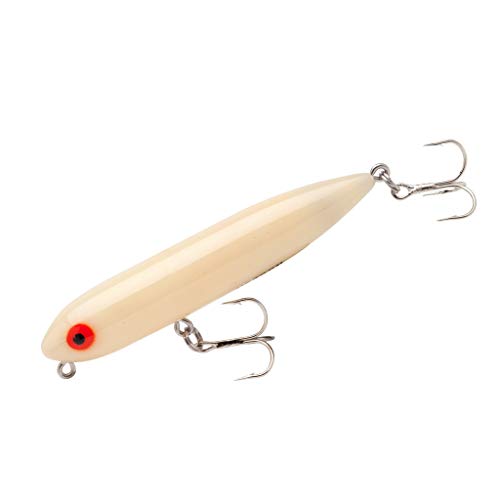
Walking baits are a good starting point when you want to control cadence with rod-tip twitches and pauses. The KeenCatch Topwater Pencil Lure is the clearest match because its listing specifically describes a walk-the-dog motion, weight-forward casting, and a floating pause. The Heddon Zara Spook provides another classic walking profile with a stated 3-inch size and quarter-ounce weight.
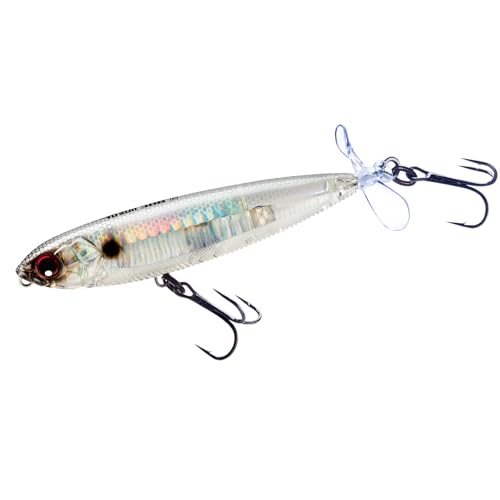
Propeller and plopper lures are more focused on sound, spray, and visible disturbance. Yo-Zuri’s 3DB Prop Floating Lure uses a polycarbonate prop and large blades. TRUSCEND’s Popobait uses a double-blade design and documents immediate action at slow retrieve speeds. Calissa Offshore Tackle combines a rotating fin with a strong buoyancy claim, making it especially relevant when the lure must remain on the surface.
Poppers use a concave or cupped front to push water. The Sougayilang pack explicitly lists a concave head and popping action, while its internal steel ball is tied to stability and casting in the supplied evidence. This style can be useful when you want to work a lure in short bursts rather than maintain a continuous retrieve.
Consider cover and hook layout
Frog-shaped baits are natural candidates for cover-oriented fishing, but hook details matter. The KRLAO Floating Prop Frog Lure Kit documents double weedless hooks and rotating feet. Strike King’s KVD Sexy Frog lists a fully sealed nose, a free-floating rattle, and positioning for open water and heavy cover. These are different approaches: KRLAO emphasizes a flexible frog-style body and hook arrangement, while Strike King emphasizes sealing and internal sound.
Do not assume that every floating lure is equally suited to vegetation, timber, rocks, or open water. The supplied evidence supports specific design claims only. For example, a listing that mentions through-wire construction may be more informative for anglers concerned about body-to-hook strength than a listing that only describes realistic colors. Likewise, a stated weedless hook is more relevant to cover than a generic sharp-hook claim.
Use size and weight to narrow the field
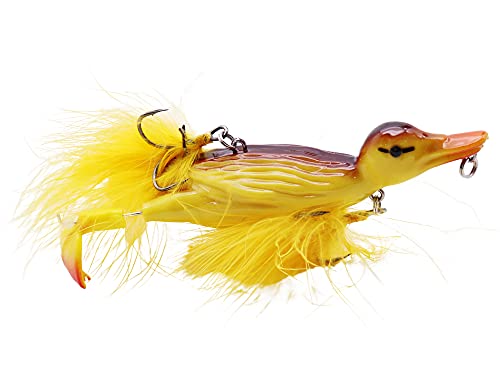
The documented sizes range from compact 3-inch walking and plopping baits to the 12-centimeter CREEYA duck imitation. Smaller lures can help when you want a restrained silhouette, while larger profiles may create more visual presence and surface disturbance. However, the evidence does not establish how fish will respond in a particular body of water, so size should be treated as a matching consideration rather than a guarantee.
Weight also affects tackle selection and casting expectations. Yo-Zuri is listed at 5/8 ounce, Heddon Zara Spook at one-quarter ounce, TRUSCEND at 0.3 ounce, and CREEYA at 28 grams. The Jeoronuly set is listed at 0.2 ounce per lure, while Sougayilang is listed at 0.44 ounce. Compare those figures with your rod and line setup before choosing a surface bait.
Freshwater, saltwater, and hardware
Several selected products are explicitly listed for both freshwater and saltwater. KeenCatch documents corrosion-proof hardware, TRUSCEND lists corrosion-resistant BKK hooks, and Calissa describes corrosion-resistant hooks for seawater exposure. Those details are more useful for saltwater selection than a general statement that a lure catches many species.
Freshwater anglers have more flexibility, especially when choosing among walking baits, frogs, poppers, and small insect or duck imitations. The CREEYA duck lure and the KRLAO frog offer unusual silhouettes, while the standard profiles from Heddon, Yo-Zuri, and Sougayilang may be easier to fit into a conventional topwater selection.
Read package claims carefully
A multi-lure pack can provide color variety and replacements, but it does not automatically mean each individual lure has more advanced construction. Jeoronuly includes five propeller lures and a tackle box; Sougayilang includes ten poppers; KRLAO includes five frog-style lures. These sets are useful when you want several colors or expect to lose baits, but a single lure may be preferable when you want to focus on a specific design.
Also separate product dimensions from package dimensions. The Jeoronuly listing includes box dimensions, while some other listings provide only lure size or weight. When precision matters, favor products with clearly stated individual lure measurements, such as Heddon Zara Spook, Yo-Zuri, TRUSCEND, or CREEYA.
Final recommendation
KeenCatch Topwater Pencil Lure ranks first overall in this specification-based comparison under the published weighted criteria.
KeenCatch Topwater Pencil Lure is the highest-scoring returned product and the first overall specification-based choice. Its documented walk-the-dog action, weight-forward casting design, floating pause, through-wire body, and corrosion-resistant hardware give it the most complete evidence profile.
For the top floating topwater fishing lures aimed at strong surface disturbance, choose Calissa Offshore Tackle or Yo-Zuri. TRUSCEND is the more action-focused option for slow retrieves, while Heddon Zara Spook is a straightforward walking bait with clearly stated dimensions. Choose Strike King or KRLAO when a frog presentation fits the cover and forage. Sougayilang and Jeoronuly make sense when assortment and color flexibility are priorities, and CREEYA is the specialist choice for a large duckling silhouette.
The best floating topwater fishing lures are ultimately the ones whose documented action, size, hook arrangement, and water-use claims fit your tackle and fishing environment. Start with the retrieve you can work confidently, then narrow by buoyancy, disturbance, and hardware.
Frequently Asked Questions
What makes the best floating topwater fishing lures different from shallow-running lures?
A floating topwater lure is intended to remain on the surface during at least part of the presentation. The selected products include explicit floating or no-sink claims, such as KeenCatch, Calissa, and KRLAO.
Which top floating topwater fishing lures are suited to a walk-the-dog retrieve?
KeenCatch and Heddon Zara Spook are the clearest selected examples. KeenCatch explicitly documents a walk-the-dog motion, while Heddon identifies the same surface technique. Work these lures with alternating rod-tip movements and pauses, but remember that the guide does not independently test their action.
Are propeller lures better than poppers?
Neither design is universally better. Propeller lures such as Yo-Zuri, TRUSCEND, and Calissa emphasize rotating components, spray, sound, or water displacement. Sougayilang uses a concave head for popping action. Choose based on whether you want continuous surface disturbance or short, deliberate bursts.
What should I check before using a floating lure in saltwater?
Look for explicit corrosion-resistant hardware or hooks and a stated saltwater application. Calissa, TRUSCEND, and KeenCatch provide those details in their listings. Rinse and maintain tackle according to the manufacturer’s guidance, and do not infer saltwater durability solely from a lure’s color or shape.
Which selected lure has the most unusual profile?
CREEYA’s duckling imitation is the most distinctive, with a 12-centimeter body and rotating duck feet. KRLAO’s frog profile and Strike King’s frog-style bait are also specialized silhouettes. These options are best considered when the local forage or fishing situation supports a larger or non-minnow surface presentation.