Buying Guide
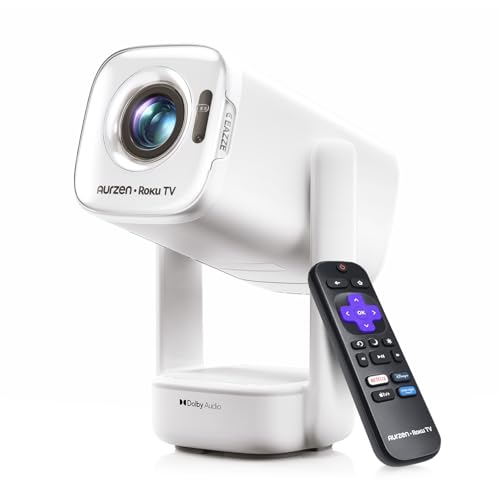
Choosing among the best usb projectors starts with identifying what “USB” needs to mean in your setup. A projector may use USB for playing files from a flash drive, accepting a TV stick, connecting to a source device, or receiving power through USB-C. Those are different functions. The Aurzen Roku TV D1R air, for example, documents USB-C PD power input, while several other models document USB ports for source compatibility. Check the exact use before comparing features.
Decide between USB playback and USB-C power
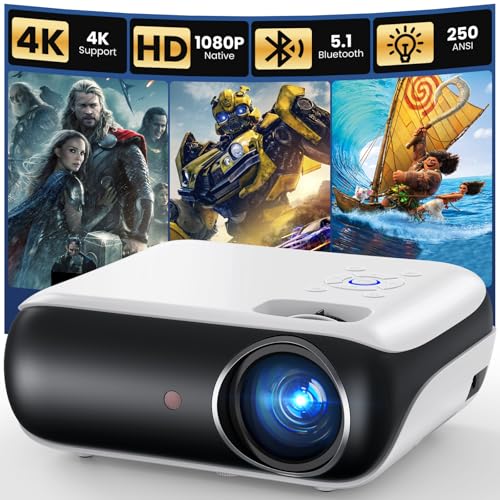
USB playback is useful when you want to connect a flash drive or another compact device without relying on wireless mirroring. VOPLLS specifically notes that local USB playback does not support 4K, even though 4K playback is supported within its app. The ClokoWe listing says USB playback supports 4K video. These examples show why a “4K support” phrase should not be treated as a universal statement about every input.
USB-C power is a separate consideration. The Aurzen Roku TV D1R air lists 65W-or-higher USB-C PD input and says it can work with a compatible wall charger, laptop charger, or power bank. This is the clearest choice for users who want a projector designed around portable power, but the charger or power bank still needs to meet the stated requirement. A conventional USB media port does not automatically provide the same power function.
Compare native resolution with playback support
Native resolution describes the projector’s actual display resolution, while “supports 1080P” or “supports 4K” may describe the incoming video signal. The Aurzen D1R air, Aurzen EAZZE D1, VOPLLS Q5, YGSKK model, and HAPPRUN H1 provide native-1080P claims in their listings. Maypug describes 1080P and 4K playback support without calling the display native 4K.
For text-heavy presentations, game menus, and detailed movie images, a documented native-1080P model is the safer specification match. For casual bedroom viewing, children’s content, or travel, a native-720P projector may still fit the use case. Brightness also needs careful reading: the supplied listings provide ANSI figures for the D1R air, VOPLLS, YGSKK, and Magcubic, but not for every model. Do not compare unspecified brightness claims as if they used the same measurement.
Automatic focus and keystone correction reduce adjustment work when the projector moves between locations. The D1R air lists TOF real-time auto focus and auto keystone. The EAZZE D1 adds obstacle avoidance, screen alignment, zoom, and multiple mounting options. VOPLLS combines automatic focus with 6D keystone and a 360-degree bracket. These tools are especially relevant when the projector sits on a bedside table, a low coffee table, or an uneven temporary surface.
Rotatable designs provide another kind of flexibility. WISHOLY documents a 180-degree adjustable stand, while Magcubic and ClokoWe also document 180-degree rotation. A rotating stand can help with ceiling viewing, but it does not replace a suitable surface or guarantee a perfectly rectangular image. Auto keystone can correct alignment, but extreme angles may reduce the usable image area.
Short-throw designs suit small rooms. Maypug states a 40-to-130-inch range with a short-throw lens, and ClokoWe lists a 0.9:1 short-throw ratio. These claims suggest that the models are designed to create a larger picture without requiring a long distance from the wall. Still, measure the available placement area and confirm the intended screen size before buying.
Consider audio and streaming needs
Built-in speakers can simplify a movie night, but the supplied products differ substantially. Aurzen EAZZE D1 lists dual 8W speakers and Dolby Audio. The D1R air lists dual 5W speakers in an independent base and Dolby Audio. If you want headphones or a larger speaker, check whether the projector supports Bluetooth audio, a headphone output, or both.
Built-in apps can remove the need for an external streaming stick, but they do not remove the need for internet access when streaming. Maypug, YGSKK, ClokoWe, Aurzen EAZZE D1, Aurzen D1R air, and VOPLLS list built-in apps or smart platforms. That makes a physical HDMI or USB connection useful even when wireless features are available.
Weigh portability against screen size
A small body is helpful for dorm rooms, travel, bedrooms, and occasional outdoor use. ClokoWe lists a 0.35-kilogram weight, CiBest lists 0.52 kilogram, Maypug lists 0.67 kilogram, and Magcubic lists the current price. These figures favor frequent movement. HAPPRUN’s listed the current price and EAZZE D1’s listed the current price are less travel-oriented but may be easier to keep in a dedicated home setup.
Outdoor use also requires realistic planning. The listings describe portable or outdoor use, but they do not establish daylight performance, weather resistance, or battery operation for every model. Use a suitable power source, protect the projector from moisture, and plan for a darker environment unless the product’s documented brightness and your conditions support otherwise.
Final Recommendation
Aurzen Roku TV D1R air ranks first overall in this specification-based comparison under the published weighted criteria.
Aurzen Roku TV D1R air is the first overall specification-based choice among the best usb projectors because it combines native 1080P, documented 300 ANSI lumens, USB-C PD power, Roku TV, automatic setup, and a compact gimbal design. It is the most complete fit for users who want portable smart viewing without a separate streaming stick, provided they have a compatible 65W-or-higher power source.
The Aurzen EAZZE D1 is better suited to a less mobile home setup where dual 8W speakers, HDR10, multiple mounting choices, zoom, and automatic alignment matter more than weight. VOPLLS Q5 is a compelling slim native-1080P alternative with 320 ANSI lumens and a 360-degree bracket. Maypug P3 and YGSKK are practical smart choices when built-in apps and wireless connectivity are priorities.
WISHOLY X3, ClokoWe, and Magcubic are the top usb projectors to consider when ceiling viewing, rotation, low weight, or casual bedroom use is more important than maximum image detail.
Frequently Asked Questions
Among the best usb projectors, are USB projectors powered through a regular USB port?
Not necessarily. A USB port may be intended for media playback or device compatibility rather than power. The Aurzen Roku TV D1R air specifically documents 65W-or-higher USB-C PD power input. For other models, use only the power method stated by the manufacturer and do not assume that a laptop USB port can run the projector.
Is native 1080P better than 4K support?
Native 1080P means the projector’s display resolution is specified as 1920x1080. 4K support may only describe the input or playback source. Read both the native-resolution claim and the input-specific limitations.
Can a USB flash drive play movies on these projectors?
Some can, but file support and resolution limits vary. VOPLLS documents local USB playback but excludes 4K through USB, while ClokoWe lists 4K video playback via USB. The supplied evidence does not provide a complete list of supported file formats for every model, so confirm format compatibility before relying on a flash drive as your main source.
Do these projectors need a separate streaming stick?
Models with built-in apps or smart TV platforms may not need one for supported services. Aurzen D1R air includes Roku TV, and Maypug, YGSKK, ClokoWe, VOPLLS, and Aurzen EAZZE D1 list built-in apps or smart functions. A separate stick can still be useful when an app is unavailable, when mirroring is restricted, or when you prefer a different interface.
Are portable projectors suitable for outdoor movie nights?
Outdoor suitability still depends on darkness, a stable surface, power availability, and protection from moisture. The supplied listings do not establish weather resistance for these projectors, so outdoor use should be planned in a dry, sheltered setting.