Buying Guide
The best tripod projector screens should be matched to the projector, room, audience, and transport routine rather than selected by diagonal size alone. The supplied listings show several distinct designs: manual pull-up screens in a metal case, foldable fabric screens, PVC surfaces mounted to folding supports, and tensioned screens that use tubes to help maintain a flat display.
Start with aspect ratio and viewing size
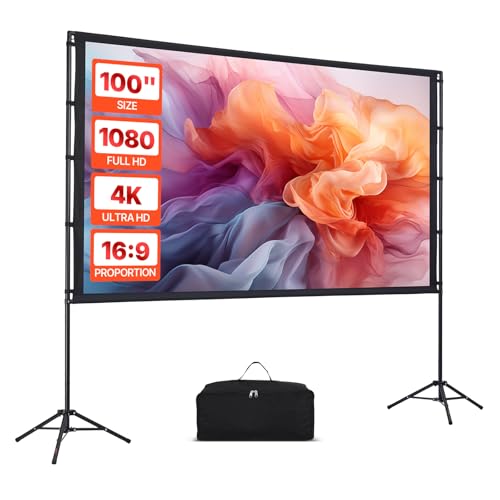
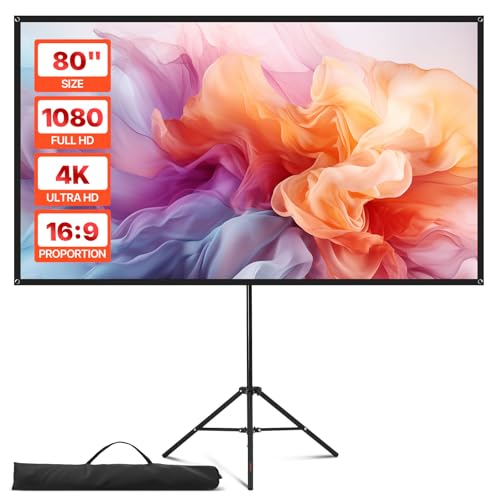
A 16:9 screen is the most common format in this comparison. The Elite Screens T100UWH, KODAK 100-Inch Tripod Projector Screen, both VEVOR models, the TWJouko 80-Inch PVC Tripod Screen, Smartxchoices 84-Inch 16:9 Screen, and excelimage 100-Inch 16:9 Tripod Screen all document 16:9 designs. That format suits widescreen video and many home-theater projectors.
The Elite Screens T120UWH expands the 16:9 image to 120 inches, while the Elite Screens T72UWH reduces it to 72 inches for smaller spaces. The Smartxchoices model lists an 84-inch diagonal and a 73-by-41-inch view area. Check the actual view size, not only the diagonal, when planning seating distance and wall clearance.
The AKIA Screens AK-T100SB1 is the format specialist. It is primarily listed as 4:3 but supports 1:1, 16:9, and 16:10. That makes it a useful option for presentations or mixed projector sources. A multi-aspect screen can be more adaptable, but a dedicated 16:9 surface may be simpler when all content is widescreen.
Compare surface specifications carefully
Surface details include material, gain, backing, viewing angle, and compatibility statements. Elite Screens uses MaxWhite 2 on its selected models, with 1.1 gain on the 72-inch and 100-inch versions and 1.0 gain on the 120-inch version. Those listings also specify black backing, 180-degree viewing, 4K Ultra HD readiness, and Active 3D readiness.
The KODAK model lists a matte-white PVC and Terylene surface with 1.0 gain and a 160-degree viewing angle. Both VEVOR screens use foldable, washable polyester and list 160-degree viewing angles, while the TWJouko PVC model states a 1.5 gain. The excelimage model lists 1.2 gain and a four-tube tension structure. These numbers describe the supplied listing specifications; they do not replace projector placement and room-light planning.
The stated purpose is to limit light penetration. For outdoor use, a backing or opaque construction can be particularly relevant when there is light behind the screen. A matte surface may also be useful where viewers sit across a broad area, but compare each model’s stated viewing angle.
Examine tripod height and support
Height adjustment is important when the audience sits on different levels or when the screen must clear furniture. Elite Screens documents an auto-locking mechanism and a keystone eliminator. Smartxchoices lists adjustment from 70.5 to 98.5 inches, while the TWJouko PVC screen adjusts from 52 to 84.5 inches. VEVOR lists ranges of 50.4 to 86.6 inches for its 100-inch model and 54.1 to 74.4 inches for its 80-inch model.
Stand construction also varies. KODAK describes a metal-alloy tripod with nonslip feet and a locking frame. VEVOR uses a triangular metal stand. TWJouko uses an X-shaped iron tripod, and excelimage uses a tripod with four aluminium tension tubes. The AKIA and Elite Screens models use collapsible tripod structures with metal casing or legs. Look for a height range that suits the room, then consider leg width, locking hardware, and whether the surface is held securely by the stand.
Choose a setup style
Manual pull-up designs, such as the Elite Screens and AKIA models, store the surface in a case and use a built-in height mechanism. This can protect the screen while stored and keeps the setup format consistent. The trade-off is that the case and support structure may weigh more than a soft fabric screen.
Foldable fabric designs, including both VEVOR screens, can be lighter and easier to pack. Their listings include carry bags and describe quick assembly. The TWJouko PVC model uses a detachable folding tripod and bracket arms, while the excelimage screen uses tension tubes to hold the surface. Tensioned designs may involve more parts, but the supplied excelimage description specifically connects the tubes with a flat surface.
KODAK combines a locking frame, tripod, nonslip feet, and carry bag.
Plan for indoor and outdoor use
For indoor rooms, prioritize the right format, view size, height, and viewing angle. Certification information is documented for the Elite Screens and AKIA models, while other selected products emphasize portable or outdoor use. For presentations, aspect-ratio flexibility and height adjustment can matter more than maximum diagonal size.
For outdoor setups, look for a carry bag, a stable base, and features that address wind or uneven placement. The VEVOR listings emphasize triangular metal stands and vehicle storage. The KODAK screen lists nonslip feet. The excelimage model uses tension tubes, and the selected TWJouko fabric screen includes ground stakes and a water weight bag in its supplied evidence, although that outdoor kit belongs to a different TWJouko model than the PVC screen ranked here.
Final recommendation
AKIA Screens AK-T100SB1 100-Inch ranks first overall in this specification-based comparison under the published weighted criteria.
Elite Screens T100UWH is the first overall specification-based choice among the best tripod projector screens. It combines a useful 100-inch 16:9 size, MaxWhite 2 material, 1.1 gain, 180-degree viewing, height adjustment, keystone correction, black backing, and a carrying case. For a larger image, choose Elite Screens T120UWH. For multiple formats, AKIA Screens AK-T100SB1 is the more adaptable design. The top tripod projector screens also include lighter choices: VEVOR’s 100-inch and 80-inch models, excelimage’s tensioned 100-inch screen, and TWJouko’s 80-inch PVC option.
Frequently Asked Questions
Among the best tripod projector screens, what size should I choose for a tripod projector screen?
Match the diagonal and listed view size to the room and audience. The selected range runs from 72 inches on Elite Screens T72UWH to 120 inches on Elite Screens T120UWH. A 100-inch model such as KODAK 100-Inch Tripod Projector Screen or VEVOR 100-Inch 4K HD Tripod Screen provides a larger image for group viewing, while an 80-inch or 84-inch model can fit tighter spaces.
Is 16:9 better than 4:3 for a tripod screen?
Neither is universally better. A 16:9 screen suits widescreen video and is documented on most selected models. The AKIA Screens AK-T100SB1 is primarily 4:3 but supports 1:1, 16:9, and 16:10, making it more flexible for mixed presentation sources. Match the screen to the projector and the content you use most.
Which features matter for outdoor setup?
Prioritize a stable tripod, height adjustment, a carry bag, and a surface or support system suited to the location. VEVOR documents triangular metal stands and carry bags. KODAK lists nonslip feet, while excelimage lists tension tubes. The best tripod projector screens for outdoor use should also be placed on a flat surface and protected from conditions that could move the stand or screen.
Does gain determine picture quality by itself?
No. Gain is one listed surface specification, but projector placement, ambient light, screen size, content format, and viewing position also affect the setup. The selected screens list gains from 1.0 to 1.5, along with viewing angles from 160 to 180 degrees. Use those figures to compare designs, then confirm that the projector and room suit the screen.