Buying Guide
The best portable projector screens should be selected around the projector, viewing location, and transport routine rather than diagonal size alone. A screen that fits a room but lacks the right aspect ratio can leave unused space or require image cropping. Likewise, an outdoor screen needs more than a carry bag: its frame, legs, stakes, ropes, or weight system determine how practical it is on grass, patios, and other surfaces.
Most selections here use a 16:9 format, which suits widescreen video and is documented on the AWOL Valerion, PARIS RHÔNE, VEVOR, excelimage, HYZ, TWJouko, ZUVMITG, Elite Screens, and PropVue models. The Epson Duet is the exception with switchable 4:3 and 16:9 formats. That makes it particularly relevant for a mixed-use room where older presentation content and widescreen video share the same screen.
Check the image width and height against the intended wall or viewing area. A 70- or 80-inch screen is easier to place in a smaller room, while 100- and 120-inch models need more open width. Large screens such as the AWOL Valerion and ZUVMITG models also need more clearance for their frames and outdoor support accessories.
Choose a stand style
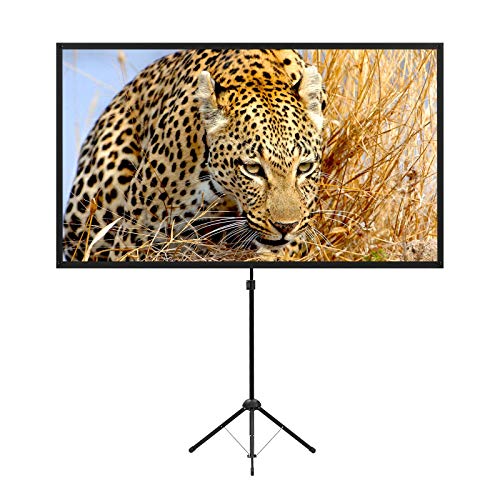
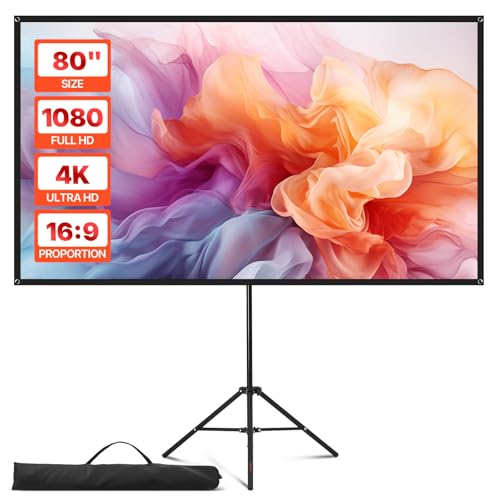
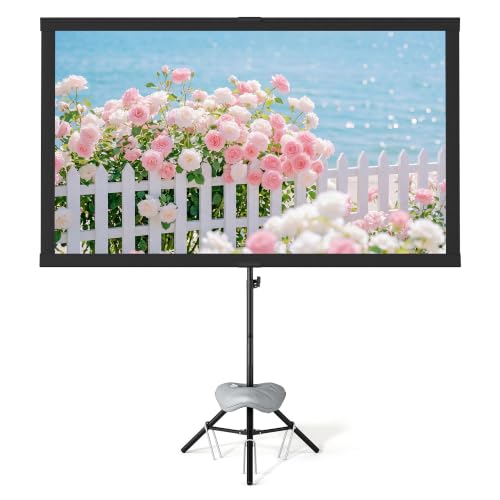
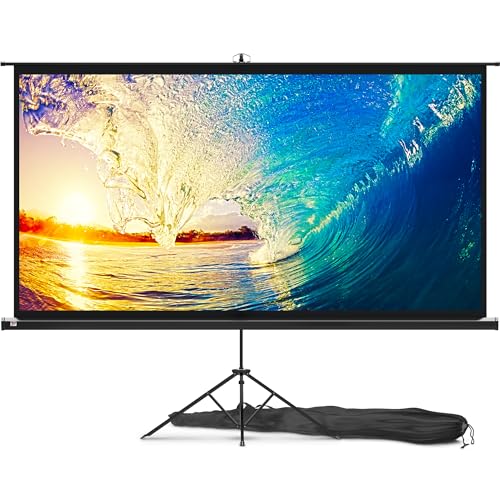
Tripod screens are familiar because they fold into a carry bag and provide adjustable height. VEVOR, excelimage, HYZ, TWJouko, and PropVue all document tripod-based designs. Look for locking height adjustments, wide legs, reinforced brackets, or tension rods when the screen will be moved often.
Freestanding frames can provide a broad viewing surface without a wall. The AWOL Valerion uses a portable alloy frame with anti-twist feet, while the ZUVMITG screen documents a reinforced base and support accessories. These designs can be suitable for open spaces, but their larger footprints should be measured before setup.
A floor pull-up model such as the Elite Screens ezCinema 2 stores in an aluminum casing and uses a scissor-backed mechanism. This can be convenient for offices, classrooms, and rooms where a tripod footprint is undesirable. The Epson Duet takes another approach by combining an included floor stand with a wall bracket.
Match the surface to the projector
Surface material and gain are important specification points. The AWOL Valerion lists 1.3 gain, while PARIS RHÔNE and HYZ list 1.5 gain. VEVOR uses foldable washable polyester, excelimage lists 1.2 gain glass fiber, and Elite Screens specifies 1.1 gain MaxWhite 2 matte white material. PropVue lists a matte 1.1 gain surface.
A wider viewing angle can help when people sit off-center. VEVOR, excelimage, HYZ, PARIS RHÔNE, and ZUVMITG provide wide-angle descriptions in their listings. Do not treat a wide viewing angle as a substitute for correct placement: the projector still needs to be aligned with the screen, and ambient light can affect the visible image.
Wrinkle-resistant or tensioned materials are useful for portable products because folding and transport are part of normal use. The excelimage screen uses tension from four tubes, while VEVOR, HYZ, TWJouko, and ZUVMITG describe wrinkle-resistant or washable materials. The Elite Screens floor model uses a fixed casing and pull-up structure rather than a loose folding cloth.
Plan for outdoor stability
Outdoor use requires a securing method appropriate to the surface and conditions. PropVue uses wide tripod legs and tight straps. The AWOL Valerion lists anti-twist feet for grass, sand, or patio placement. PARIS RHÔNE includes ground nails, and TWJouko combines stakes with a water weight bag.
The larger ZUVMITG model includes four sandbags, four stakes, and ropes. Those accessories provide several documented ways to add support, but they do not eliminate the need to assess the setup area. A large screen presents more surface to moving air, so select an open location where the included securing equipment can be used properly. The portable outdoor designs should be taken down when conditions are unsuitable rather than treated as permanent structures.
Consider front, rear, or wall placement
Front projection is the standard arrangement for most home-theater and presentation setups. The Elite Screens listing specifically recommends standard-throw projectors and excludes ultra-short-throw models. Confirm projector compatibility before choosing a screen, particularly when the projector sits close to the screen.
Some products document more than one placement method. HYZ and PARIS RHÔNE can be used with a stand or wall mounting. ZUVMITG supports front and rear projection, and the Epson Duet includes a wall bracket as well as a floor stand. Rear projection can help keep people from crossing the light path, but it requires enough room behind the material and a suitable projector position.
Compare transport and storage details
Portability includes more than the word portable in a title. The VEVOR screen lists a 7.1-pound weight, excelimage lists 8.5 pounds, and TWJouko uses a foldable fabric with a carry bag. The AWOL Valerion adds a wheeled case, which may be helpful for a larger frame. Epson’s Duet closes into a case approximately 43 inches long, while the Elite Screens model uses a casing and carrying bag.
Before selecting, measure the packed length, vehicle storage area, and available closet or shelf space. Larger screens may offer a more expansive picture but can require longer frame pieces and a wider assembly area. A smaller screen that can be moved and stored easily may be more practical for rooms used for several purposes.
Final Recommendation
AWOL Valerion 120-inch Outdoor Screen ranks first overall in this specification-based comparison under the published weighted criteria.
AWOL Valerion 120-inch Outdoor Projector Screen is the highest-scoring specification-based choice among these best portable projector screens. Its freestanding alloy frame, rolling case, 1.3 gain surface, anti-twist feet, and documented three-minute setup cover the main requirements for a large indoor or outdoor system.
For a 100-inch screen with tripod and wall options, PARIS RHÔNE offers the most flexible placement specification. VEVOR and excelimage are better suited to users who prioritize a lighter, compact tripod format, while HYZ adds a useful wall-mount alternative. TWJouko is the more outdoor-focused 80-inch pick because it includes both a water weight bag and ground stakes.
Among the top portable projector screens for specialized setups, Elite Screens ezCinema 2 stands out for its floor pull-up construction and standard-throw guidance. Epson Duet is the practical format-switching option for 4:3 and 16:9 content. For large outdoor viewing, ZUVMITG provides a 120-inch surface with a more extensive listed wind-support kit. The right choice depends on the available space, projector throw arrangement, screen format, and how often the system will be packed away.
Frequently Asked Questions
What size should I choose for portable viewing?
Choose the largest diagonal that fits the projection distance, room width, and storage space. The selected models range from 70 to 120 inches. An 80-inch screen is easier to place in compact rooms, while 100- and 120-inch options require more width and a larger assembly area.
Are the best portable projector screens suitable for outdoor use?
Several selected models document indoor and outdoor use, including AWOL Valerion, PARIS RHÔNE, VEVOR, TWJouko, PropVue, and ZUVMITG. Outdoor suitability depends on the included frame and securing equipment. Check whether the design uses stakes, ropes, sandbags, a water bag, or reinforced feet, and use those components as directed.
Does every portable screen support a 16:9 projector image?
No. Most selected screens use 16:9, but Epson Duet supports both 4:3 and 16:9. Match the screen format to the content and projector settings. The Elite Screens ezCinema 2 is 16:9 and is specified for standard-throw projectors, not ultra-short-throw models.
Is a tripod better than a freestanding frame?
Neither style is universally better. Tripods such as those on VEVOR, excelimage, HYZ, TWJouko, and PropVue provide adjustable-height portability. Freestanding designs such as AWOL Valerion and ZUVMITG can provide a broad surface without wall support, but they may need more floor space and outdoor securing.
What should I check before storing a portable screen?
Confirm the screen is clean and dry, follow the fabric-care instructions, and make sure rods, stakes, ropes, and brackets are accounted for before packing. Foldable materials such as polyester or milk silk may have specific care needs, while casing-based designs such as Elite Screens ezCinema 2 and Epson Duet store differently.