Buying Guide
The best 3d projector screens are not defined by one specification alone. The right choice depends on how the screen will be installed, how much ambient light reaches the image, whether the projector uses a 16:9 or 4:3 output, and whether the screen must move between locations. The products above are compared from supplied listing data, not from hands-on testing. Treat compatibility statements as listing claims and verify the screen dimensions against your projector and room before installation.
A 16:9 screen is the most common cinema-oriented format in this selection. Silver Ticket STR Series, ShowMaven, VEVOR, YODOLLA, TOWOND, and the Elite Screens Aeon CineGrey 3D and Yard Master 2 models all document 16:9 dimensions. That format can keep widescreen movie content proportioned as intended, but the projector must also be configured for the same output.
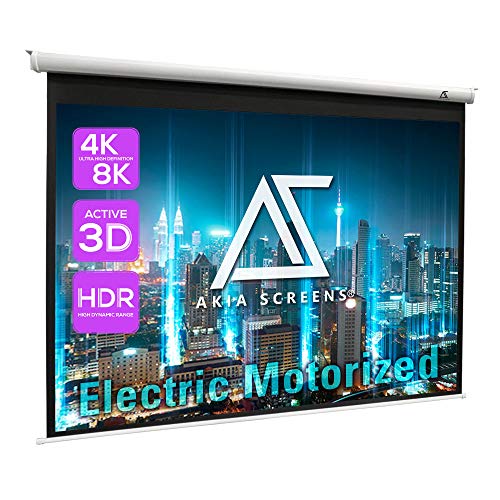
The Akia Screens model uses a 4:3 aspect ratio and is described for standard long-throw projector setups. A 4:3 design may make more sense for classroom, office, and presentation content where the source is not primarily widescreen. Check the projector’s native resolution and the intended content before choosing between formats.
Choose a surface for the room
Surface material and gain affect how the screen is positioned and used. White surfaces in the selected products include the 1.1-gain ShowMaven, Silver Ticket, Elite Manual B, and Akia models. Their listed viewing angles range from 160 to 180 degrees, making them reasonable candidates for seating that spreads across a room.
The Aeon CineGrey 3D takes a different approach. Its CineGrey 3D CLR/ALR material lists a 65% rejection ratio, 1.2 gain, and a 90-degree viewing angle. That combination is documented for spaces where incident light is a factor, but the narrower angle makes seating layout more important. The screen should face the primary seating area rather than a very wide audience.
Portable screens in this list use polyester or similar fabric materials. TOWOND and AAJK describe thickened or high-density polyester, while the Yard Master 2 uses a PVC-based dual-sided surface. Fabric systems can be convenient to fold and carry, while rigid fixed frames provide a more permanent installation approach. Do not assume that a material listed as wrinkle-free will eliminate every setup or tensioning consideration; the evidence only supports the specific claims made by each listing.
Decide between fixed, retractable, and portable designs
Fixed-frame screens are suited to a dedicated wall. The Aeon CineGrey 3D, Silver Ticket STR Series, ShowMaven, and VEVOR models document aluminum frames and tensioning or assembly systems. Fixed frames can keep the projection surface presented in a consistent plane, but they remain visible on the wall and require a suitable mounting location.
Retractable designs are useful when the wall has another purpose. The Elite Screens Manual B uses a manual pull-down case and a two-inch interval auto-lock mechanism. YODOLLA adds motorized movement, wall or ceiling mounting, and a stopping mechanism for adjustable height. Akia also uses motorized deployment and includes an infrared remote, wall controller, programmable drop settings, and a 12V-trigger port. These features are relevant when the screen needs repeatable operation or integration with compatible equipment.
Portable screens divide into freestanding frame systems and fabric systems attached with ropes, hooks, or similar hardware. The Yard Master 2 includes a freestanding aluminum frame, carrying bag, stakes, rigging cord, and support rings. The TOWOND and AAJK stand products also document carry-oriented designs. A portable choice should be evaluated by packed dimensions, included stabilizers, and the surface needed at each location—not only by diagonal size.
Match the screen to indoor or outdoor use
Outdoor placement introduces support and anchoring concerns. AAJK’s 120-inch stand model documents a triangular base, four windproof ropes, and six heavy-duty ground stakes. The Yard Master 2 lists ground stakes, rigging cord, support rings, and a padded carrying bag. These details make them more purpose-built for freestanding placement than a wall-mounted fixed frame.
The VEVOR screen is described for indoor, outdoor, classroom, business, and cinema applications, but it uses a fixed aluminum frame and wall-mounted tension-rod installation. That makes it a different type of outdoor option: a rigid screen that needs an appropriate wall or mounting surface rather than a complete stand package. Consider the site before selecting a design.
Check 3D and projector compatibility
A listing that says 3D ready does not by itself establish compatibility with every projector, 3D format, throw distance, or eyewear system. The selected products document different forms of support. The Aeon CineGrey 3D lists active 3D readiness and polarization for passive 3D. Silver Ticket, ShowMaven, Elite Manual B, and Akia identify active 3D readiness. VEVOR, YODOLLA, TOWOND, and the stand-mounted models state 3D support in their listings.
Also check throw requirements. The Aeon CineGrey 3D is listed for standard throw projection, while Akia is recommended for standard long-throw setups. Silver Ticket notes that some UST projectors are not compatible with its STR frame and recommends its S7 frame series for UST use. Those are specific compatibility notes worth checking before installation.
Verify dimensions and mounting space
Diagonal size is only the starting point. The 100-inch Aeon CineGrey 3D has a listed viewing size of 49.0 by 87.2 inches, while the 150-inch Silver Ticket screen lists a viewing area of 73.5 by 130.75 inches. Housing, frame depth, brackets, motor casings, and surrounding clearance can add to the required wall space. Measure the usable wall or stand area, then compare it with the supplied viewing and overall dimensions.
Final Recommendation
Elite Screens Yard Master 2 Dual 120-inch ranks first overall in this specification-based comparison under the published weighted criteria.
Elite Screens Aeon CineGrey 3D is the first overall specification-based choice among these best 3d projector screens because it documents ambient-light rejection, active and passive 3D support, 4K/8K readiness, permanent tensioning, and an edge-free fixed frame. It is most compelling when the room has controllable seating and stray light is a concern.
For outdoor or two-sided projection, Elite Screens Yard Master 2 Dual is the more specialized pick because its front-and-rear surface, freestanding frame, carrying bag, stakes, and rigging accessories are all documented. Silver Ticket STR Series is the better fit for a large dedicated 16:9 theater, provided the wall can support its 150-inch fixed frame and the projector is compatible.
ShowMaven and VEVOR cover conventional fixed-frame installations with wide viewing angles and stated 3D support. Elite Screens Manual B is the retractable manual option, while YODOLLA and Akia add motorized operation. For portable outdoor use, AAJK and TOWOND provide stand-based alternatives. Together, these top 3d projector screens cover the main installation decisions without treating a single design as suitable for every room.
Frequently Asked Questions
What should I check before choosing among the best 3d projector screens?
Check the projector’s native aspect ratio, throw type, image size, mounting position, and 3D system first. Then compare the screen’s viewing area, overall dimensions, surface type, gain, viewing angle, and installation method. A screen can list 3D support while still requiring projector-specific compatibility checks.
Is a fixed-frame or retractable screen better for 3D viewing?
The supplied evidence does not establish that one housing type is universally better for 3D. Fixed-frame products such as the Aeon CineGrey 3D, Silver Ticket, ShowMaven, and VEVOR models emphasize a tensioned or rigid presentation surface. Retractable products such as Elite Manual B, YODOLLA, and Akia emphasize storage or controlled deployment. Choose based on room use, mounting space, and the surface specifications that fit your projector.
Which selected screen is suited to ambient light?
The Elite Screens Aeon CineGrey 3D is the clearest documented fit because its CineGrey 3D material lists a 65% rejection ratio and identifies CLR/ALR use. Its 90-degree viewing angle means the seating arrangement should remain within the primary viewing area. Other selected screens list black backing, white surfaces, or wide viewing angles, but those details should not be treated as equivalent to the Aeon’s stated rejection specification.
Are portable screens suitable for outdoor 3D movies?
Several selected listings state 3D support for portable designs. The Yard Master 2 Dual documents active 3D and front/rear projection, while TOWOND and AAJK stand products document 3D projection. Outdoor results still depend on projector placement, ambient conditions, anchoring, and the particular 3D system. Use the included ropes, stakes, or support hardware as directed and verify the projector’s compatibility.
Does a larger diagonal always create a better viewing setup?
No. A larger screen needs more wall or stand space and sufficient projector throw distance. The 150-inch Silver Ticket, for example, lists a viewing area over 130 inches wide, while 100-inch products require substantially less horizontal space. Confirm the projector’s image-size range and measure the complete installation area before selecting a diagonal size.