Buying Guide
The best waterproof phone sleeves differ in water rating, size, closure, window design, and carry system. Start by deciding whether you need protection from splashes and sand, a pouch listed for submersion, or a floating design for activities where the phone could fall into the water. This guide uses public listing specifications only; it does not represent hands-on testing.
Check the stated water protection
Look for a documented IP rating and read the accompanying depth claim. Several selected models list IPX8, including UNBREAKcable, CACOE, JOTO, Lamicall, and Rynapac. Their listings state depths of 30 meters or 100 feet. Pelican lists IP68 but specifies a shallower 3.3-foot or 1-meter depth. Those details help distinguish poolside protection from products listed for deeper water activities.
An IP rating is not a substitute for correct preparation. CACOE, Rynapac, and wellhouse recommend testing with a paper towel before use. Rynapac also advises squeezing air from the pouch before sealing and keeping objects away from the top mount. Sand, debris, or an incorrectly positioned item can interfere with closure, so inspect the sealing area before each outing.
Match the size to your phone and case
Measure the phone and case together if you want to leave the case installed. Hiearcool describes an 8.9-inch inner space intended to fit many large phones with protective cases. Lamicall lists compatibility with phones up to 7 inches with a case on. CACOE, wellhouse, and Rynapac caution that bulky cases may need removal.
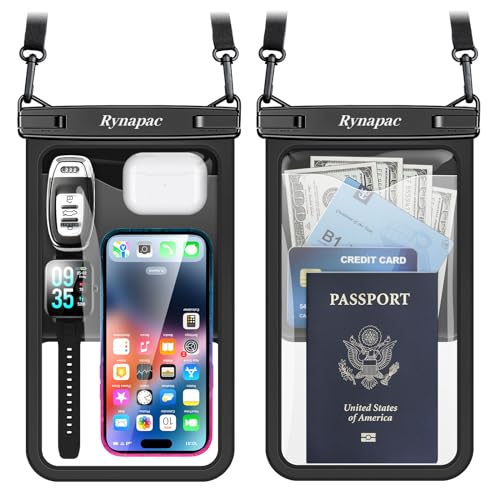
Extra room can be useful, but it can also add bulk. The Rynapac Large model is listed for up to 10 inches and includes separate interior areas for cash, IDs, keys, and room cards. That makes it useful for cruise travel, but a compact phone-only pouch may be easier to carry when you do not need storage. Compare the listed dimensions with the complete phone setup rather than relying only on a model name.
Decide whether flotation matters
A floating design addresses a different problem from water resistance alone. UNBREAKcable, CACOE, Foweroty, and Pelican document flotation. UNBREAKcable specifies a built-in sponge airbag and support up to 360 grams, while CACOE describes four-sided double airbags. These features may be useful for swimming, boating, kayaking, or other activities where a dropped phone could be difficult to retrieve.
Do not assume that every pouch with a water rating floats. Check the evidence for an explicit flotation claim. Also consider bulk: a floatable design may be thicker than a flat pouch, while a non-floating option may pack more easily in a pocket or travel bag.
Consider touch and camera access
Clear windows are common, but the access details differ. JOTO lists clear windows on both sides. UNBREAKcable describes a large front window and a rear camera window. Pelican documents side-button access, and Lamicall lists touchscreen, camera, calls, and other functions while excluding fingerprint recognition.
Touch access can help with maps, messages, photos, and basic controls, but several listings warn that water pressure may affect operation at depth. UNBREAKcable suggests using side volume buttons for photos if touch input is difficult underwater. Choose a pouch for its documented functions, not an assumption that every phone feature will work unchanged through the material.
Compare closure and materials
Closure design is central to a waterproof pouch. The selected products describe snap-lock, reinforced-lock, triple-seal, double-lock, or heat-pressed construction. Rynapac’s regular pouch lists a triple-seal design, Hiearcool describes a dual-lock system, and wellhouse combines TPU molding with an ABS reinforced clip. Lamicall highlights an upgraded locking clip with a curved side.
Material descriptions also show how designs differ. Soft TPU appears in CACOE, Foweroty, Pelican, and wellhouse listings. Lamicall uses soft PVC, while other listings describe transparent PVC or TPU windows. Materials do not establish performance on their own, but they can indicate whether a pouch emphasizes a flexible window, molded body, or thin clear construction.
Choose the carrying system
Most selected products include a neck strap or lanyard. UNBREAKcable and Foweroty offer adjustable options, while Pelican’s lanyards are detachable. Think about whether you want the phone hanging in front, removable for storage, or carried across the body.
A two-pack or larger pack may suit couples, families, or travelers who want a spare. Hiearcool, CACOE, JOTO, Lamicall, Pelican, and Rynapac offer multi-pouch configurations in the supplied evidence. A single pouch may be preferable when you want fewer accessories, while a multi-pack can simplify group travel.
Final recommendation
Rynapac Large Waterproof Phone Pouch 10-Inch ranks first overall in this specification-based comparison under the published weighted criteria.
UNBREAKcable Floating Waterproof Phone Pouch 2 Pack is the first overall specification-based choice among the returned products.
It combines an IPX8 claim, a stated 30-meter or 100-foot depth rating, flotation, camera access, touch compatibility, and an adjustable lanyard. The case-removal guidance and underwater touchscreen limitation remain important considerations.
Among the top waterproof phone sleeves, Hiearcool is the stronger fit-focused option when keeping a protective case on matters, while Rynapac Large is suited to carrying a phone with small travel essentials. Pelican stands out for its marine-oriented design and detachable lanyards, and JOTO is a straightforward clear-window alternative. Before water use, select the correct size, inspect the closure, and complete the paper-towel test where the listing recommends it.
The best waterproof phone sleeves should be selected by matching documented specifications to the activity. A stated rating, proper fit, reliable closure, usable windows, and suitable carry system are more useful decision points than a generic waterproof label alone.
Frequently Asked Questions
Are the best waterproof phone sleeves suitable for underwater photography?
The selected listings for UNBREAKcable, CACOE, JOTO, Pelican, Foweroty, and Rynapac describe underwater photography or camera access through clear windows. That supports the feature claim, but touchscreen response may change under water pressure. Follow the pouch instructions and consider phone volume buttons when touch controls are difficult.
Should I remove my phone case before using a waterproof pouch?
It depends on the pouch and case. Hiearcool and Lamicall specifically describe room for phones with cases, while CACOE, wellhouse, and Rynapac warn that bulky cases may need removal. Check the listed size and case guidance before sealing the phone. A tight fit can interfere with proper closure.
What is the difference between IPX8 and IP68 here?
IPX8 identifies a water-resistance level without a dust-resistance rating in the supplied description, while IP68 includes dust and water protection categories. The practical details still depend on the stated depth and instructions. Pelican lists IP68 with a 1-meter depth, while several IPX8 models state 30 meters or 100 feet.
Are floating phone pouches worth choosing?
A floating pouch may be useful for swimming, kayaking, boating, or other activities where a phone could fall into water. UNBREAKcable, CACOE, Foweroty, and Pelican document flotation features. Floating construction does not remove the need to seal the pouch correctly and may add bulk compared with a slim phone-only sleeve.
How should I prepare a waterproof phone sleeve before a trip?
Inspect the seal and closure, keep sand and sharp objects away from the opening, and follow the testing instructions. CACOE, Rynapac, and wellhouse recommend a paper-towel test, while Rynapac also advises squeezing air out before sealing. Confirm that the phone fits without stressing the closure, then check that the lanyard is attached securely.