Buying Guide
Selecting the best awg electrical wire is less about the gauge number alone and more about matching the cable design to the circuit. Every product here is identified as 14 AWG, but the group includes solid building cable, stranded duplex cable, single-conductor automotive wire, silicone hookup wire, marine wire, and copper-clad aluminum (CCA) products. Those designs are not interchangeable in every installation.
Start with the conductor material
Pure copper and oxygen-free copper are documented in the YDDECW THHN, FuseFlex, Kimbluth, and building-cable options. Tinned copper appears in the NOVINO marine cable, NAOEVO automotive cable, BNTECHGO silicone wire, and NAOEVO silicone kit. Tinning adds a corrosion-oriented feature to the copper surface and is especially relevant when the listing targets marine or harsh environments.
CCA is used in the GS Power product. Its listing emphasizes lighter weight and flexibility, and it explicitly limits the product to low-voltage applications. CCA can be useful for automotive, audio, robotics, and similar projects, but do not treat a low-voltage CCA product as a substitute for a documented household AC building cable. The GS Power listing specifically says not to use it for household 110/220V AC wiring.
Choose the cable design for the installation
Solid NM-B cable is the focused choice for indoor branch-circuit work when the installation calls for that building-wire format. Energeaster identifies black and white insulated conductors plus a 14-gauge ground, and its application notes point to switches, outlets, wall cavities, and attics. Arizona Electrical Solutions also identifies 14/2 copper cable with ground and cites UL and NFPA-related standards, although its supplied listing provides less application detail.
THHN is another building-wire design, represented here by YDDECW. It uses a solid copper core with nylon over PVC insulation and is listed for residential, industrial, CNC, control, machinery, lighting, grounding, and transformer work. THHN conductors are commonly selected as individual conductors for an appropriate raceway or related installation; confirm the complete wiring method and local requirements before buying.
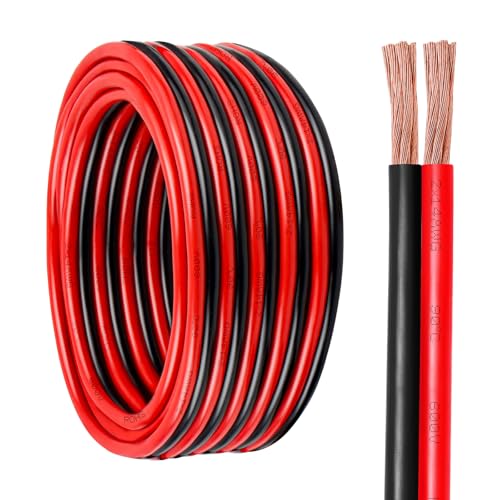
Duplex cable places two conductors together. NOVINO’s marine product uses red and black conductor sheaths, while FuseFlex and the NAOEVO 14/2 cable also provide two-conductor formats. These designs are convenient when a positive and negative or other paired connection must be routed together. They do not automatically provide a grounding conductor.
Single-conductor assortments are useful when each circuit path needs separate routing or color identification. GS Power supplies six colors in separate rolls. Silicone kits from BNTECHGO and NAOEVO likewise emphasize flexibility and multiple colors, but their evidence is oriented toward hookup, electronics, appliance, motor, model, and low-voltage work rather than NM-B replacement.
Match insulation to the environment
For indoor dry locations, NM-B options provide the most direct application match in this selection. Energeaster explicitly cautions that its cable may not be run in wet or damp locations. That restriction matters even when another product in the comparison advertises moisture resistance.
For outdoor, damp, marine, or corrosion-prone settings, review the environmental claims carefully. NOVINO identifies marine-grade construction, tinned copper, and resistance claims for corrosion, abrasion, temperature changes, and flame. FuseFlex lists IP68, UV resistance, and suitability for outdoor or buried low-voltage uses. Kimbluth describes PVC insulation with moisture, chemical, and UV resistance and states that it can adapt to outdoor environments.
Silicone wire serves a different purpose. BNTECHGO and NAOEVO list silicone insulation that remains flexible across a stated -60°C to 200°C range. That makes these products attractive for hot, cold, or tight-routing applications documented in their listings. Still, a wide temperature claim does not establish that a product is approved for every building, marine, or automotive wiring method.
Check voltage, temperature, and protection claims
Several selected products state 600V ratings, including YDDECW, NOVINO, BNTECHGO, FuseFlex, Kimbluth, and the NAOEVO 14 AWG cable. The number should be read together with the product type and application. A 600V statement on flexible hookup wire does not by itself make that wire suitable for a household branch circuit.
Temperature details also vary. YDDECW lists 90°C dry and 75°C wet for its THHN wire. NOVINO lists 105°C dry and 75°C wet. GS Power lists 105°C, while BNTECHGO and NAOEVO silicone products list a much wider -60°C to 200°C range. FuseFlex states operation from -22°F to 221°F, and Kimbluth states -40°F to 224°F. These are supplied listing specifications, not independent measurements.
Some products add IP or flame-related claims. FuseFlex and NAOEVO’s 50-foot cable list IP68, and both FuseFlex and that NAOEVO model mention VW-1 flame-retardant grades. NOVINO cites UL 1426, SAE, and ABYC references. Use such information as a screening tool, then confirm the exact approval needed for the installation.
Plan the length and handling
Length affects both suitability and waste. The comparison includes 25-foot, 50-foot, 90-foot, 100-foot, 300-foot, and 600-foot formats. A short spool can be convenient for a compact repair or project, while multi-color assortments can reduce the need to buy separate identification colors.
Stranding generally supports flexibility, while solid conductors hold a more fixed shape. The silicone products document 400 fine strands and are aimed at flexible routing. NOVINO’s marine cable is stranded and designed for marine and external wiring. By contrast, the YDDECW and NM-B products use solid construction and are more directly positioned for fixed building installations.
Final recommendation
YDDECW 14 AWG THHN Solid Copper Wire ranks first overall in this specification-based comparison under the published weighted criteria.
The final choice among the best awg electrical wire depends on the documented features that match your intended use.
YDDECW 14 AWG THHN Solid Copper Wire is the first overall specification-based choice among this selection because it combines pure copper, named THHN construction, broad applications, 600V service, temperature details, and UL 83 documentation. For indoor branch circuits, Energeaster 14/2 NM-B Cable is the more focused fit, while NOVINO 14 AWG Duplex Marine Wire is the most specification-aligned documented match for marine and corrosion-prone work.
The top awg electrical wire for flexible high-temperature hookup work is BNTECHGO 14 AWG Silicone Wire, supported by its tinned copper, fine-strand construction, and silicone temperature range. FuseFlex is a practical alternative for outdoor low-voltage projects where its IP68 and UV-related claims are relevant. For color-coded DIY or electronics work, the NAOEVO silicone kit provides six colors, while GS Power is best kept to the low-voltage automotive and electronics uses stated in its listing.
Before purchase, confirm whether the project requires NM-B, THHN, marine-grade, automotive, or hookup wire; whether the conductor must be copper or may be CCA; how many conductors are needed; and whether the insulation rating matches the location. Follow the applicable electrical code and manufacturer instructions rather than relying on gauge alone.
Frequently Asked Questions
What is the best awg electrical wire for household branch circuits?
The selected NM-B products are the most directly aligned with indoor residential branch-circuit wiring. Energeaster explicitly identifies switches, outlets, wall cavities, and attics and includes two insulated conductors plus a ground. Arizona Electrical Solutions also identifies 14/2 copper cable with ground and cites relevant standards. Verify the required cable type, conductor count, and local code for the specific circuit.
Is 14 AWG wire suitable for every 120V project?
No. Gauge is only one specification. The insulation, conductor arrangement, temperature rating, wiring method, and approval must fit the installation. The GS Power listing explicitly limits its CCA wire to 6–80V and says not to use it for household 110/220V AC wiring. Flexible silicone and low-voltage duplex products likewise should not be assumed to replace building cable.
Should I choose solid or stranded 14 AWG wire?
Choose based on the documented application and handling needs. Solid wire is used by YDDECW and the NM-B products and is positioned for fixed building installations. Stranded wire appears in the marine, automotive, and silicone products and is described as flexible or suitable for tight spaces, models, vehicles, appliances, or electronics. Confirm terminal compatibility and the permitted wiring method before installation.
When is tinned copper useful?
Tinned copper is documented in NOVINO marine wire, NAOEVO’s 50-foot automotive cable, BNTECHGO silicone wire, and the NAOEVO silicone kit. The supplied descriptions connect it with corrosion resistance or marine and flexible applications. It can therefore be a sensible feature for humid, corrosive, or frequently handled environments, but it does not remove the need to verify the complete cable approval and installation conditions.
Is CCA 14 AWG wire a good choice for automotive projects?
CCA can fit the low-voltage automotive and electronics uses stated for GS Power, where its listing emphasizes light weight and flexibility. The same listing clearly excludes household 110/220V AC wiring. Compare the conductor material and the application limits with the project requirements; do not assume a CCA product has the same suitability as a copper building cable or marine cable.