Buying Guide
The best direct burial electrical wire is determined by the circuit, not by the package title alone. Start by identifying whether the run feeds a low-voltage lighting system, an outdoor branch circuit, a pump, or a detached-building panel. The selected products cover those different use cases, but they are not interchangeable.
Match the cable type to the job
UF-B is the dominant design in this comparison for general underground feeder and branch-circuit work. The Southwire 12/2, FIRMERST 12/3, Southwire 10/2, Energeaster 10/2, Energeaster 6/3, YDDECW 10/3, and FIRMERST 14/2 listings all describe UF-B construction and direct-burial use. UF-B products in the selection are also described for wet or dry locations, although installation still needs to follow the applicable electrical code.
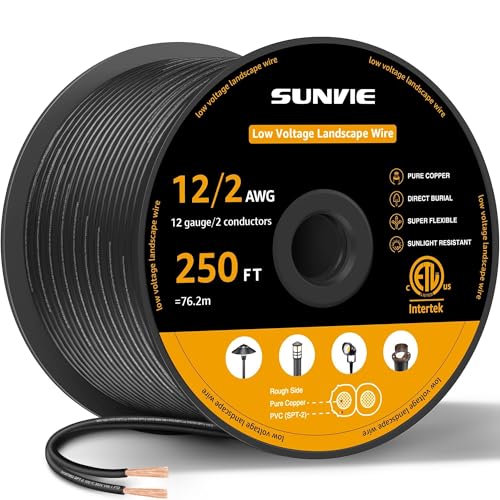
Low-voltage landscape wire is a different design category. The SUNVIE 12/2 is described for path, wall, spot, in-ground, and similar landscape lighting, with a 300-volt maximum working voltage. That makes it a logical match for low-voltage lighting systems, but not a substitute for a feeder cable simply because both products can be buried.
For larger feeder applications, the Relaxweex and Nassau products use 2-2-2-4 aluminum quadruplex construction. Relaxweex is described for mobile homes, garages, workshops, and subpanels, while Nassau provides direct-burial ampacity information. These are specialized service or secondary-feeder choices rather than general-purpose lighting wire.
Choose the conductor count carefully
The first number in a cable designation identifies conductor gauge, while the second commonly indicates the number of insulated conductors. A 12/2 cable is a simpler choice than a 12/3 cable. FIRMERST 12/3 and YDDECW 10/3 provide three conductors, which can support circuit arrangements that a two-conductor cable cannot. The product listings should be read alongside the equipment requirements and local wiring rules.
A ground is also important to verify. Southwire 12/2, FIRMERST 12/3, FIRMERST 14/2, and YDDECW 10/3 explicitly mention a ground. The Relaxweex cable lists a 4 AWG equipment ground within its 2-2-2-4 arrangement. Nassau supplies detailed neutral and conductor information, but the listing evidence provided here should not be expanded beyond those documented specifications.
Use gauge and capacity as selection checks
Gauge should follow the circuit design, permitted ampacity, run length, voltage-drop calculation, and applicable code. Do not choose a thicker or thinner cable solely because it appears more robust. The selected 14/2 FIRMERST product is identified for compatible 15-amp outdoor branch circuits, while the 6/3 Energeaster and 2-2-2-4 products are positioned for larger feeder applications.
Voltage ratings also distinguish the products. Most selected UF-B cables are rated at 600 volts. SUNVIE is listed at a 300-volt maximum working voltage. Nassau provides a direct-burial ampacity of 155 amps, and Relaxweex is described as a 100-amp cable. Those figures are useful specification filters, not permission to exceed code, equipment, termination, or installation limits.
Consider jacket and location conditions
Underground runs encounter moisture, soil contact, sunlight during exposed sections, and possible temperature changes. The UF-B listings describe PVC jackets and resistance to moisture, corrosion, UV exposure, or wet locations. SUNVIE is described as resistant to sunlight, abrasion, and moisture and is identified for direct burial. These details support outdoor use, but they do not remove the need to follow burial-depth, protection, conduit, and transition requirements where applicable.
The listing for FIRMERST 14/2 specifically tells buyers to verify breaker size, burial depth, required protection, and local code. That is a useful reminder for every product in this category. A cable being labeled direct burial does not determine the complete installation method for a particular property or circuit.
Select a length that fits the route
Measure the path, account for routing and termination, and avoid assuming the nominal package length equals the exact usable run. The selected products range from 50 feet to 250 feet. YDDECW’s 50-foot format is suited to a shorter project, while Southwire 10/2 and SUNVIE offer 250-foot formats for longer outdoor layouts. FIRMERST 14/2 provides 150 feet, which may bridge the gap between common shorter and longer packages.
Which option fits each project?
For a conventional outdoor branch circuit, Southwire 12/2 is a balanced specification choice in this group. For more conductors, FIRMERST 12/3 or YDDECW 10/3 deserves attention. For heavier feeder work, compare the 6/3 Energeaster with the aluminum quadruplex options. For landscape lighting, SUNVIE is the purpose-specific pick because its listing focuses on low-voltage systems.
Final Recommendation
FIRMERST 12/3 UF Wire, 100 ft ranks first overall in this specification-based comparison under the published weighted criteria.
FIRMERST 12/3 UF Wire, 100 ft is the first overall specification-based choice in this comparison.
The final choice among the best direct burial electrical wire depends on the documented features that match your intended use.
FIRMERST 12/3 UF Wire is the first overall specification-based choice under the published criteria. Its documented solid copper conductors, ground, 600-volt rating, direct-burial use, wet-location suitability, and applications for subpanels and pumps give it a strong all-around profile for projects requiring three conductors.
The top direct burial electrical wire for a specific project may be different. Choose Southwire 12/2 for a conventional outdoor branch circuit, Southwire 10/2 for a longer 10-gauge copper run, or SUNVIE for low-voltage landscape lighting. Large feeder installations should be evaluated separately using the Relaxweex or Nassau conductor arrangements and their documented capacity information.
In every case, verify gauge, conductor count, breaker compatibility, terminations, burial conditions, and local code before installation. This comparison is specification-based and is not a substitute for a qualified electrical design or inspection.
Frequently Asked Questions
What makes the best direct burial electrical wire different from ordinary indoor cable?
The selected direct-burial products are described for underground use and typically include insulation or jacketing intended for outdoor, wet, damp, or direct-burial conditions. Indoor-only cable should not be assumed suitable merely because it has the correct gauge.
Is UF-B the same as low-voltage landscape wire?
No. UF-B products in this comparison are positioned for underground feeders and branch circuits, with most listed at 600 volts. SUNVIE is a low-voltage landscape cable with a 300-volt maximum working voltage and applications centered on outdoor lighting. Select by system voltage and equipment requirements.
Should I choose 12/2 or 12/3 cable?
A 12/2 cable has two insulated conductors, while a 12/3 cable has three. FIRMERST 12/3 is therefore more suitable when the documented circuit design requires an additional conductor. The correct choice depends on the equipment, circuit arrangement, and code requirements rather than gauge alone.
When is aluminum feeder cable appropriate?
Relaxweex and Nassau list 2-2-2-4 aluminum quadruplex construction for larger feeder or secondary-service applications. These cables are not general replacements for small copper branch-circuit wire. Aluminum terminations and installation practices must match the equipment and applicable requirements.
Does a longer cable always work better?
No. Longer cable can reduce splicing needs, but the run length affects voltage drop, routing, and installation planning. Compare the 50-, 100-, 150-, and 250-foot options with the actual route and the circuit’s electrical requirements before selecting a package.