Buying Guide
The best x 36-inch bulletin boards are large enough for calendars, notices, photos, classroom material, and team planning, but the right construction depends on the wall and the type of display. Start by separating fixed framed boards from flexible felt formats, then compare the surface, mounting method, and included hardware.
Choose the surface first
Natural cork is the conventional choice for push pins. Maxtek documents a 10mm natural cork layer, while Board2by specifies 0.47-inch natural cork. Those details are useful when the board will receive frequent pinning. VIZ-PRO also describes its cork as self-healing and high-density, which supports a reusable notice surface. Staples keeps the design simpler with a durable natural-cork surface intended for documents.
Linen-covered boards change the appearance without abandoning the cork-board format. JILoffice describes a linen-and-cork construction, and Miratino combines a high-fiber linen surface with solid-wood edges. These designs may suit a home office, bedroom, or visible reception area where a conventional metal frame feels too utilitarian. The supplied listings do not provide identical construction measurements for every linen model, so compare their stated materials rather than assuming equivalent thickness.
Felt is a useful alternative when a softer, lighter, or more customizable display is preferred. Lightomorrow and AKTOP describe polyester-fiber felt surfaces, while both use a frameless or foldable approach. Felt tile systems can also be arranged into different layouts, but the selected Lightomorrow and AKTOP models provide a single large-format board rather than requiring users to assemble multiple separate tiles.
Check the actual usable area
A nominal 48 x 36-inch label generally describes the overall product or intended format, not always the exposed pinning area. VIZ-PRO lists an available surface of 45.7 x 33.9 inches, and Maxtek lists an overall measurement of approximately 47.04 x 35.23 inches including the frame. Allow room around the product for the frame, corners, hooks, and mounting clearance.
Orientation is another practical consideration. VIZ-PRO, Maxtek, Board2by, and Miratino document vertical or horizontal installation. That flexibility can help align the board with a narrow wall, a desk, or an existing group of frames. Staples is listed as 4 x 3 feet, but the supplied evidence does not specify its mounting orientation or hardware, so measure the intended wall before choosing it.
Compare framed and foldable designs
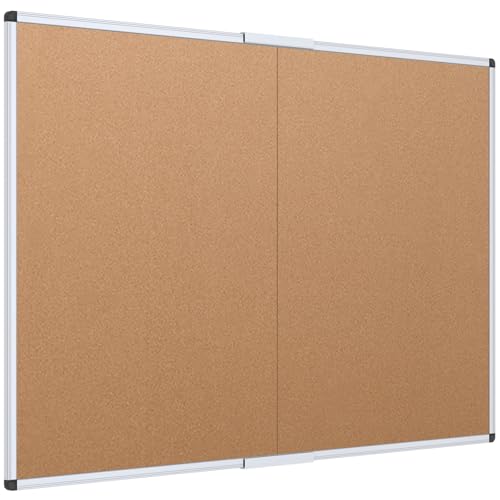
Aluminum frames are common on office-style cork boards. VIZ-PRO, Maxtek, JILoffice, and the TRIPOLLO combination board use aluminum framing or aluminum-frame components. They can create a defined perimeter and may be easier to align against a wall. Board2by and Miratino provide wood or wood-style edging for a warmer look.
Foldable products have a different advantage. The VIZ-PRO foldable model is designed to fold in half, and both Lightomorrow and AKTOP describe foldable felt formats. Folding can make a large board easier to handle or store, but inspect the product’s fold structure and installation instructions. VIZ-PRO notes that its hinge or U-slot structure may be shipped randomly, so buyers who need a particular structure should account for that uncertainty.
Review installation requirements
Included hardware varies considerably. Maxtek lists expansion screws, hooks, and instructions. VIZ-PRO includes fixing kits, while Board2by lists screws, anchors, and anchor covers. These details matter when mounting a framed board to a wall and can reduce the need to source basic hardware separately.
Adhesive mounting is more relevant to felt products. AKTOP lists adhesive tape for smooth surfaces such as glass and tile, and Lightomorrow uses hook-and-loop backing. These approaches avoid drilling, but surface compatibility remains important. Do not treat a removable or adhesive claim as universal: wall finish, paint condition, load, and removal technique can affect the result.
Consider combination functionality
TRIPOLLO is the selected option for buyers who want more than a pinning area. Its 48 x 36-inch board divides the surface between dry erase and cork, includes a detachable pen tray, and supplies markers, an eraser, magnets, and push pins. That makes it suitable for planning sessions where written notes and pinned documents need to share one wall location. The trade-off is straightforward: only half of the board is cork, so it offers less cork area than a full-size cork model.
Match accessories to the project
Included pins are helpful for a new board. Miratino supplies 30 push pins, Board2by supplies 18, AKTOP supplies 25, and TRIPOLLO includes 12 along with other accessories. Still, accessory counts should not replace attention to the surface and mounting design. A board intended for a classroom, meeting room, or shared office may need additional pins, labels, clips, or markers regardless of the initial package.
Final recommendation
Maxtek 48 x 36-inch Cork Board ranks first overall in this specification-based comparison under the published weighted criteria.
Maxtek 48 x 36-inch Cork Board is the highest-scoring returned product and the first overall specification-based choice. Its documented 10mm natural cork, aluminum frame, flexible mounting, and supplied installation components create a balanced package for frequent office or classroom use. Among the top x 36-inch bulletin boards, it offers particularly clear evidence about surface thickness and mounting options.
Choose VIZ-PRO’s black-frame model if you want a conventional framed board with hidden screw covers and two-way installation. Choose the VIZ-PRO foldable version when transport or storage is a priority. Board2by and Staples are straightforward framed alternatives, while JILoffice and Miratino provide more decorative linen or wood-oriented styling.
For mixed planning, TRIPOLLO is the more functional choice because it adds a dry-erase surface and writing accessories. Lightomorrow and AKTOP are better fits when a lightweight felt appearance or adhesive installation is more important than a traditional cork frame. These differences make the best x 36-inch bulletin boards a use-case decision rather than a single-format purchase.
Frequently Asked Questions
Among the best x 36-inch bulletin boards, are all 48 x 36-inch bulletin boards the same usable size?
No. The stated format can describe the overall board, intended layout, or package size. VIZ-PRO lists both overall and available surface measurements, while framed products naturally reserve some area for the frame and corners. Measure the wall and check the exposed display area before ordering.
Is cork or felt better for a large bulletin board?
Neither material is universally better. Cork is the more conventional choice for repeated pinning, and Maxtek, VIZ-PRO, and Board2by provide specific natural-cork details. Felt can offer a softer appearance, lower weight, or flexible installation, as shown by Lightomorrow and AKTOP. Select based on the desired look, wall surface, and pinning routine.
Which selected board supports both writing and pinning?
The TRIPOLLO Magnetic White and Cork Board combines a dry-erase section with a cork section. It also includes markers, an eraser, magnets, push pins, and a detachable tray. It is useful when schedules or notes need to be written beside pinned documents, but it provides less full-size cork area than a dedicated cork board.
Do foldable bulletin boards require special care?
A foldable design can make handling and storage easier, but follow the product’s mounting directions and inspect the fold area during setup. The VIZ-PRO foldable model notes that hinge or U-slot construction may vary, while Lightomorrow and AKTOP describe foldable felt formats. Keep the board supported as directed rather than assuming every folding structure installs identically.
Can adhesive-backed felt boards go on any wall?
No. The selected adhesive or hook-and-loop models describe use on suitable indoor or smooth surfaces, but wall compatibility still depends on paint, texture, cleanliness, and the removal method. Test a small area when possible, follow the supplied instructions, and avoid assuming that an adhesive board is appropriate for every painted or textured wall.