Buying Guide
The best dehumidifiers with timers are not all designed for the same moisture load. The selected products range from small semiconductor units for closets and bathrooms to compressor models intended for basements and large rooms. Start by matching the unit’s documented coverage and capacity claim to the space, then examine how the timer, drainage, controls, and maintenance features fit your routine.
Match capacity to the room
Coverage claims are useful for narrowing the list, but they should not be treated as a guarantee for every climate or room layout. COWSAR lists up to 4,500 square feet and an 80-pint maximum claim, while KEGIAN lists 5,000 square feet and a 55-pint-per-day claim. Amazon Basics lists 4,000 square feet with a 50-pint size. These are appropriate profiles for broad, persistent moisture problems compared with compact bedroom units.
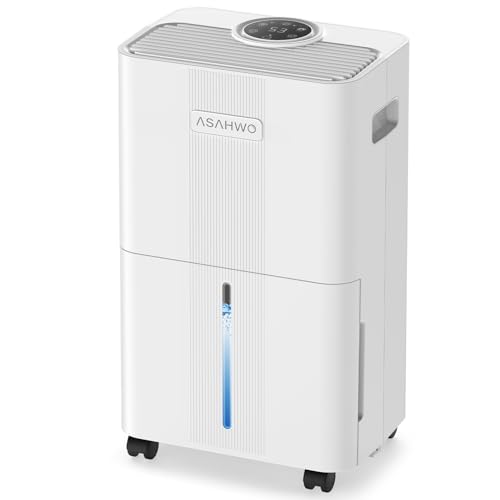
Midea lists 1,500 square feet and 22 pints, while KNKA lists 2,500 square feet and 34 pints. Glowells and ASAHWo each document 21-pint operation for areas up to 1,600 square feet. Such models can suit a basement, laundry area, office, or several connected rooms when placement and airflow are appropriate.
Compact models have a different role. Spacekey lists 1,000 square feet, KeepGlad lists use up to 1,000 square feet, and Windangel lists 215 square feet. These units may be easier to position in a bedroom, bathroom, closet, RV, or other enclosed area, but their smaller format should not be confused with the moisture-handling profile of a compressor model.
Choose the timer type you actually need
Timer wording varies considerably. A 24-hour timer, such as the one documented for Glowells, ASAHWo, and COWSAR, is useful when you want a daily operating window. Spacekey gives four short presets—2, 4, 6, and 8 hours—which may be convenient for overnight or post-shower use. Windangel lists 24-, 48-, and 72-hour choices, better suited to longer unattended intervals.
Midea adds programmable operation to Wi-Fi, app, and voice controls. KEGIAN documents app-based scheduling, allowing the user to schedule operation remotely. Those features are useful when the dehumidifier is placed in a basement or another room that is not checked frequently. Amazon Basics confirms a timer but does not provide its duration in the supplied evidence, so buyers who need a precise interval should verify the manual or current listing.
A timer only controls operation for the period described by the product. It does not replace a humidistat, drainage plan, or full-tank protection. If the unit has a full tank, the selected products generally document automatic shutoff, but a timer cannot make a filled tank continue running safely.
Consider drainage before placement
Manual tank emptying is workable for occasional use, but continuous drainage is more convenient for damp basements and laundry rooms. COWSAR, KNKA, Glowells, ASAHWo, KEGIAN, KeepGlad, and the compact models Spacekey and Midea document hose-related drainage features, although Midea’s hose is not included. Check that the hose can run downward toward a suitable drain; gravity drainage depends on the placement and route.
Tank size also affects maintenance. KEGIAN lists a 4.5-liter tank, COWSAR lists 4 liters, and KNKA lists a 0.79-gallon tank. Compact choices use smaller reservoirs, including Windangel’s 44-ounce tank and Spacekey’s 106-ounce tank. A larger tank can reduce emptying frequency, but actual fill time depends on room humidity and operating conditions.
Look for safety and cold-room features
Auto-shutoff when the tank is full is a useful protection documented across much of this group. Auto-defrost appears on the compressor and semiconductor selections, including Midea, Amazon Basics, COWSAR, KNKA, Glowells, ASAHWo, Spacekey, and Windangel. This feature is relevant in cooler areas because frost can affect operation, but the supplied evidence does not establish identical low-temperature performance among models.
Child locks appear on KNKA and ASAHWo. Midea and Amazon Basics document auto-restart after a power interruption, while COWSAR documents memory for previous settings. Those details matter if the unit operates while you are away or in an area where power interruptions are possible.
Compare modes, noise claims, and maintenance
Modes can make a timer more useful. Dry-clothes modes appear on Glowells and KNKA, while COWSAR offers Comfort, Basement, and Continuous modes. Midea lists turbo operation, and KEGIAN lists Auto and Sleep modes. Compact models commonly provide Sleep, Normal, or Performance settings.
Noise figures are product claims rather than independent measurements in this comparison. KeepGlad lists 28 dB in sleep mode, Spacekey lists 20 dB, Glowells lists below 36 dB, and Windangel describes a quiet sleep mode without a supplied dB figure in the relevant feature point. Use those figures for comparison, but consider that fan speed, room acoustics, and compressor cycling can affect perceived sound.
Washable filters are documented for Amazon Basics, Glowells, KNKA, KeepGlad, Spacekey, and Windangel. They can simplify routine upkeep, but a washable filter still needs cleaning according to the manufacturer’s instructions. Wheels and handles on compressor models help reposition heavier units; compact models such as Spacekey and Windangel emphasize carry-friendly designs instead.
Final recommendation
COWSAR 80-Pint Dehumidifier ranks first overall in this specification-based comparison under the published weighted criteria.
The final choice among the best dehumidifiers with timers depends on the documented features that match your intended use.
COWSAR is the capacity-focused option, combining a high stated moisture-removal claim, coverage up to 4,500 square feet, a 24-hour timer, included hose, multiple modes, and auto-restart. KEGIAN stands out for remote scheduling, while Amazon Basics emphasizes Energy Star certification and a reusable filter. KNKA offers three drainage paths and a child lock.
Midea is an alternative for shoppers who want app, voice, and programmable controls alongside a 1,500-square-foot claim, adjustable humidity, drainage flexibility, auto-defrost, and auto-restart. Glowells and ASAHWo are balanced choices for medium-size rooms, with 21-pint claims, timer controls, hose drainage, and multiple modes.
For the top dehumidifiers with timers in smaller areas, KeepGlad is useful when a humidity display and washable filter matter. Spacekey and Windangel are better suited to localized moisture, with compact designs and clearly documented timer choices. Select based on the room, expected moisture load, and whether continuous drainage is available—not solely on the presence of a timer.
Frequently Asked Questions
Are timer dehumidifiers suitable for basements?
Some are. Compressor models such as Midea, COWSAR, KEGIAN, KNKA, Amazon Basics, Glowells, and ASAHWo document basement use or larger-area coverage. For a basement, prioritize the stated capacity, hose drainage, full-tank shutoff, and auto-defrost. A compact semiconductor model may be more appropriate for a small enclosed basement area, but its lower stated coverage should guide expectations.
How long should the timer run?
The appropriate duration depends on the room’s humidity, the unit’s mode, and whether a hose provides continuous drainage. Spacekey lists 2-, 4-, 6-, and 8-hour presets; Windangel lists 24-, 48-, and 72-hour choices; and several larger units list 24-hour timers. Use the shortest documented period that addresses the routine, then check the room and tank status. A timer does not replace humidity monitoring.
Do all of the best dehumidifiers with timers include a drain hose?
No. The supplied listings document included hoses for COWSAR, KEGIAN, Glowells, ASAHWo, KNKA, KeepGlad, and several compact products. Midea supports hose drainage but says the hose is not included. Amazon Basics does not document an included hose in the supplied evidence. Confirm the package contents and drain connection before purchase.
Are small semiconductor dehumidifiers enough for a whole home?
The selected small units are generally positioned for enclosed areas such as bedrooms, bathrooms, closets, RVs, or similar spaces. Their stated coverage ranges from Windangel’s 215 square feet to up to 1,000 square feet for Spacekey and KeepGlad. Larger or persistently damp homes are better matched to the compressor models with higher stated pint capacities and broader coverage claims.
What maintenance features should I look for?
A washable or reusable filter can simplify recurring care, and auto-shutoff helps prevent overflow when the tank fills. Hose drainage can reduce manual emptying, while removable tanks make cleaning easier. Amazon Basics, Glowells, KNKA, KeepGlad, Spacekey, and Windangel document washable or reusable filters. Regardless of model, follow the manufacturer’s cleaning and drainage instructions and keep airflow around the unit unobstructed.