Buying Guide
Choosing the best living room dehumidifiers starts with the room itself. A compact enclosed living room may not need the same capacity as an open-plan area connected to a kitchen, hallway, or basement stairwell. The supplied products range from 21-pint compressor units for moderate spaces to large models listing 80 or 115 pints per day. Treat those figures as specification labels measured under stated conditions, not as a guarantee of identical results in every home.
Match capacity to the room
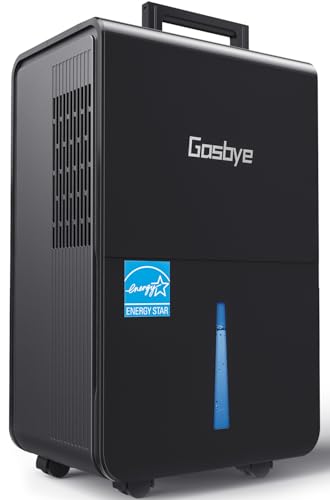
The large-room group includes Gasbye DryPrime, Wellsle, HBN, KNKA Energy Star 5500 Sq. Ft., and DGVAM. Their listings describe coverage from 4,500 to 5,500 square feet, with maximum daily removal from 80 to 115 pints. Those specifications are most relevant to open layouts, multiple connected rooms, or homes where moisture enters from a basement or other area.
For a more typical living room, the 34-pint Glowells and KNKA models provide a more moderate specification profile. Both document coverage up to 2,500 square feet, adjustable humidity, multiple modes, and hose drainage. The 21-pint HUMILABS and GoGuess models state coverage up to 1,600 square feet and may be easier to place when floor space is limited.
Frigidaire sits between those groups with a listed 50-pint size and custom humidity control. Its supplied listing does not state room coverage, so buyers should confirm the intended area before choosing it for a large open layout.
Consider compressor design and noise
Compressor models generally appear better suited to the larger room coverage claims in this pool, although the published figures should still be compared carefully.
Noise matters in a living room because the unit may run while people talk, watch television, work, or relax. Glowells lists operation below 36 dB, while KNKA 34-Pint lists 37 dB and GoGuess lists 40 dB. DGVAM also lists 40 dB, and Gasbye lists around 45 dB. Wellsle, HBN, and Frigidaire do not provide comparable operating-noise figures in the supplied evidence, so their noise characteristics cannot be ranked as confidently here.
Sleep mode is documented on KNKA 34-Pint, HUMILABS, GoGuess, and several other selected products. This can turn off display lighting or reduce operation, but the feature should not be treated as a measured promise of silent operation.
Decide how you will drain water
Drainage is one of the most important practical differences among the best living room dehumidifiers. Manual tanks work where a drain is unavailable, but they require regular emptying. Automatic shutoff or a full-tank alert is documented across many selections and helps prevent continued operation after the container fills.
Continuous drainage is better for damp spaces or unattended use when the unit can sit near a floor drain or sink. Wellsle includes a 3.28-foot hose, Glowells 34-Pint includes a 6.56-foot hose, and HBN and KNKA Energy Star 5500 Sq. Ft. also document included hoses. Gasbye adds a threaded outlet for a standard 3/4-inch garden hose, giving it more installation flexibility than a simple bucket-only setup.
Check the route before purchase. The listings generally recommend keeping a hose angled downward to prevent backflow. A hose does not create drainage by itself; the destination must be suitable and positioned below the outlet.
Look for useful humidity controls
Basic on-and-off operation is less flexible than a unit with a target humidity setting. Glowells 34-Pint, KNKA 34-Pint, GoGuess, and Frigidaire document customizable humidity control. Glowells and GoGuess state ranges from 30% to 80%, while the KNKA model provides the same broad adjustment range. Gasbye automatically cycles around the selected target, and Wellsle provides a DEHU mode with a stated 30% to 80% range.
Modes can also affect daily convenience. Dry or Dry Clothes modes are documented on Glowells, HBN, KNKA, HUMILABS, and GoGuess. Continuous modes are useful for unusually damp conditions but are generally best paired with a hose, since the tank can fill while the unit keeps running. Timers are listed on several models, including Wellsle, Glowells, HBN, KNKA, and HUMILABS.
Check mobility and maintenance details
Large compressor units can be heavy, so casters and handles are valuable. Gasbye, Wellsle, HBN, DGVAM, and both KNKA models document wheels or casters and a handle. HUMILABS and GoGuess also include mobility features. These details matter when the dehumidifier must move between a living room and another room, but wheels do not eliminate the need to lift the unit over thresholds or stairs.
Washable or reusable filters can reduce the need for replacement-filter purchases. Wellsle, HBN, Gasbye, DGVAM, Frigidaire, KNKA Energy Star 5500 Sq. Ft., KNKA 34-Pint, and HUMILABS document washable, reusable, or easy-to-clean filter features. Maintenance still involves cleaning the filter and water container according to the manufacturer’s directions.
Final recommendation
Gasbye DryPrime 4500 Sq. Ft. Dehumidifier ranks first overall in this specification-based comparison under the published weighted criteria.
Gasbye DryPrime is the highest-scoring returned product and the first overall specification-based choice among the best living room dehumidifiers. Its broad coverage, listed moisture capacity, Energy Star certification, automatic humidity cycling, and three drainage options make it the most complete fit for a large or open living area.
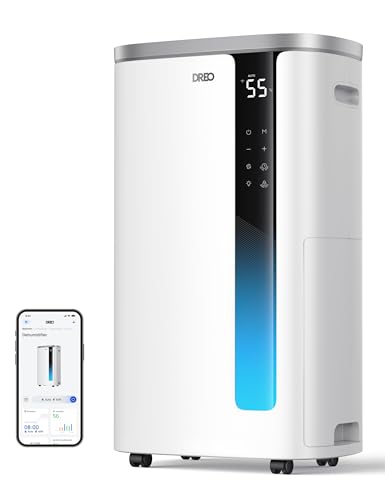
For a slightly smaller target area, Glowells 34-Pint and KNKA 34-Pint provide a better-balanced format with adjustable humidity, hose drainage, mobility, and low listed noise. Choose HUMILABS or GoGuess when a smaller footprint and moderate coverage matter more than maximum capacity. Buyers seeking connected control should consider Frigidaire, while Wellsle, HBN, KNKA Energy Star 5500 Sq. Ft., and DGVAM are more appropriate when the room or connected area is especially large.
The top living room dehumidifiers are not interchangeable: compare the stated coverage, tank and hose arrangement, noise specification, and available controls with the room’s layout before selecting one.
Frequently Asked Questions
What capacity should I choose for a living room?
Use the documented coverage as a starting point, then consider whether the living room is open to other rooms or affected by basement moisture. The HUMILABS and GoGuess models list up to 1,600 square feet, while Glowells 34-Pint and KNKA 34-Pint list up to 2,500 square feet. Gasbye, Wellsle, HBN, and DGVAM list much broader coverage for large connected spaces. These figures come from product listings and may depend on test conditions.
Are compressor dehumidifiers suitable for living rooms?
The selected products are compressor-based models with room-appropriate control and drainage features. Compressor designs are represented across the capacity range, from the 21-pint HUMILABS and GoGuess to the larger Gasbye and Wellsle units. Suitability still depends on placement, clearance, drainage, and the room’s moisture load. Keep doors and windows closed during operation when the product listing recommends it.
Which of the best living room dehumidifiers has the quietest listed specification?
Glowells 34-Pint lists operation below 36 dB. KNKA 34-Pint and HUMILABS list 37 dB, while GoGuess and DGVAM list 40 dB. Gasbye lists around 45 dB. These are published specifications rather than independent measurements, so room acoustics, fan speed, and operating mode may affect the sound you hear.
Is a drain hose better than a water tank?
A hose is more convenient when the unit can sit near an appropriate floor drain or sink. It can reduce manual emptying during continuous operation. A tank remains useful where no suitable drain is available, and many selected models pair the tank with an automatic shutoff or full indicator. Before using a hose, confirm that it slopes downward and that the connection is secure.
What maintenance does a living-room unit need?
The selected products commonly document washable or reusable filters, removable tanks, or both. Clean the filter and tank as directed, keep air inlets and outlets clear, and inspect the drain hose for kinks or backflow. Wheels and handles make relocation easier, but the unit should remain upright during use. Follow the product’s setup instructions before first operation.