Buying Guide
Choosing among the best kitchen dehumidifiers starts with the kitchen’s size, moisture load, ventilation, and available drainage. A compact thermoelectric model can fit on a shelf or in a small utility area, while a larger unit is more appropriate when cooking moisture spreads into an open-plan room, basement, or adjoining hallway. The figures here come from public product listings rather than hands-on testing.
Match capacity to the room
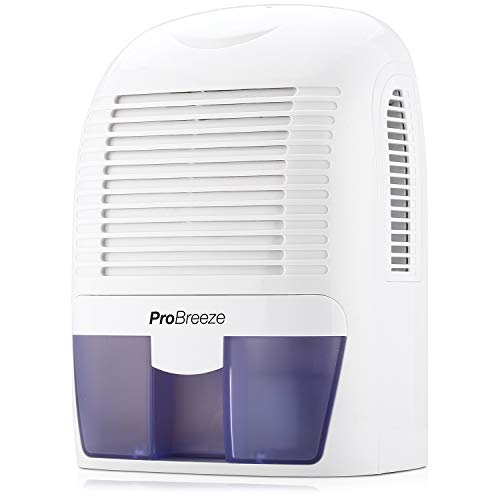
Coverage claims vary substantially. The compact Pro Breeze model lists up to 250 square feet, while Erizolt lists up to 350 square feet. MORFY lists up to 600 square feet, Levoair up to 650 square feet, and the Lonxfy 88-ounce model up to 850 square feet. NineSky and ToLife each list up to 1,000 square feet. Treat these figures as manufacturer-stated guidance rather than a guarantee for every kitchen layout or climate.
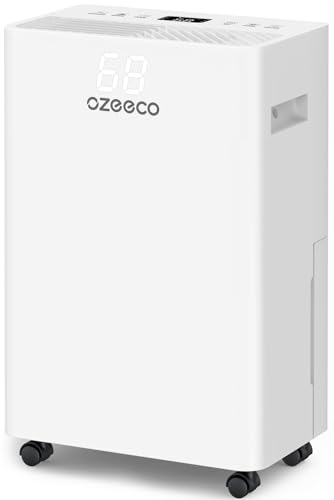
For larger spaces, Midea lists 22 pints per day and 1,500 square feet, while ozeeco lists up to 34 pints per day and 2,500 square feet under stated test conditions. Those options are more suitable when moisture is not limited to a small enclosed kitchen. They also take more floor space and weigh more than the mini models.
Consider thermoelectric versus larger units
Most compact selections use semiconductor or Peltier technology. That design is documented in the Pro Breeze, ToLife, MORFY, BREEZOME, Levoair, NineSky, and Erizolt listings. It supports compact bodies and quiet operation, but the listed coverage and removal figures are generally aimed at small or medium rooms. MORFY and BREEZOME specifically describe dual-semiconductor condensers.
Midea is the clearest full-size alternative in this selection. Its listing describes a 22-pint unit with adjustable humidity control, turbo mode, and ENERGY STAR certification. ozeeco describes a 34-pint model with dehumidify, dry, and sleep modes. Consider these designs when a kitchen opens into a large area or when moisture needs exceed what a compact appliance is designed to handle.
Tank size and drainage
A larger tank can reduce how often you need to empty the appliance, but tank size alone does not determine runtime. The selected compact models range from Pro Breeze’s 52-ounce tank to the 95-ounce tanks listed for NineSky and ToLife. Lonxfy lists an 88-ounce tank, while MORFY lists 2,100 ml.
Continuous drainage is useful near a floor drain or sink. Midea accepts a standard hose, ozeeco provides a drain hose, Lonxfy includes a hose, and Levoair documents a five-foot hose. MORFY also lists a hose option. Confirm that a hose can run downward without kinks and that the unit can remain level. If no hose option is documented, plan for manual emptying.
Automation and safety features
Automatic shutoff is common across this group and is useful when the tank becomes full. Several listings also describe a red light or other indicator. Midea adds auto restart after a power interruption, while ozeeco includes a child lock.
Timers can help limit operation during particular cooking or drying periods. BREEZOME lists four timer settings, Lonxfy lists 8-, 12-, and 24-hour settings, and ozeeco provides a 1-to-24-hour timer. Some compact models also offer sleep, normal, performance, or powerful modes. These are convenience features; the listings do not establish identical moisture performance across modes.
Noise, placement, and maintenance
Noise specifications are useful when the kitchen is near a dining, work, or sleeping area. Erizolt lists approximately 25 dB, ToLife below 30 dB in sleep mode, BREEZOME 35 dB, Levoair below 40 dB, and Midea 47 dBA. The absence of a numeric noise figure, as with NineSky, limits direct comparison.
Keep air inlets and outlets clear. Pro Breeze recommends clearing dust from intake valves, and ozeeco documents a washable filter. A visible tank window, offered by Erizolt, can make routine checking easier. Handled designs from Levoair, NineSky, ToLife, and MORFY can simplify repositioning, while Midea’s wheels support movement despite its larger body.
How this comparison was scored
The editorial ranking uses five category-specific criteria: moisture removal and coverage, tank capacity and drainage, controls and automation, noise and energy features, and portability and maintenance. Scores reflect supplied technical specifications and feature descriptions only. No customer sentiment, popularity data, marketplace labels, or hands-on measurements were used in the published scores.
Final recommendation
Midea 22 Pint Wi-Fi Dehumidifier ranks first overall in this specification-based comparison.
Midea 22 Pint Wi-Fi Dehumidifier is the first overall specification-based choice among these best kitchen dehumidifiers. Its combination of 22-pint removal, 1,500-square-foot coverage, adjustable humidity control, smart-home compatibility, hose drainage, wheels, auto defrost, and auto restart makes it a strong fit for a large or open kitchen based on the supplied specifications.
For the highest stated capacity, choose ozeeco. For a compact unit with flexible drainage, consider the Lonxfy 88-ounce model or Levoair. ToLife and NineSky are suitable when a large tank and quiet operation matter, while Erizolt is the noise-focused compact option by its listed figure. These top kitchen dehumidifiers serve different room sizes, so coverage and drainage should guide the final choice more than appearance or lighting features.
Frequently Asked Questions
Are compact thermoelectric units suitable for kitchens?
They can suit smaller enclosed kitchens or nearby utility spaces when the documented coverage is sufficient. Pro Breeze, Erizolt, and BREEZOME list compact coverage or small-room use, while MORFY and Levoair list broader compact coverage. A large open-plan kitchen may call for Midea or ozeeco instead.
Is a large tank better than a drain hose?
They solve different problems. A large tank, such as the 95-ounce tanks listed by NineSky and ToLife, can reduce manual emptying. A hose connection, documented for Midea, ozeeco, Lonxfy, Levoair, and MORFY, can support continuous drainage when a suitable drain is available.
Which best kitchen dehumidifiers have the clearest noise specifications?
Erizolt lists approximately 25 dB, ToLife lists below 30 dB in sleep mode, BREEZOME lists 35 dB, Levoair lists below 40 dB, and Midea lists 47 dBA. These published figures use different product descriptions and should not be treated as laboratory-equivalent measurements.
What maintenance should I plan for?
Empty the tank when required, keep air openings clear, and follow the manufacturer’s cleaning instructions. Pro Breeze advises clearing dust from intake valves, while ozeeco documents a washable filter. Auto defrost can help with frost management on models that include it, but it does not eliminate routine care.
Do all models support continuous drainage?
No. The supplied listings specifically document hose drainage for Midea, ozeeco, Lonxfy’s 88-ounce model, Levoair, and MORFY. For the other selected products, the evidence supports tank-based emptying and automatic shutoff but does not establish a continuous-drain connection.