Buying Guide
The best ball mount towing hitch receivers are not interchangeable simply because they fit the same receiver opening. A suitable match depends on the receiver size, trailer coupler, ball diameter, shank hole, height relationship, and the lowest capacity in the complete towing system. The products in this comparison are all documented for standard 2-inch receiver applications, but their designs differ substantially.
Confirm the receiver size
Start with the vehicle-side receiver. Every selected product here lists compatibility with a 2-inch receiver, generally described as a 2-inch by 2-inch receiver tube. That does not mean each mount suits a smaller receiver. The CURT 45134, CURT 45360, Nilight 92137B, and VEVOR adjustable mount all state a 2-inch receiver fit in their supplied evidence.
A compatible shank should slide into the receiver without forcing. Check the pin-hole size and the required pin before installation. Some listings include a pin and clip, such as the CURT 45134 and Nilight 92137B, while the CURT 45370 listing states that its hitch pin is sold separately. Included hardware should not be assumed across the category.
Match the ball to the coupler
Ball diameter is a critical compatibility check. The CURT 45134 uses a welded 2-inch ball, while the CURT 45370 uses a 2-5/16-inch ball. Multi-ball designs address multiple couplers: the TOPTOW mount lists 1-7/8-inch, 2-inch, and 2-5/16-inch balls, and the CURT 45002 provides 2-inch and 2-5/16-inch balls.
A multi-ball mount can reduce the need to change the mount when the trailer changes, but each ball position has its own listed capacity. TOPTOW documents 2,000 pounds for its 1-7/8-inch ball, 6,000 pounds for the 2-inch ball, and 10,000 pounds for the 2-5/16-inch ball. Always use the capacity for the ball actually coupled to the trailer.
Some fixed mounts accept a separate ball instead of including one. The Buyers Products 1803051 is designed for a 1-1/4-inch ball shank, while its feature text specifically identifies a 1.25-inch shank. This is why the ball, hole, and shank specifications should be checked together.
Choose the right height arrangement
The mount should position the trailer as level as practical for the vehicle and load. Fixed mounts are simple but offer limited geometry. The CURT 45134 and CURT 45370 document a 2-inch drop and 6-inch drop respectively. The Nilight 92137B provides a 6-inch drop and 4-3/4-inch rise, while the CURT 45360 reverses for a 2-inch drop or 1-inch rise.
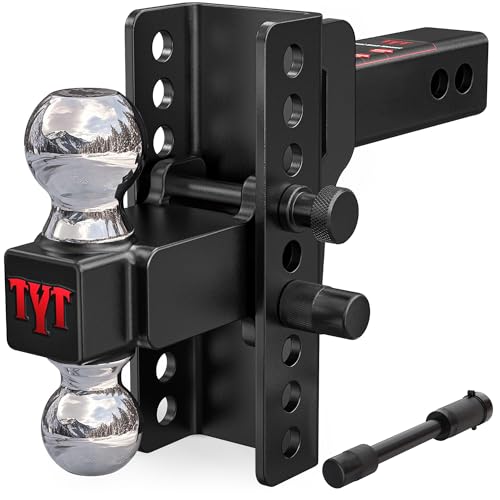
Adjustable designs offer more positions when one vehicle pulls trailers with different coupler heights. The MaxxHaul 70067 documents eight positions, including 5-, 7-, 9-, and 11-inch drops and 4-, 6-, 8-, and 10-inch rises. The VEVOR mount documents six holes and up to a 9.5-inch drop. The Koerdo mount documents a 6-inch drop and rise with 1-inch increments.
More adjustment can help with fit, but it also adds hardware and weight. Inspect the adjustment points, use the correct pins, and secure every removable component according to the manufacturer’s instructions. Do not select a height solely from the product title; measure the vehicle receiver and trailer coupler relationship.
Compare construction and finish
Construction details help distinguish the designs. The CURT 45370 and Buyers Products 1803051 use solid forged steel, while the CURT 45360 uses solid aluminum. The CURT 45134 is a welded one-piece design. Adjustable products such as the VEVOR, MaxxHaul, and Koerdo mounts use multiple components to provide height changes.
Finishes vary but commonly include black powder coating, chrome-plated balls, zinc-plated pins, or e-coating. These finishes are described as helping resist corrosion from outdoor exposure. They do not remove the need to inspect the mount, ball, pin, and receiver for wear, damage, or corrosion before use.
Read capacity by component
Gross trailer weight and tongue weight are separate figures. The CURT 45134 lists 7,500 pounds gross trailer weight and 750 pounds tongue weight. The CURT 45370 lists 15,000 and 1,500 respectively. Buyers Products documents a 20,000-pound maximum gross trailer weight, while MaxxHaul lists 5,000 pounds and 500 pounds.
Use the lowest-capacity component in the towing system, including the vehicle, receiver, mount, ball, coupler, and related hardware. A high mount capacity cannot increase the vehicle’s permitted towing limit. Capacity may also vary by ball size or configuration, as shown by the TOPTOW and Koerdo listings.
Fixed, adjustable, or multi-ball?
Choose a fixed mount when one trailer and one height relationship are the main use case. It generally has fewer adjustment parts and may include a pre-attached ball and pin. Choose an adjustable mount when trailer heights vary or when a rise and drop range is important. Choose a multi-ball mount when different trailers use different coupler sizes.
The right choice among the best ball mount towing hitch receivers is therefore a compatibility decision, not simply a capacity comparison. Confirm the exact coupler, height, ball shank, receiver, and load limits before selecting a design.
Final recommendation
Koerdo Adjustable Dual-Ball Hitch ranks first overall in this specification-based comparison under the published weighted criteria.
The final choice among the best ball mount towing hitch receivers depends on the documented features that match your intended use.
Among the top ball mount towing hitch receivers, the selected products differ under documented capacity, receiver and ball compatibility, trailer-leveling range, construction and finish, and connection versatility. Koerdo combines dual balls, a 6-inch drop and rise, 1-inch adjustment increments, solid bar-stock construction, and documented anti-rattle measures.
For higher documented capacity, the Buyers Products 1803051 and CURT 45370 stand out, though they serve different setups: Buyers Products is designed around a 1-1/4-inch ball shank, while CURT 45370 uses a 2-5/16-inch ball and 6-inch drop. The Koerdo and VEVOR mounts are suited to users who need height adjustment, with Koerdo adding dual-ball flexibility.
TOPTOW is the most flexible selected design for three common coupler sizes, while CURT 45002 provides a simpler two-ball arrangement. CURT 45134 and Nilight 92137B are straightforward fixed configurations with documented hardware and capacity details. CURT 45360 adds solid aluminum construction and a reversible drop or rise. Before towing, verify that the selected ball size, height, pin, and capacities match the complete vehicle and trailer combination.
Frequently Asked Questions
What should I check before choosing the best ball mount towing hitch receivers?
Check the vehicle receiver size, the trailer coupler diameter, the required ball-shank size, the needed rise or drop, and both gross trailer weight and tongue weight limits. The mount must not exceed the vehicle or receiver limits.
Are adjustable ball mounts better than fixed mounts?
They are more adaptable when trailer heights vary. The MaxxHaul 70067, VEVOR adjustable mount, and Koerdo mount document multiple rise or drop positions. A fixed mount may be more suitable when one trailer height is already known and no adjustment is needed.
Which selected mounts support multiple ball sizes?
TOPTOW documents 1-7/8-inch, 2-inch, and 2-5/16-inch balls. CURT 45002 documents 2-inch and 2-5/16-inch balls, and Koerdo documents 2-inch and 2-5/16-inch dual balls. Match the selected ball’s capacity to the trailer.
Does a 2-inch receiver mean every ball mount is interchangeable?
No. A common receiver size does not guarantee matching ball diameter, shank hole, rise or drop, pin requirements, or capacity. For example, CURT 45370 and CURT 45134 both fit 2-inch receivers but use different fixed ball and drop configurations.
How should capacity be interpreted?
Treat gross trailer weight and tongue weight as separate limits, then follow the lowest capacity among the vehicle, receiver, mount, ball, coupler, and hardware. Some multi-ball products specify different capacities for each ball size.