Buying Guide
Choosing the best heavy-duty towing hitch receivers starts with matching the receiver opening and trailer connection, not simply selecting the largest capacity figure. The products here include receiver-mounted adjustable ball mounts and a vehicle-specific receiver assembly, so they do not all install or function in the same way. Confirm the vehicle manufacturer’s towing limits and use the lowest-capacity component in the complete towing system.
Match the receiver size
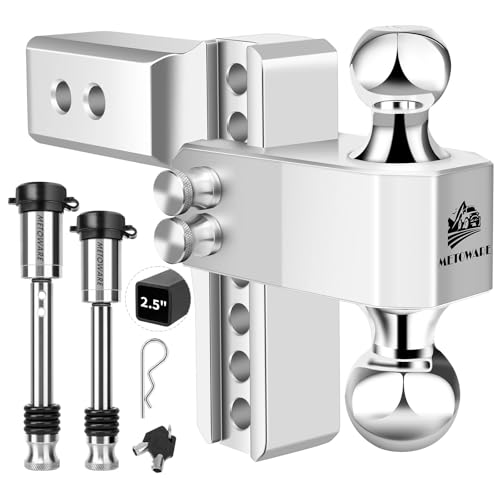
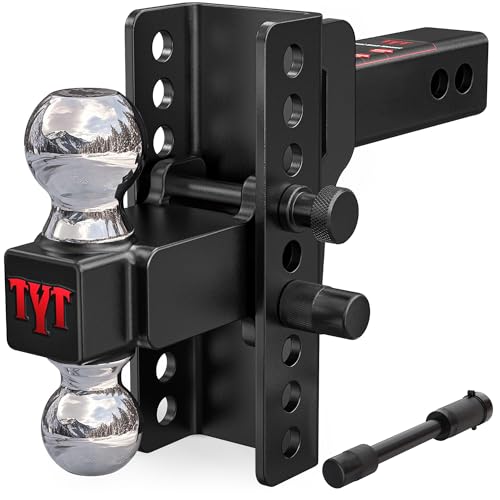
The first distinction is receiver size. The TYT 2.5-Inch Adjustable Dual-Ball Hitch and METOWARE 2.5-Inch Aluminum Adjustable Hitch are designed for 2.5-inch receiver trucks. The other adjustable ball mounts in this selection use standard 2-inch receivers. A 2.5-inch shank should not be treated as interchangeable with a 2-inch receiver, and a smaller receiver does not become a heavy-duty platform merely because the mounted product has a high advertised capacity.
Vehicle-specific receivers require a separate fitment check. The CURT 14301 Class 4 Trailer Hitch is made for select Chevrolet Silverado and GMC Sierra applications, while the other selected products are described around receiver dimensions rather than one vehicle model. Check the vehicle year, trim, bumper configuration, and existing hitch before ordering. The receiver opening, pin-hole position, bumper clearance, and installation requirements all matter.
Compare capacity correctly
A capacity figure applies to a particular configuration. The Koerdo 6-Inch Adjustable Dual-Ball Hitch gives separate figures for its 2-inch and 2-5/16-inch balls, and the Rhino USA Adjustable 6-Inch Hitch does the same. The TYT 2.5-Inch Adjustable Dual-Ball Hitch is listed for up to 22,000 pounds, while the PSAUTO Adjustable Gooseneck Drawbar Hitch and Vullteeon 8-Inch Adjustable Dual-Ball Hitch are listed at 20,000 pounds. Compare these figures with the trailer’s gross weight and the vehicle’s towing limit.
Tongue weight is also important. The supplied evidence does not provide a tongue-weight figure for every selected mount, so consult the complete product documentation before towing. The CURT 14301 Class 4 Trailer Hitch specifically documents a 1,000-pound tongue-weight figure for its standard configuration.
Weight-distribution use is another separate consideration. The CURT 14301 Class 4 Trailer Hitch specifically lists compatibility with a weight-distribution hitch and gives a 12,000-pound weight-distribution gross trailer weight capacity. That detail is not stated for every adjustable ball mount in this comparison. Do not infer weight-distribution compatibility from a standard ball-mount capacity.
Choose the right height adjustment
A level trailer connection generally requires the ball height to correspond to the vehicle and trailer geometry. Adjustable products help when one vehicle tows trailers with different coupler heights. The Vullteeon 8-Inch Adjustable Dual-Ball Hitch provides an 8-inch drop/rise range, the OPENROAD 9.5-Inch Adjustable Ball Mount provides a 9.5-inch drop or 8.25-inch rise, and the TYT 2.5-Inch Adjustable Dual-Ball Hitch, Koerdo 6-Inch Adjustable Dual-Ball Hitch, PSAUTO Adjustable Gooseneck Drawbar Hitch, and METOWARE 2.5-Inch Aluminum Adjustable Hitch document 6-inch adjustment ranges.
More adjustment is not automatically better. A deep-drop product may place the ball farther from the receiver and can add clearance or positioning considerations. Measure the receiver height, coupler height, and desired ball position on level ground. Then check the mount’s usable drop or rise direction and the manufacturer’s load limits for that configuration.
Fixed and reversible designs can be simpler. The Orion Motor Tech 6-Inch Reversible Ball Mount reverses from a 6-inch drop to a 4.75-inch rise, while the CURT 14301 Class 4 Trailer Hitch is a vehicle-specific receiver with no documented rise or drop adjustment. A fixed receiver may be appropriate when the vehicle and trailer combination is already known, whereas an adjustable ball mount is more adaptable across trailer heights.
Evaluate ball compatibility
Ball size must match the trailer coupler. Dual-ball products such as the TYT 2.5-Inch Adjustable Dual-Ball Hitch, Koerdo 6-Inch Adjustable Dual-Ball Hitch, PSAUTO Adjustable Gooseneck Drawbar Hitch, METOWARE 2.5-Inch Aluminum Adjustable Hitch, Vullteeon 8-Inch Adjustable Dual-Ball Hitch, and Rhino USA Adjustable 6-Inch Hitch reduce the need to change the entire mount when switching between the two documented coupler sizes. The TYT Adjustable Tri-Ball Hitch with Tow Hook adds a 1-7/8-inch ball to its 2-inch and 2-5/16-inch options, giving it the broadest stated ball coverage here.
The tri-ball design also includes a tow hook and swivel D-ring shackle. That can be useful for buyers who need the documented recovery-related functions in addition to trailer coupling, but those features do not increase the trailer capacity. The Orion Motor Tech 6-Inch Reversible Ball Mount is more specialized around a pre-assembled 2-inch ball and includes a pin and clip.
Evaluate construction and finish
Construction descriptions vary. The TYT 2.5-Inch Adjustable Dual-Ball Hitch uses heavy-duty steel; the Koerdo 6-Inch Adjustable Dual-Ball Hitch describes solid bar stock; the PSAUTO Adjustable Gooseneck Drawbar Hitch states 100% steel; and the Vullteeon 8-Inch Adjustable Dual-Ball Hitch describes solid steel. The METOWARE 2.5-Inch Aluminum Adjustable Hitch uses aluminum with an oxide finish. The CURT 14301 Class 4 Trailer Hitch uses vehicle-specific welded construction, while the OPENROAD 9.5-Inch Adjustable Ball Mount and Orion Motor Tech 6-Inch Reversible Ball Mount describe steel construction.
Finish information is useful but should be read precisely. Powder coating, zinc plating, oxide treatment, and chrome plating are described as corrosion protection on various products. These finishes may help resist exposure, but they do not remove the need to inspect the mount, balls, pins, and receiver for damage, corrosion, or looseness. Follow the supplied installation and torque instructions, and confirm that locking hardware is fully engaged.
Consider included hardware and fit security
Included hardware differs across the products. The TYT 2.5-Inch Adjustable Dual-Ball Hitch includes two locking hitch pins, while the METOWARE 2.5-Inch Aluminum Adjustable Hitch includes two sets of stainless-steel locks. The PSAUTO Adjustable Gooseneck Drawbar Hitch and Vullteeon 8-Inch Adjustable Dual-Ball Hitch describe anti-rattle pads, and the Orion Motor Tech 6-Inch Reversible Ball Mount includes a pin and clip. Hardware can simplify installation, but the hitch still needs the correct receiver pin and secure ball connection for the application.
Anti-rattle components address movement or noise at the receiver interface; they should not be interpreted as an increase in towing capacity. The Koerdo 6-Inch Adjustable Dual-Ball Hitch, PSAUTO Adjustable Gooseneck Drawbar Hitch, and Vullteeon 8-Inch Adjustable Dual-Ball Hitch describe multiple pads, washers, or adjustment measures for this purpose. Inspect the connection after installation and before each towing session.
Final recommendation
TYT 2.5-Inch Adjustable Dual-Ball Hitch ranks first overall in this specification-based comparison under the published weighted criteria.
The TYT 2.5-Inch Adjustable Dual-Ball Hitch is the first overall specification-based choice in this comparison.
Among the best heavy-duty towing hitch receivers, it combines a 22,000-pound product capacity, 2.5-inch receiver fit, dual balls, 6-inch drop/rise range, steel construction, corrosion-resistant finish, and included locking pins. For a standard 2-inch receiver, the Koerdo 6-Inch Adjustable Dual-Ball Hitch and PSAUTO Adjustable Gooseneck Drawbar Hitch are capacity-focused alternatives, while the Vullteeon 8-Inch Adjustable Dual-Ball Hitch is a better match when an 8-inch adjustment range is important. The CURT 14301 Class 4 Trailer Hitch is the most application-specific option because it documents fitment for select Silverado and Sierra vehicles and includes weight-distribution capacities. Among the top heavy-duty towing hitch receivers, the right choice still depends on receiver size, vehicle fit, ball size, trailer height, and the lowest capacity in the system.
Frequently Asked Questions
Are 2-inch and 2.5-inch receivers interchangeable among the best heavy-duty towing hitch receivers?
No. Receiver opening size is a fundamental fit requirement. The TYT 2.5-Inch Adjustable Dual-Ball Hitch and METOWARE 2.5-Inch Aluminum Adjustable Hitch are for 2.5-inch receivers, while the Koerdo 6-Inch Adjustable Dual-Ball Hitch, Vullteeon 8-Inch Adjustable Dual-Ball Hitch, and other selected standard designs are for 2-inch receivers. Verify the vehicle’s receiver size before selecting a mount.
How much drop or rise do I need?
Measure the vehicle receiver height and trailer coupler height with both on level ground, then select a mount that provides the required direction and range. The Vullteeon 8-Inch Adjustable Dual-Ball Hitch provides an 8-inch drop/rise range, the OPENROAD 9.5-Inch Adjustable Ball Mount provides a 9.5-inch drop and 8.25-inch rise, and the Orion Motor Tech 6-Inch Reversible Ball Mount provides a 6-inch drop with a 4.75-inch rise. Do not estimate from vehicle type alone.
Does a dual-ball hitch fit every trailer?
No. A dual-ball hitch covers the two ball sizes supplied or documented for that product, but the chosen ball must match the trailer coupler. The TYT Adjustable Tri-Ball Hitch with Tow Hook adds a 1-7/8-inch option, while the TYT 2.5-Inch Adjustable Dual-Ball Hitch and METOWARE 2.5-Inch Aluminum Adjustable Hitch document 2-inch and 2-5/16-inch balls. Confirm the coupler size and the applicable capacity for that ball.
What is the difference between a vehicle-specific receiver and an adjustable ball mount?
A vehicle-specific receiver, such as the CURT 14301 Class 4 Trailer Hitch, is an assembly designed to attach to particular vehicle applications. An adjustable ball mount, such as the Koerdo 6-Inch Adjustable Dual-Ball Hitch or Vullteeon 8-Inch Adjustable Dual-Ball Hitch, fits an existing receiver and changes the ball position or height. They solve different fitment problems and should not be substituted for one another.
What should I check before towing?
Confirm receiver and ball compatibility, trailer and vehicle capacities, tongue weight, pin and lock engagement, ball attachment, clearance, and the required rise or drop. Inspect for visible damage or corrosion and follow the product’s installation instructions. The capacities in this guide are specification-based figures, not a substitute for the vehicle, trailer, or hitch manufacturer’s instructions.