Buying Guide
Selecting the best adjustable towing ball mounts is mainly a fit-and-specification exercise. Start with the receiver opening on the vehicle, then compare the trailer coupler’s ball size, the height difference between the vehicle and trailer, and the lowest capacity limit in the towing system. A mount that fits the receiver but uses the wrong ball size or cannot level the trailer is not an appropriate match.
This comparison uses public product data. It is not a hands-on test, and the scores describe documented specifications rather than observed towing behavior.
Confirm the receiver size
Receiver size is the first screening step. Most of the selected products fit a standard 2-inch square receiver, including the CURT 45935, TYT tri-ball, Nilight tri-ball, XaXmTee, Onsski, VEVOR 2-Inch Adjustable Ball Mount, CURT 45900, and MAXXHAUL 70067. The B&W Tow & Stow TS20037B and the VEVOR 2.5-Inch Adjustable Hitch require a 2.5-inch receiver.
That distinction matters because a 2.5-inch mount is not a direct substitute for a 2-inch mount. Verify the receiver opening rather than relying on the vehicle’s general towing category. The shank dimensions, pin position, and clearance around the bumper also deserve attention during final fitment.
Match the ball size to the coupler
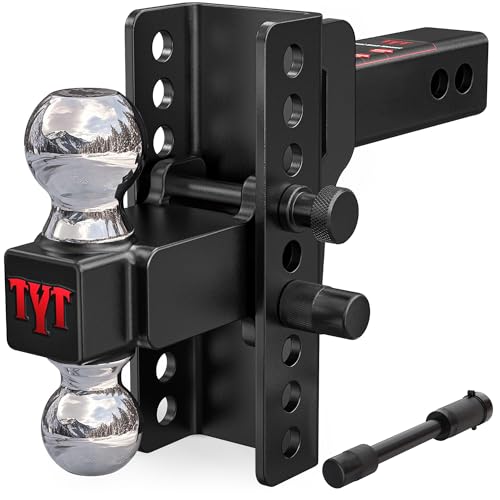
The trailer coupler must match the ball mounted on the hitch. Dual-ball designs such as the CURT 45935, CURT 45900, XaXmTee, Onsski, B&W Tow & Stow TS20037B, and VEVOR 2.5-Inch Adjustable Hitch offer two ball sizes. This can be useful when one vehicle is used with trailers that have different couplers.
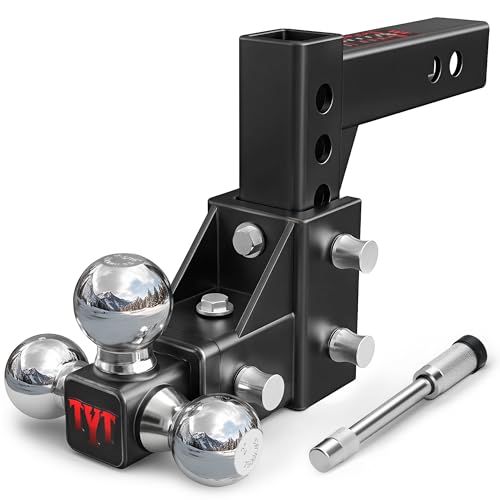
Tri-ball designs provide an additional 1-7/8-inch option. The TYT tri-ball and Nilight tri-ball list 1-7/8-inch, 2-inch, and 2-5/16-inch balls in one mount. That broader selection does not remove the need to verify the coupler specification; it only gives the mount more documented ball options.
The VEVOR 2-Inch Adjustable Ball Mount includes a 2-inch ball. The MAXXHAUL 70067 instead lists a 1-inch ball hole, so the appropriate tow ball must be selected separately according to the trailer and mount requirements.
Calculate the needed drop or rise
Measure the receiver height and the trailer-coupler height on level ground, using the intended loaded configuration where applicable. The difference indicates whether drop or rise is needed. Adjustable designs then allow the ball position to be moved to better align the trailer.
The MAXXHAUL 70067 documents four drop positions from 5 to 11 inches and four rise positions from 4 to 10 inches. The Nilight tri-ball offers an 8-inch drop/rise range, while the VEVOR 2-Inch Adjustable Ball Mount documents up to 9.5 inches of drop. These longer ranges are useful when the vehicle and trailer heights vary substantially, but the actual available position must still be checked against clearance and coupler height.
The XaXmTee adjusts in 1-inch increments across a 6-inch range, which provides finer documented positioning than designs that move in 2-inch increments. The Nilight tri-ball adjusts in 2-inch increments. The CURT 45935, CURT 45900, TYT tri-ball, and Onsski provide shorter documented ranges, so compare their stated limits with your measurements before choosing.
Compare capacity limits carefully
Use the lowest applicable limit among the vehicle, receiver, ball mount, ball, hitch ball, coupler, and trailer. Several selected products publish separate gross trailer weight and tongue-weight figures. For example, the TYT tri-ball lists 10,000 pounds GTW and 1,000 pounds tongue weight, while the Nilight tri-ball lists different GTW figures for each ball size.
The B&W Tow & Stow TS20037B lists an 18,000-pound GTW capacity. The VEVOR 2.5-Inch Adjustable Hitch lists 20,000 pounds for its 2-inch ball and 28,000 pounds for its 2-5/16-inch ball. Those figures do not mean every vehicle or receiver can tow at that level. They are product specifications that must be considered alongside the complete towing system.
The MAXXHAUL 70067 is listed at 5,000 pounds GTW and 500 pounds tongue weight. The VEVOR 2-Inch Adjustable Ball Mount lists 7,500 pounds GTW, while the CURT 45935 reaches 15,000 pounds with its 2-5/16-inch ball. Choose based on the required specification, not simply the largest number.
Consider ball changes and connection hardware
If you regularly change trailers, an integrated dual-ball or tri-ball mount may reduce the need to remove the complete mount. The B&W Tow & Stow TS20037B also documents a stowable ball assembly. The VEVOR 2-Inch Adjustable Ball Mount includes pins and a pin lock, while the CURT 45935 lists anti-rattle technology and the Onsski includes four hitch silencers.
Security hardware varies. The B&W Tow & Stow TS20037B uses stainless adjustment pins, the XaXmTee lists two anti-theft pin locks, and the TYT tri-ball includes a hitch pin lock and tri-pins. These features secure the mount or reduce movement according to the supplied descriptions, but they do not replace correct installation and inspection.
Review construction and finish details
Steel is documented for the B&W Tow & Stow TS20037B, CURT 45935, TYT tri-ball, Nilight tri-ball, CURT 45900, and MAXXHAUL 70067. The XaXmTee and Onsski product data specify aluminum alloy construction. The VEVOR 2.5-Inch Adjustable Hitch and VEVOR 2-Inch Adjustable Ball Mount specify high-strength carbon steel.
Finish descriptions include powder coating, e-coating, zinc plating, and electro-galvanized treatment. These are useful indicators of the stated corrosion-resistance approach, but the guide does not infer a service life or field result from them. Inspect the mount, pins, ball, and receiver connection before each towing session and follow the manufacturer’s installation instructions.
Final Recommendation
VEVOR 2.5-Inch Adjustable Hitch ranks first overall in this specification-based comparison under the published weighted criteria.
VEVOR 2.5-Inch Adjustable Hitch is the highest-scoring returned product and the first overall specification-based choice.
The final choice among the best adjustable towing ball mounts depends on the documented features that match your intended use.
VEVOR 2.5-Inch Adjustable Hitch ranks first under the published weighted criteria. Its 2.5-inch receiver fit, dual-ball arrangement, nine-hole adjustment, included locking system, and 28,000-pound maximum ball capacity make it a well-documented heavy-duty option when the receiver is compatible.
For a standard 2-inch receiver, the CURT 45935 is a dual-ball alternative with 15,000 pounds of published capacity, while the TYT and Nilight tri-ball mounts suit users who need three coupler sizes. The VEVOR 2-Inch Adjustable Ball Mount emphasizes a long drop range and included hardware. The MAXXHAUL 70067 is the height-range specialist, with eight stated positions and an 11-inch maximum drop.
Among the top adjustable towing ball mounts, the right selection still depends on the receiver opening, measured drop or rise, coupler ball size, and complete system limits. Confirm each detail before installation, tighten every connection as directed, and inspect the setup before towing.
Frequently Asked Questions
Among the best adjustable towing ball mounts, what receiver size do most of these adjustable mounts use?
Most selected models fit a standard 2-inch square receiver. The B&W Tow & Stow TS20037B and VEVOR 2.5-Inch Adjustable Hitch are exceptions and require a 2.5-inch receiver. Check the vehicle receiver specification before selecting a mount.
How do I choose between a dual-ball and tri-ball mount?
Choose a dual-ball mount when your trailers use 2-inch and 2-5/16-inch couplers. Choose a tri-ball mount when you also need a 1-7/8-inch coupler option. The TYT and Nilight tri-ball models document all three sizes, while the CURT 45935 and CURT 45900 document two sizes.
Is a longer drop range always better?
No. A longer range is useful only if it covers the measured height difference and still provides suitable clearance. The MAXXHAUL 70067 lists an 11-inch maximum drop, and the VEVOR 2-Inch Adjustable Ball Mount lists up to 9.5 inches, but the correct position depends on the specific vehicle and trailer combination.
Does the stated GTW capacity determine the towing limit?
No. The complete system is limited by its lowest applicable limit, including the vehicle, receiver, hitch ball, mount, coupler, and trailer. Treat each product’s GTW and tongue-weight figures as component specifications, then confirm the vehicle and receiver limits.
What should I inspect before towing?
Verify receiver fit, pin engagement, ball tightness, coupler attachment, safety-chain routing, and the selected adjustment position. Look for looseness, damage, or corrosion. Follow the product instructions; several products specifically direct users to check connections before towing.