Buying Guide
The best towing hitch receivers for trucks should be chosen by matching the receiver opening, trailer coupler, height difference, and complete towing-system limits. The ten selected products include 2-inch and 2.5-inch receiver formats, adjustable drop hitches, dual-ball configurations, and one vehicle-specific receiver hitch. This is a specification-based comparison, not a hands-on test.
Start with receiver size
Measure the receiver’s inside opening before choosing a hitch. Koerdo, CAMMOO, Orion Motor Tech OMT, Onsski, CAMPX, and Rhino USA document 2-inch receiver compatibility. CURT 13333 is also a 2-inch receiver product, but its supplied information emphasizes a custom-made fit for specified Dodge and Ram applications.
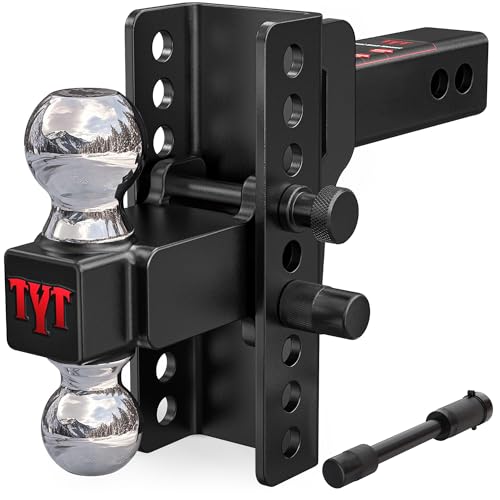
A 2.5-inch receiver is a separate fit. TYT, Fastgo, and Vullteeon are designed for 2.5-inch receivers and are aimed at heavy-duty truck platforms. Do not assume that a hitch for one opening will fit another. Confirm the truck’s receiver dimensions and the hitch’s shank size before installation.
CAMMOO provides especially specific fit-check guidance, including measuring the receiver’s inner size and usable lock-pin length. That detail is useful because the nominal receiver size is only the first check. Also verify pin-hole clearance, shank length, and surrounding space.
Match the ball and towing capacity
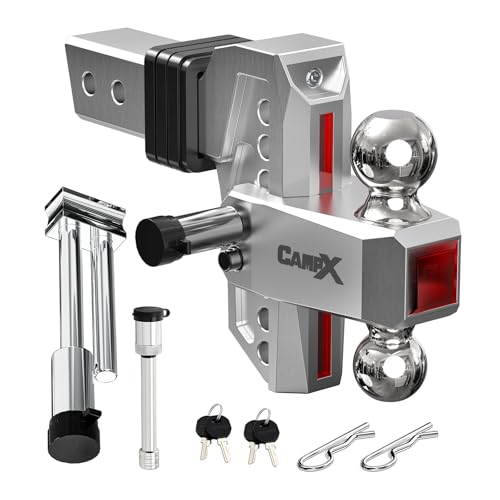
A trailer coupler must match the ball diameter. Koerdo, TYT, CAMMOO, Fastgo, Orion Motor Tech OMT, Onsski, CAMPX, Rhino USA, and Vullteeon document 2-inch and 2-5/16-inch ball options. This dual-ball format can serve trailers with different couplers, but the correct ball still must be selected for each trailer.
Capacity is tied to the selected ball and hitch configuration. Koerdo lists 15,000 pounds for its 2-inch ball and 20,000 pounds for its 2-5/16-inch ball. Onsski lists 8,000 pounds and 12,500 pounds for those sizes. CAMPX lists 14,500 pounds and 18,500 pounds, while Orion Motor Tech OMT lists 8,000 pounds and 12,500 pounds.
Fastgo documents an 18,500-pound gross trailer weight capacity, and Vullteeon states 22,000 pounds. TYT is designed for a 2.5-inch receiver and includes both common ball sizes. These figures must be compared with the truck, receiver, trailer, ball, and hitch limits as a complete system. A hitch capacity does not increase the truck’s tow limit or permit a trailer to exceed its own limit.
CURT 13333 uses a different specification format because it is a receiver hitch rather than a loaded adjustable ball mount. Its supplied information gives a 6,000-pound gross trailer weight capacity, a 600-pound tongue weight capacity, and compatibility with a weight-distribution hitch rated to 10,000 pounds gross trailer weight. Read those figures alongside the vehicle and trailer documentation.
Select the correct drop or rise range
A level trailer connection depends on the relative height of the truck receiver and trailer coupler. Adjustable designs can be installed in a drop or rise orientation, allowing one hitch to cover more than one trailer height. Rhino USA documents a 6-inch drop for receivers 18 to 20 inches from the ground. Koerdo, CAMMOO, Orion Motor Tech OMT, Onsski, and CAMPX document 6-inch ranges. Fastgo documents 5 inches, while Vullteeon documents 8 inches.
The longest range is not automatically the correct range. Measure from the ground to the receiver opening and from the ground to the trailer coupler when the trailer is level. Then select a mount whose adjustment positions cover the difference. Koerdo, CAMMOO, Orion Motor Tech OMT, Fastgo, and Vullteeon describe incremental or position-based adjustment, which can help with repeatable setup.
Rhino USA’s supplied information specifies a 6-inch drop but does not provide the same rise detail as several other products. CURT 13333 is a receiver hitch rather than an adjustable drop mount, so its usefulness depends on the vehicle application and trailer height. Do not assume an adjustment range that is not documented.
Compare construction and security features
Construction descriptions vary across the selected products. CURT 13333 documents a concealed main body and SAE J684 safety testing. Koerdo describes solid bar stock, while CAMMOO describes a solid shank, reinforced channel, and additional reinforcement beams. TYT and Vullteeon describe high-strength steel construction. Fastgo specifies high-strength steel with an e-coat and powder-coat finish. Onsski and CAMPX describe aluminum construction.
Several adjustable products include components intended to limit movement or noise at the receiver and adjustment points. Koerdo lists silencer pads, O-rings, and rubber washers. Onsski includes four hitch silencers. Vullteeon lists rubber and steel pads with side adjustment bolts, while CAMPX lists silicone cushion washers and a metal washer. CAMMOO lists O-rings, silencer pads, and ball side pads. These components may help control movement or noise, but the supplied evidence does not establish a measured performance result.
Security hardware also differs. Onsski includes two stainless-steel hitch pin locks. Fastgo describes dual anti-theft protection, and TYT includes two locking hitch pins. Vullteeon documents a locking slot design. Confirm whether receiver pins, adjustment pins, ball hardware, and locks are included, then follow the manufacturer’s installation instructions.
Match the design to your towing routine
For several trailers with different coupler sizes, a dual-ball product can avoid changing the entire hitch between setups. Koerdo, CAMMOO, Orion Motor Tech OMT, Onsski, CAMPX, Rhino USA, TYT, Fastgo, and Vullteeon all document dual-ball configurations. Their differences are receiver size, adjustment range, material, stated capacity, and security hardware.
For a 2.5-inch heavy-duty receiver, separate the choices by adjustment needs. Vullteeon provides the broadest documented range at 8 inches. TYT supplies a 6-inch range, and Fastgo supplies a 5-inch range with a fold-away feature. For a 2-inch receiver, Koerdo, CAMMOO, Orion Motor Tech OMT, Onsski, CAMPX, and Rhino USA provide different combinations of dual-ball coverage and adjustment.
CURT 13333 is the most application-focused choice because its supplied information describes a custom-made receiver for selected Dodge and Ram trucks. It is not an adjustable ball mount, so evaluate it by vehicle fit, receiver capacity, tongue weight capacity, and weight-distribution compatibility.
Final recommendation
Vullteeon 2.5-Inch 8-Inch Adjustable Hitch ranks first overall in this specification-based comparison under the published weighted criteria.
Vullteeon 2.5-Inch 8-Inch Adjustable Hitch is the first overall specification-based choice among the best towing hitch receivers for trucks in this comparison.
Vullteeon combines an 8-inch adjustment range, dual-ball format, slot-fit design, solid steel construction, anti-rattle components, and a stated 22,000-pound gross trailer weight capacity. It is the most specification-aligned fit for a 2.5-inch Class V receiver when the truck and trailer documentation supports the intended setup.
For a 2-inch receiver with multiple trailer heights, Koerdo offers a strong combination of dual-ball coverage, high stated capacity, and 6-inch incremental adjustment. CAMMOO is a useful alternative when solid-shank and anti-rattle details are priorities. Orion Motor Tech OMT, Onsski, CAMPX, and Rhino USA provide other documented 2-inch dual-ball configurations with different adjustment and security features.
For 2.5-inch heavy-duty receivers, Fastgo adds a fold-away design, while TYT pairs a 6-inch range with a heavy-duty steel format. CURT 13333 is the focused choice for its documented vehicle-specific receiver application. The top towing hitch receivers for trucks are appropriate only when their receiver size, ball size, and capacity match the actual truck and trailer.
In short, the best towing hitch receivers for trucks are the ones whose documented fit and capacity align with the complete towing system. Measure first, select the correct coupling format, and treat every stated capacity as one part of the vehicle-and-trailer specification check.
Frequently Asked Questions
Among the best towing hitch receivers for trucks, what receiver size should I choose?
Use the receiver’s measured inside opening and confirm the truck documentation. TYT, Fastgo, and Vullteeon are designed for 2.5-inch receivers. Koerdo, CAMMOO, Orion Motor Tech OMT, Onsski, CAMPX, and Rhino USA list 2-inch receiver compatibility. CURT 13333 is a 2-inch vehicle-specific receiver, so its specified Dodge and Ram application also matters.
How do I choose between the dual-ball designs?
Compare receiver size, adjustment range, stated ball capacities, and security hardware. Vullteeon, TYT, Fastgo, Koerdo, CAMMOO, Orion Motor Tech OMT, Onsski, CAMPX, and Rhino USA document 2-inch and 2-5/16-inch ball options. Use the ball size that matches the trailer coupler and stay within the capacity for that ball.
Is an 8-inch drop range always better than a 6-inch range?
No. The correct range depends on the measured difference between the truck receiver and a level trailer coupler. Vullteeon documents 8 inches, while Koerdo, TYT, CAMMOO, Orion Motor Tech OMT, Onsski, and CAMPX document 6-inch designs. A shorter range is appropriate when it covers the measured height difference and keeps the hitch within its adjustment positions.
What should I verify before using an adjustable hitch?
Verify the receiver size, shank fit, ball diameter, adjustment position, pin placement, and included locking hardware. Check the gross trailer weight and tongue weight limits for the hitch, ball, receiver, truck, and trailer. The manufacturer’s instructions should control installation and final checks.
When is a fixed receiver hitch a better fit?
A fixed receiver can be appropriate when the vehicle application and trailer height already match. CURT 13333 documents a custom-made receiver for selected Dodge and Ram trucks, a concealed main body, a 6,000-pound gross trailer weight capacity, and compatibility with weight-distribution equipment. It should be selected for that documented vehicle application rather than for adjustable height.