Buying Guide
The best heavy-duty towing ball mounts are selected by fit and documented specifications, not by a single headline capacity. Start with the receiver opening on the tow vehicle, then confirm the trailer coupler size, required drop or rise, and the lowest-rated component in the towing system. A mount can be well suited to one combination and inappropriate for another.
Match the receiver size
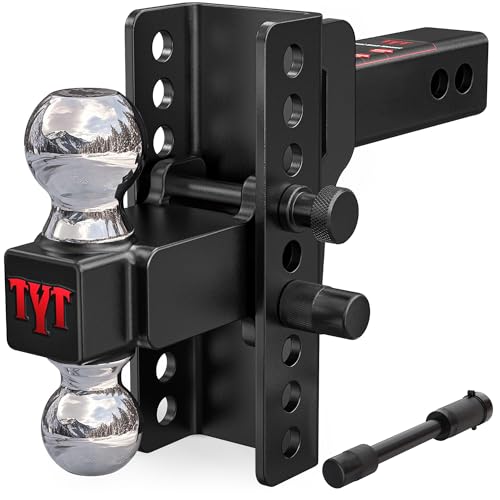
Receiver size is the first compatibility check. The CURT 45372, CURT 45371, Buyers Products 1803075, and TYT dual-ball adjustable hitch are designed for 2-1/2-inch receivers. The other selected products use standard 2-inch receivers. Do not assume a 2-inch mount can be used in a 2-1/2-inch receiver without an appropriate, separately documented adapter; the supplied listings do not establish that interchangeability.
The shank style also matters. Buyers Products 1803051 and 1803075 specify a solid shank, while the CURT 45141 listing identifies a hollow shank. Adjustable products use a channel or height-position design rather than a simple fixed drawbar. Check the receiver pin hole, shank dimensions, and included hardware before purchase.
Calculate the required drop or rise
A level trailer is the practical goal. Measure from the ground to the top of the receiver opening, then compare that measurement with the trailer coupler height while the trailer is level. Fixed mounts such as Buyers Products 1803051, CURT 45371, and CURT 45372 provide a defined drop with limited or no repositioning. They are appropriate when the vehicle and trailer pairing is consistent.
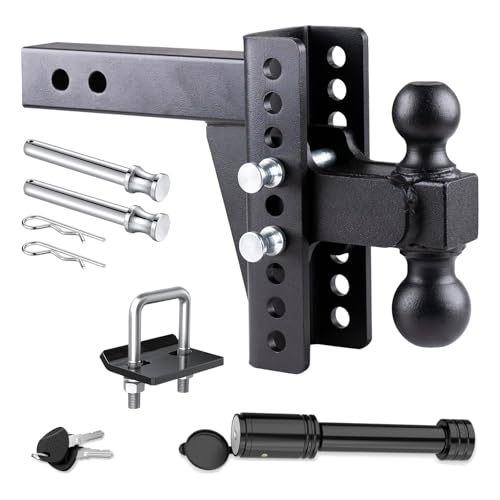
Adjustable mounts are more adaptable. The fouwick and TYT 2.5-inch designs document a 6-inch drop-and-rise range. The VEVOR mount provides up to a 9.5-inch drop with six holes, while the TYT 7500-pound mount lists a 9.5-inch drop and 8.25-inch rise. The FAHKNS model documents nine positions across a 6-inch range. More adjustment can help when one truck pulls trailers with different coupler heights, but it also creates more hardware to inspect and secure.
Compare capacity with the whole towing system
Use the lowest rating among the vehicle, receiver, ball mount, hitch ball, coupler, and other relevant components. The top fixed mounts in this comparison document 20,000-pound maximum gross trailer weight ratings. CURT 45371 and 45372 also specify the current price of tongue weight. Buyers Products 1803075 lists a 2,700-pound maximum vehicle load rating in addition to its MGTW figure.
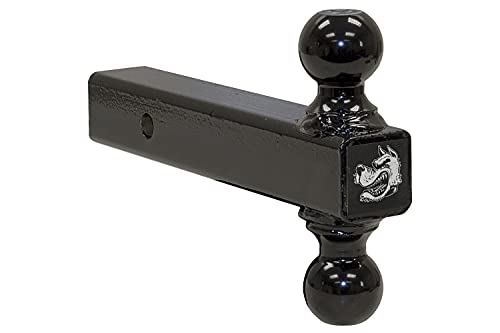
Dual-ball designs require special attention because capacity may differ by ball size. Buyers Products 1802215 lists the current price with its 2-inch ball and the current price with its 2-5/16-inch ball. FAHKNS lists the current price for the 2-inch ball and the current price for the 2-5/16-inch ball. Never apply the larger ball’s rating to the smaller ball.
Choose the ball arrangement
A fixed mount with a single ball is simple when the trailer coupler is known. CURT 45372, CURT 45371, and VEVOR each document a 2-5/16-inch or 2-inch ball arrangement suited to a defined use. The CURT models include factory-torqued 2-5/16-inch balls, while VEVOR lists a 2-inch ball.
Dual-ball mounts reduce the need to change hardware between common coupler sizes. TYT, fouwick, FAHKNS, and Buyers Products 1802215 document both 2-inch and 2-5/16-inch balls. That versatility is useful for a mixed trailer fleet, but the buyer should still verify the rating for the selected ball and the coupler’s required size.
Consider construction and finish
Forged steel is documented on Buyers Products 1803051, Buyers Products 1803075, CURT 45371, CURT 45372, and fouwick. Welded steel appears in the CURT 45141 listing, while the VEVOR, TYT, and other adjustable options describe high-strength or heavy-duty steel.
Most selected products list a black powder-coated or corrosion-resistant finish. Buyers Products 1803051 specifically describes protection against rust, road salt, and harsh weather. VEVOR adds zinc-plated pins and an e-coated lock guard. These finishes are useful for exposure, but they do not eliminate the need to inspect the mount, pins, ball, and receiver for wear or corrosion.
Review included hardware and maintenance needs
Included equipment differs. CURT 45372 and 45371 list factory-torqued balls, while CURT 45141 is not selected here but illustrates why included hardware should be checked carefully. The selected VEVOR and TYT adjustable products document locking hardware. Fouwick describes an integrated U-bolt mechanism, and the TYT 7500-pound model lists anti-rattle screws.
Before towing, verify that the ball is tightened to the applicable manufacturer specification, the receiver pin is secured, and the coupler fully engages the ball. Inspect adjustable channels, pins, clips, locks, and finish regularly. The listing evidence supports product features, not a guarantee of performance under every load or road condition.
Final Recommendation
TYT Dual-Ball Adjustable Hitch for 2.5-Inch Receivers ranks first overall in this specification-based comparison under the published weighted criteria.
Buyers Products 1803051 is the highest-scoring returned product and the best heavy-duty towing ball mounts choice for a fixed 2-inch receiver setup requiring a 2-inch drop and high documented capacity. Its forged one-piece construction and powder-coated finish make it the most specification-aligned specification-based starting point in this comparison, provided the trailer uses a compatible 1-1/4-inch ball shank.
For a 2-1/2-inch receiver, CURT 45372 is the most compelling fixed option when a 4-inch drop is needed, while CURT 45371 is better aligned with a 2-inch drop. Buyers Products 1803075 offers another forged fixed design for the same receiver class. If you change between coupler sizes, the TYT 2.5-inch dual-ball model, fouwick, or FAHKNS provides more flexibility. The VEVOR and TYT 7500-pound models are useful when a deep drop or rise matters more than maximum capacity.
In short, the top heavy-duty towing ball mounts differ mainly in receiver class, height strategy, ball arrangement, and rating. Select the product that matches every component rather than choosing by capacity alone.
Frequently Asked Questions
What should I check before buying the best heavy-duty towing ball mounts?
Confirm the tow vehicle’s receiver size, the trailer coupler size, the required drop or rise, and the ratings of the vehicle, receiver, ball, mount, and coupler. Also check whether the ball, pin, clips, or lock are included. The product listings do not establish universal fitment for every vehicle, so model-specific verification remains necessary.
Are adjustable ball mounts better than fixed mounts?
Neither design is automatically better. A fixed mount such as Buyers Products 1803051 or CURT 45372 can be a focused choice when one vehicle-trailer combination consistently needs the same height. An adjustable model such as fouwick, VEVOR, or TYT can be more practical when trailer heights vary. Adjustable hardware should be positioned and secured according to its instructions before every towing session.
When is a dual-ball mount useful?
A dual-ball mount is useful when trailers use both 2-inch and 2-5/16-inch couplers. TYT, fouwick, FAHKNS, and Buyers Products 1802215 document that arrangement. Check the rating for the specific ball being used, since the supplied evidence shows that capacities can differ by ball size.
Does a higher towing rating make a mount suitable for any trailer?
No. The tow vehicle, receiver, hitch ball, coupler, and mount must all be rated for the application, and the lowest-rated component controls the setup. A 20,000-pound mount is not a reason to exceed a vehicle or receiver limit. Weight distribution, trailer loading, and applicable manufacturer requirements also matter.
How do I choose between a 2-inch and 2-1/2-inch receiver mount?
Choose the mount that matches the actual receiver opening on the vehicle. The CURT 45371, CURT 45372, Buyers Products 1803075, and TYT 2.5-inch model are listed for 2-1/2-inch receivers. The VEVOR, fouwick, FAHKNS, and other standard designs in this comparison are listed for 2-inch receivers. Receiver size is not interchangeable merely because both products are called heavy-duty.