Buying Guide
The best letter-size colored file folders should fit standard documents without folding, make categories easy to recognize, and provide enough labeling space for the way you file. Public listings show that the main differences are pack size, tab position, paper stock, expansion design, and the number of colors.
Confirm the document size
Look for wording that explicitly supports standard 8.5 x 11-inch documents or identifies the product as letter size. The selected products generally describe this fit directly. Smead 11943, Amazon Basics AMZ401, Oxford 1018326, Comix, and Pendaflex PFX84370 all identify letter-size use in their listings. A folder can be colorful and useful for papers yet still be a poor choice if its dimensions do not suit your cabinet, desktop sorter, or hanging-file system.
Many folder bodies are slightly larger than the papers they hold, leaving room for tabs and making them easier to handle. That outside dimension is normal for letter-size filing and should not be confused with a larger document format.
Match the pack size to the workload
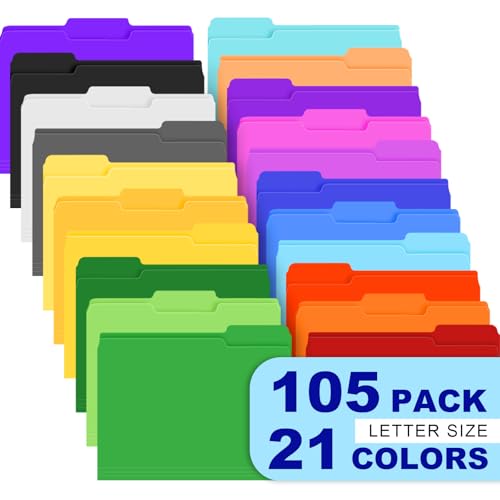
A 100-folder box is appropriate when you are establishing a filing system, replacing many worn folders, or organizing several people or projects at once. Smead, Amazon Basics, Pendaflex jewel-tone, Oxford, Comix, Staples, and SUNEE all provide 100-folder options. PANDRI increases that quantity to 120, while TUXIYA provides 105 folders.
Smaller packs are more suitable for limited projects. Pendaflex PFX84370 includes 30 folders, making it a reasonable fit when you need several categories but do not want a full bulk box. Pack quantity also affects whether you can assign one color to a broad subject or reserve multiple shades for subcategories.
Use colors as a filing system
Color coding works best when each shade has a defined meaning. Five-color packs can separate common groups such as household, tax, school, medical, and work papers. Nine-, 10-, or 21-color assortments support finer divisions, but they may require a written key so the system stays consistent.
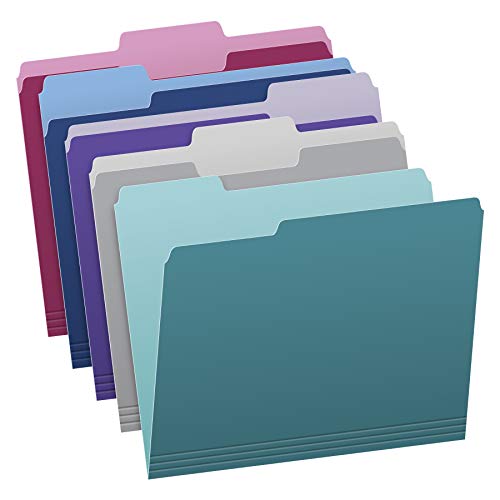
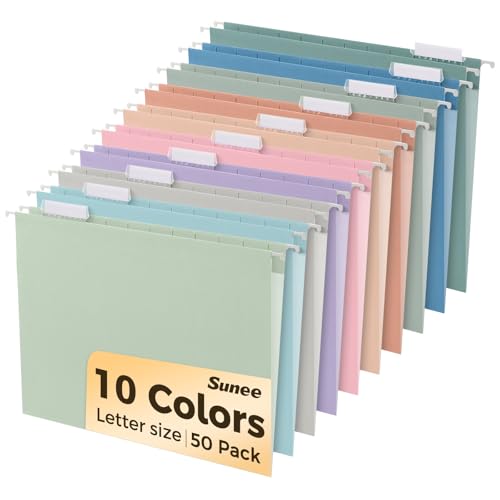
Staples documents nine colors, while Comix and SUNEE list 10-color assortments. TUXIYA lists 21 colors and six theme colors. Oxford uses five pastel colors, and Pendaflex’s jewel-tone set uses teal, violet, gray, navy, and burgundy. Choose bright, pastel, jewel-tone, or light colors based on visibility and the filing environment rather than treating one palette as universally superior.
Compare tabs and labeling
Most selected products use 1/3-cut tabs in left, center, and right positions. That staggered arrangement distributes labels across the top edge, making adjacent folders easier to distinguish. Amazon Basics specifies reinforced 1/3-cut tabs, and Smead, Oxford, Staples, and Pendaflex also describe three positions.
Pendaflex PFX84370 is distinctive because its listing says labels can be written with a ballpoint pen and erased with a pencil eraser. PANDRI lists 120 white labels with its folders. These features may be useful when categories change regularly, but they do not eliminate the need to label folders consistently.
Consider expansion for bulky paperwork
Expansion lines or scored bottoms matter when folders will hold more than a thin group of pages. Smead and Amazon Basics specify expansion up to 3/4 inch. Comix, Oxford, Pendaflex, and several other selected products describe scored bottoms or expansion without supplying a numeric capacity.
Treat these figures as listing specifications, not independent measurements. If a file will hold bulky forms, receipts, or project notes, prioritize a product with an explicit expansion figure. For thin correspondence, a standard folder may be sufficient and easier to store in a tightly packed drawer.
Review paper-stock evidence
Paper construction affects how a folder is positioned for use, but the listings do not provide a standardized cross-brand test. Smead and Amazon Basics specify 11-point stock, Staples specifies 10.5-point stock and a 114-pound basis weight, and TUXIYA specifies 180 GSM/65 LB paper. Other products use descriptions such as sturdy, durable, premium, or heavyweight without a numeric grade.
Use numeric stock information when you need a closer specification comparison, but avoid assuming that one number alone predicts every aspect of handling. Recycled content may also matter to some buyers: Smead and Amazon Basics document recycled material, and Smead states SFI certification.
Final recommendation
TUXIYA 105 Pack, 21 Colors ranks first overall in this specification-based comparison under the published weighted criteria.
TUXIYA 105 Pack, 21 Colors is the first overall specification-based choice in this comparison.
Among the top letter-size colored file folders, TUXIYA has the highest weighted editorial result because it combines 21 colors and six theme colors with 180 GSM/65 LB paper, three tab positions, three expansion creases, and a stated capacity of up to 200 sheets. It is a particularly suitable choice for detailed color systems and thicker groups of paperwork.
Smead 11943 remains a strong alternative for a conventional large filing system. It combines 100 letter-size folders, assorted primary colors, three tab positions, 11-point stock, and documented 3/4-inch expansion for approximately 100 to 150 sheets. Choose Pendaflex Two Tone Jewel-Tone if darker colors and reversible filing are more useful, or Amazon Basics AMZ401 for a 100-pack with reinforced tabs and 11-point stock.
Comix, SUNEE, Oxford, and Staples suit shoppers who prioritize more color categories. Pendaflex PFX84370 is a practical smaller-pack option because it supplies 30 folders and erasable labeling. The best letter-size colored file folders for your situation are the ones whose pack size, color system, and expansion details match the paperwork you manage.
Frequently Asked Questions
What size documents do these colored folders hold?
The selected products are intended for letter-size documents, commonly described as standard 8.5 x 11-inch papers. The folder itself is normally larger than the paper so the tab and edges can be handled. Confirm the listing’s size designation before ordering if your filing cabinet has unusually tight dimensions.
Are 1/3-cut tabs useful for color-coded filing?
Yes. Left, center, and right 1/3-cut positions distribute labels across the top edge, making adjacent folders easier to distinguish. Most products in this comparison use that design. It is useful when a drawer contains many folders with similar colors or when labels need to remain visible in a staggered sequence.
Which selected folders are best for thicker documents?
Smead 11943 and Amazon Basics AMZ401 both document expansion up to 3/4 inch. TUXIYA states a capacity of up to 200 sheets, while PANDRI states up to 120 sheets. Other selected folders describe scored or expandable bottoms without a numeric capacity. Use the explicit figures as a comparison point, not as an independent test result.
Which best letter-size colored file folders offer the most colors?
TUXIYA lists 21 colors and six theme colors, making it the broadest documented assortment in this selection. Comix and SUNEE each list 10 colors, while Staples lists nine. More colors can support more categories, but a simple color key is helpful so the system remains consistent.
Is a 30-pack enough for a home filing system?
A 30-pack can be enough for a focused set of household, school, or short-term project categories. Pendaflex PFX84370 also adds erasable labeling and five colors. For a full cabinet, multiple projects, or shared office use, a 100- or 120-folder pack is more appropriate.