Buying Guide
Choosing the best carbide miter saw blades starts with matching the blade to the saw, then matching the tooth design to the cut. A technically impressive blade is still unsuitable if its diameter or arbor does not match the machine. The listings in this comparison cover common 10-inch and 12-inch formats, with 5/8-inch and 1-inch arbors documented on several models. Always compare those specifications with the saw manual before installation.
Confirm diameter, arbor, and RPM
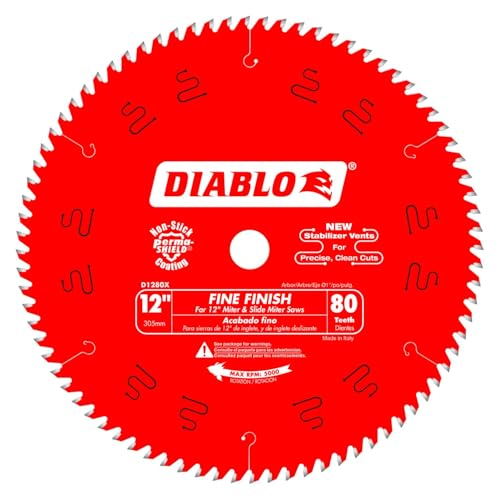
Blade diameter is the first filter. The selected options include 10-inch blades such as the WEN BL1080 and 12-inch models such as the Diablo D1280X. A blade should not be chosen solely because it is described as a miter-saw blade; the saw’s designed diameter matters for clearance and intended cutting geometry.
Arbor size is equally important. The WEN 10-inch models specify a 5/8-inch arbor, while the WEN 12-inch models specify a 1-inch arbor. Ridge Carbide also documents a 1-inch bore. Some selected DEWALT, Makita, and FOXBC listings omit arbor information here, so those products require a separate fit check rather than an assumption.
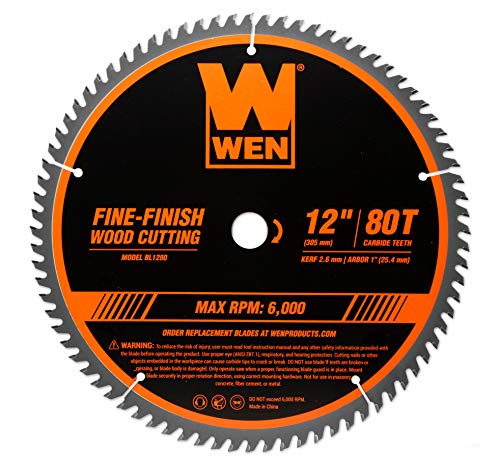
Maximum RPM is another useful compatibility check. WEN states up to 6,000 RPM for its selected blades, while other listings either provide different operating information or do not include a maximum RPM. The saw’s rated speed should be compatible with the blade specification.
Choose tooth count for the job
Tooth count provides a practical starting point for choosing among the best carbide miter saw blades. Lower counts generally indicate a more general-purpose cutting role in the supplied listings. The WEN BL1248 has 48 teeth and is explicitly described for general-purpose wood cutting. The DEWALT combo pack adds a 40-tooth blade alongside a 60-tooth blade, giving the pack two documented tooth-count options.
Higher counts are positioned for finer work. The WEN BL1080 uses 80 teeth on a 10-inch blade, while the WEN BL1280 and Diablo D1280X use 80 teeth on 12-inch blades. The Makita and DEWALT fine-finish options use 100 teeth, and the FOXBC FOX12100X also uses 100 teeth. These descriptions support a finish-oriented selection, but they do not establish hands-on performance results or guarantee a particular surface outcome.
Tooth count should therefore be treated as a task-matching specification, not a universal ranking. For frequent rough and general-purpose work, a 40- or 48-tooth option may be more appropriate. For trim, molding, veneer, or finish-focused crosscuts, the 80- and 100-tooth designs provide stronger documented alignment.
Understand kerf and blade construction
Kerf is the width of the cut and can affect material removal. Several selected blades document thin or ultra-thin kerf designs. WEN lists kerfs from 2.4 to 2.8 mm across its selected models. The FOXBC 100-tooth blade lists a 0.098-inch kerf, while Ridge Carbide lists a 0.125-inch kerf and identifies its blade as full kerf. These figures are not interchangeable, so compare them in the same unit when making a close choice.
Construction features add useful context. DEWALT describes patented body slots, optimized tooth geometry, precision tensioning, and ultra-sharp carbide. The Makita blade documents ATAFR teeth and a thin-kerf design. Diablo lists TiCo high-density carbide, alternate top bevel geometry, a laser-cut kerf, and Perma-SHIELD coating. Ridge Carbide provides plate thickness, hook angle, and AR 4+1 grind details.
The FOXBC 100-tooth option is unusually specific about double-side grind and axial shear-face grind geometry. That makes it a compelling specification match for polished-finish work. By contrast, the WEN products give clearer diameter, arbor, RPM, tooth, and kerf information but fewer details about stabilizers, coatings, or plate design.
Match materials and cut direction
Most selected products are intended for wood, but their documented material ranges differ. WEN describes hard and softwoods. Diablo identifies hardwood and softwood fine crosscuts. FOXBC lists molding, veneered plywood, melamine, hardwoods, and softwoods. Ridge Carbide specifies solid wood and sheet goods from 3/8 to 1 inch thick.
The cut direction also matters. A fine crosscut blade is not automatically the best choice for ripping. Diablo is specifically positioned for fine-finish crosscuts, while the Ridge AR 4+1 grind is described as suitable for both ripping and crosscutting. The FOXBC 60-tooth combination blade is designed around both operations, with large gullets for chip removal and grouped teeth for crosscutting. Choose the product whose documented purpose resembles the work you perform.
Decide whether a single blade or pack is better
Single blades are easier to match precisely to one recurring task. A 100-tooth blade may make sense when the priority is a refined finish, while a 48-tooth blade may better suit routine work. Combination packs offer flexibility. DEWALT supplies 40- and 60-tooth blades, so the user can change tooth count by task. This can be useful when one saw handles both general-purpose cuts and finer work.
The trade-off is that a pack may not include the exact specialized configuration you need. The DEWALT combo does not provide an 80- or 100-tooth option, for example. Select a pack for documented range, or select a single blade when finish requirements are more specific.
Final recommendation
Diablo D1280X 12-Inch 80-Tooth Blade ranks first overall in this specification-based comparison under the published weighted criteria.
Diablo D1280X is the first overall specification-based choice among the best carbide miter saw blades in this comparison. Its 12-inch, 1-inch arbor format, 80-tooth alternate top bevel geometry, high-density carbide, thin kerf, and coating provide the most complete evidence for fine crosscutting. Ridge Carbide is a strong alternative when detailed grind, hook, plate, and material specifications matter. Makita and DEWALT suit finish-focused users who prioritize specialized tooth or stability features, while WEN offers clearly documented 10-inch and 12-inch choices with thin kerfs and stated RPM limits.
Among the top carbide miter saw blades, the best fit still depends on your saw’s diameter and arbor. Choose the WEN BL1248 for a documented general-purpose 12-inch format, the WEN BL1080 for a 10-inch fine-finish format, or the DEWALT combo when two tooth counts are more useful than one specialized blade. Treat missing arbor or RPM data as a reason to verify compatibility before purchase, not as an invitation to guess.
Frequently Asked Questions
What should I check before choosing the best carbide miter saw blades?
Check blade diameter, arbor size, and maximum RPM first. Then compare tooth count, kerf, grind, and the materials named in the listing. For example, the WEN BL1080 documents a 10-inch diameter and 5/8-inch arbor, while the WEN BL1200 documents a 12-inch diameter and 1-inch arbor. Those are different fit categories even though both are intended for fine wood cutting.
Are 80 teeth or 100 teeth better for a miter saw?
Neither is universally better. The selected listings position both counts for fine-finish work. An 80-tooth blade such as the Diablo D1280X is specifically described for fine crosscuts, while the FOXBC FOX12100X and Makita B-67000 use 100 teeth for finish-oriented cutting. Consider the material, desired finish, and the saw’s compatible blade size rather than tooth count alone.
Is a thin-kerf blade useful for woodworking?
A thin kerf removes less material than a wider kerf, based on the listed specification, and may reduce material waste. WEN documents ultra-thin kerfs from 2.4 to 2.8 mm, while FOXBC lists 0.098 inch for its 100-tooth blade. Ridge Carbide lists a 0.125-inch full kerf. These differences can help compare designs, but the listing data does not establish a hands-on performance result.
Which selected blade is suited to general-purpose cutting?
The WEN BL1248 is the clearest match because its listing calls it a general-purpose wood-cutting blade and specifies 48 carbide-tipped teeth. The DEWALT combo pack is another flexible option because it includes 40- and 60-tooth blades. Higher-tooth-count options in this guide are more directly positioned for fine finishes.
Can these blades cut materials besides solid wood?
Some selected listings document broader material coverage. FOXBC lists veneered plywood and melamine, while Ridge Carbide specifies sheet goods; several listings also mention hardwoods and softwoods. Use only materials identified for the specific blade, and confirm that the blade and saw are appropriate for the intended material.