Buying Guide
The best carbon steel knife sharpeners in this list are mostly honing rods rather than electric machines, pull-through units, or stones. That distinction matters. A honing rod is generally selected for maintaining or realigning an existing edge, while a diamond-coated rod can provide a more abrasive surface for a duller blade. The listings here describe those roles in different ways, so match the tool to the condition of your knives and your preferred sharpening routine.
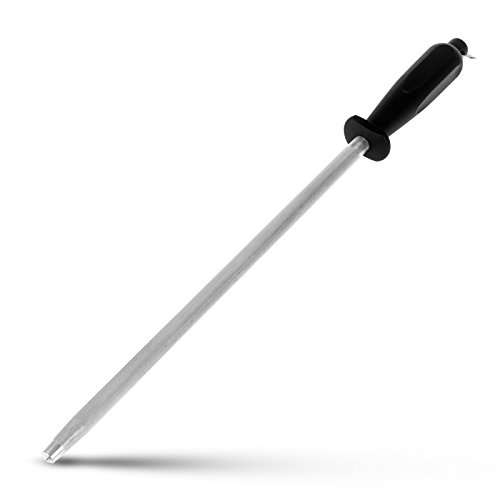
A traditional fine steel is the most straightforward format for regular edge maintenance. Azhou identifies its rod as fine 200 grit and describes it for straightening and realigning edges. ALLWIN-HOUSEWARE W likewise positions its fine carbon steel rod for daily maintenance. These products are sensible when the knife still cuts but feels less tidy at the edge.
Diamond-coated rods are a different category of rod surface. Koja and Kota Japan both document diamond electroplating, and Koja specifically describes its industrial diamond surface as suitable for dull knives. Diamond can be useful when a plain steel is not abrasive enough for your needs, but the supplied listings do not establish a universal technique or result. A lighter, controlled stroke is a reasonable precaution when using an abrasive surface, especially if you are accustomed to a traditional honing steel.
Check the carbon steel evidence
The phrase carbon steel covers more than a marketing headline, so look for the level of detail provided. KINTIF identifies high-carbon steel and gives a 63–65 HRC hardness range. Azhou lists hardened high-carbon steel at HRC 63±2, while TUO specifies high carbon steel and 62 HRC. HOSHANHO adds Japanese high-carbon steel, vacuum heat treatment, and hardness up to 62 HRC.
Other products document a carbon steel base with plating. Kota Japan, FANERFUN, Utopia Kitchen, and Cutluxe all provide material or plating information in their listings. This does not by itself prove that one rod will outperform another; it simply gives more useful specification context for comparison. If material traceability and hardness are important to you, prioritize the products with the clearest supplied technical descriptions.
Match rod length to your knives
Length affects how much of a blade can be covered in one controlled pass. The selected products range from TUO’s 8-inch rod to FANERFUN’s 13-inch overall design. A 10-inch Cutluxe rod occupies a middle position, while KINTIF, Azhou, Koja, Kota Japan, HOSHANHO, Utopia Kitchen, and ALLWIN-HOUSEWARE W use 12-inch formats.
A longer rod may be more convenient for large chef or butcher knives because it offers more working area. The listings specifically identify KINTIF for butcher and chef knives, and Azhou for kitchen, chef, and butcher tools. Shorter does not mean unsuitable: TUO is expressly designed for drawers, blocks, and knife rolls, and its 8-inch format may be easier to store in a compact kitchen. Consider the largest blade you maintain and the space where the rod will live.
Prioritize grip and bracing features
Honing requires consistent contact and deliberate movement, so the handle and base deserve attention. KINTIF lists an ergonomic handle and slip-resistant bottom. Azhou uses a Pakka wood handle for a firm, non-slip grip. TUO offers a non-slip PakkaWood handle, while Cutluxe describes its handle as non-slip and suitable for either hand.
Utopia Kitchen and FANERFUN use non-slip grip language, and ALLWIN-HOUSEWARE W adds an anti-slip metal tip that can brace against a cutting surface. These details do not replace careful technique, but they can make the rod easier to hold. A hanging loop, documented by KINTIF, Utopia Kitchen, and ALLWIN-HOUSEWARE W, also helps if you prefer wall or rail storage rather than a drawer.
Consider shape and surface texture
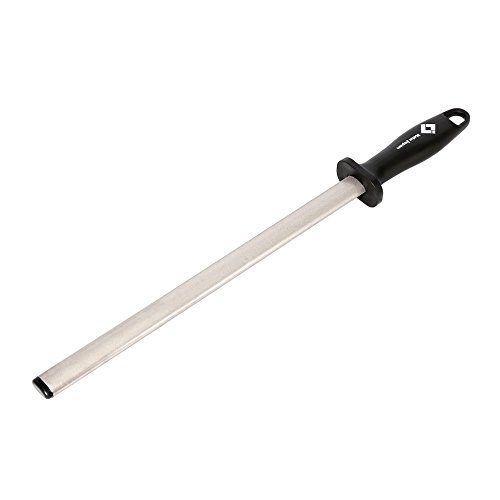
Rod geometry can influence how the tool feels during a stroke. KINTIF uses a flattened-oval profile with a listed 35 mm width. Koja and Kota Japan describe oval rods intended to improve sharpening efficiency. FANERFUN lists dense, uniform sawteeth, while HOSHANHO describes a fine, uniform sand structure. Those are meaningful differences in the supplied evidence, even though they do not substitute for independent testing.
For a user who wants a broad, professional-style rod, KINTIF’s flattened oval is the most extensively documented option here. For a more abrasive rod, Koja and Kota Japan provide the clearest diamond-surface evidence. For fine maintenance, Azhou and HOSHANHO provide more specific descriptions of their surface than several basic rods.
Plan for care and storage
Carbon steel and plated steel rods still need sensible care. Utopia Kitchen says to wipe the rod with cooking oil and dry it completely if washed, and it specifically advises against dishwasher cleaning. Koja states that its rod can be cleaned with water, while another part of the listing recommends easy maintenance.
Storage features vary. Utopia Kitchen, KINTIF, and ALLWIN-HOUSEWARE W document hanging loops or rings. TUO is explicitly sized for drawers, blocks, and knife rolls. A rod should be stored where its surface will not be struck by other tools, and any washable steel should be dried according to its listing. These are simple practical considerations, but they can matter as much as a small difference in rod length.
How to use the rankings
This comparison weighs carbon steel documentation, sharpening surface and action, control, blade coverage, and maintenance or storage. It does not use volatile marketplace information, customer sentiment, or hands-on measurements. The result is therefore best read as a structured shortlist of top carbon steel knife sharpeners based on the public specifications supplied for each product.
Final Recommendation
KINTIF 12-Inch Heavy-Duty Honing Steel ranks first overall in this specification-based comparison under the published weighted criteria.
KINTIF 12-Inch Heavy-Duty Honing Steel is the highest-scoring returned product and the first overall specification-based choice. Its high-carbon steel, stated 63–65 HRC hardness, flattened-oval profile, fine lines, anti-slip handling, and hanging ring give it the most complete evidence package in this comparison.
Choose Azhou if you want a fine 200-grit rod with a specific hardness range, or TUO if compact storage is more important than maximum blade coverage. Koja is the clearest choice among the diamond-coated options, while HOSHANHO and Cutluxe offer well-documented everyday alternatives with ergonomic handles. Utopia Kitchen is useful when a hanging loop and care instructions matter, and FANERFUN is the longest selected design. These top carbon steel knife sharpeners cover different maintenance priorities without relying on claims about customer popularity or test results.
The best carbon steel knife sharpeners are not interchangeable in use. Select a fine rod for regular realignment, a diamond-coated rod for a more abrasive surface, and a length and handle that suit your largest knife and storage setup.
Frequently Asked Questions
Among the best carbon steel knife sharpeners, are carbon steel honing rods the same as sharpening stones?
No. The selected carbon steel rods are generally described as honing or sharpening steels for edge maintenance and realignment. A stone uses a separate abrasive format and technique. None of the selected products is a whetstone; the comparison focuses on rods whose supplied evidence identifies carbon steel or high-carbon steel.
Should I choose a diamond-coated rod or a fine steel?
Choose based on the listed role and the condition of the edge. Koja and Kota Japan document diamond-coated surfaces, while Azhou and ALLWIN-HOUSEWARE W describe fine maintenance-oriented surfaces. A diamond rod may be the better fit when you specifically want a more abrasive rod, whereas a fine steel is oriented toward routine edge care. The supplied evidence does not establish a universal result for every knife.
What rod length works for a chef knife?
The answer depends on the blade size and your storage space. The selected 12-inch rods from KINTIF, Azhou, HOSHANHO, Utopia Kitchen, and ALLWIN-HOUSEWARE W offer broad listed coverage. TUO’s 8-inch design is more storage-friendly, while FANERFUN provides a 13-inch overall format. Compare the rod length with your largest blade rather than choosing by length alone.
How should a carbon steel sharpening rod be maintained?
Follow the product-specific care instructions. Utopia Kitchen recommends wiping with cooking oil and drying completely after washing, and it says not to use a dishwasher. Koja states that its rod cleans with water. In general, keep the surface dry after cleaning and use the storage feature supplied, such as a hanging loop, ring, drawer, block, or knife roll.
What features help with control?
Look for an ergonomic or non-slip handle, a stable base or tip, and a size that does not feel unwieldy. KINTIF, Azhou, TUO, Cutluxe, Utopia Kitchen, and ALLWIN-HOUSEWARE W document grip-related features. KINTIF and ALLWIN-HOUSEWARE W also list anti-slip bracing details. These specifications can help you narrow the choice, but they do not constitute hands-on performance testing.