Buying Guide
The best coiled bike cable locks are useful when you need flexible routing, manageable storage, and a lock that can reach a rack, post, fence, or another fixed object. A coiled cable is generally easier to carry than an equivalent loose cable because unused length gathers around the lock. That convenience does not make every cable equally suitable: diameter, construction, reach, locking method, and protective covering all affect the practical fit.
This guide compares public listing specifications only. The scores do not represent laboratory attack testing, field testing, customer sentiment, or a guarantee that a bicycle cannot be stolen. Cable locks are commonly positioned as basic or everyday theft deterrents in the supplied evidence, so consider the parking environment and the amount of time the bike will be left unattended.
Start with cable thickness
Cable diameter is one of the clearest specification differences in this group. The Kryptonite KryptoFlex and KEYSTP models document 15mm cables, while the Master Lock 8122D documents 13mm. The two Titanker selections list 12mm steel cable, and SmaringWing lists 11.5mm. DocksLocks, Lumintrail, and MARQUE use 10mm or 3/8-inch formats. Retrospec lists an 8mm steel cable.
A thicker cable may make sense when you want a more substantial physical deterrent, but diameter alone does not describe every part of a lock’s security. The supplied listings do not provide a common independent security test for these products. Treat thickness as a comparison point, not as proof of resistance to every tool or attack.
Match length to the parking anchor
Six feet is a useful middle ground for many single-bike setups. It can provide room to pass around a frame and wheel before reaching a rack or post. The Master Lock 8122D, Titanker models, DocksLocks key version, Kryptonite KryptoFlex, and Retrospec Grizzly all document six-foot cables.
Longer cables provide more routing options. Both the DocksLocks combination model and Lumintrail offer ten feet, while MARQUE also documents a ten-foot version. That extra reach can help when the anchor is wide, when more than one item must be secured, or when a kayak, gate, or outdoor object is involved. The trade-off is that extra cable can be harder to organize around a small rack, even though the coil helps manage unused length.
Shorter cables can be convenient when the attachment point is close. SmaringWing’s 3.9-foot model is compact, but it may not wrap around large posts or multiple objects as easily as a six- or ten-foot option. Measure the route around the bike and anchor before choosing a length.
Choose keys or a combination
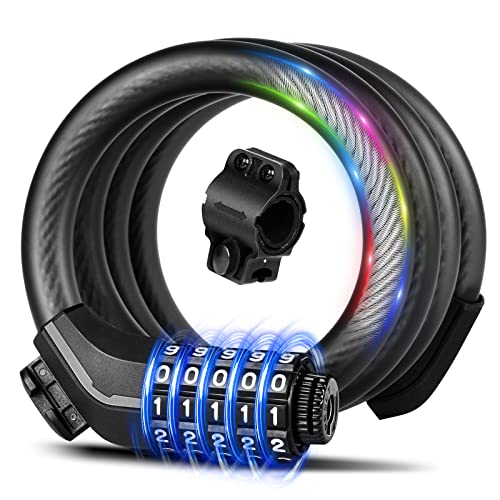
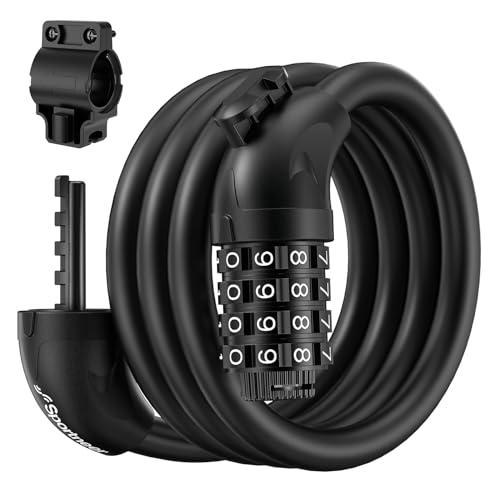
Key-operated models offer a familiar routine and do not require remembering a code. The Titanker and DocksLocks key versions include two keys, and their listings describe locking by snapping the mechanism together. A spare key can be kept separately, but losing both keys can make access inconvenient.
Combination models remove the need to carry a key. Resettable four-digit locks are documented on the Master Lock 8122D, DocksLocks, Lumintrail, MARQUE, and Retrospec models. SmaringWing and KEYSTP document five-digit combinations. More digits provide more possible code settings in the listing’s description, but daily convenience still depends on setting and remembering the code correctly.
Before relying on a new combination, follow the product’s setup directions and verify that the lock opens and closes with the chosen code. This is especially important for resettable mechanisms. A combination lock is only useful if the owner can operate it consistently.
Check carrying and storage features
A mounting bracket is helpful for riders who do not want a coiled cable loose in a bag. The KEYSTP, SmaringWing, Titanker, DocksLocks key, and Retrospec models document brackets. Titanker’s bracket includes rubber inserts for adjusting to a circular seat tube, while DocksLocks states that its bracket fits posts from 0.75 to 1.5 inches. These details are more useful than a generic portability claim because they indicate how the lock may be carried.
The Kryptonite, DocksLocks combination, Lumintrail, and MARQUE listings emphasize coiling or compact storage, but the supplied evidence does not show a bracket for every one of them. If frame mounting matters, confirm that feature rather than assuming every coiled design includes it.
Look for surface and weather protection
Vinyl or PVC coverings appear across many selected products. They are described as helping reduce scratches, abrasion, or weather exposure around the cable. The DocksLocks key model provides the most detailed outdoor protection in the supplied evidence, including a dust- and splash-resistant cover and corrosion-resistant materials. The KEYSTP listing also specifically describes waterproof and corrosion-resistant protection.
Protective covering is useful when the cable contacts a painted frame or is stored outdoors, but it does not eliminate the need to maintain the lock. Keep the mechanism clean and follow any manufacturer care instructions. Avoid assuming that a general weatherproof description means the lock is suitable for permanent exposure in every climate.
Consider the use case
For a thick cable, the Kryptonite KryptoFlex and KEYSTP are the clearest choices because both document 15mm construction. For six-foot reach with a combination, the Master Lock 8122D provides a strong balance of diameter, length, and resettable access. Titanker is practical for key users who value an adjustable bracket, while DocksLocks adds detailed weather and carrying features.
For long reach, the ten-foot DocksLocks combination model, Lumintrail, and MARQUE provide extended options. Those models may suit users securing several items or routing through narrow openings. For a close anchor and compact setup, Retrospec or a shorter model can be easier to handle, but verify that the cable can pass around the frame and through the chosen locking point.
Final Recommendation
KEYSTP 15mm 5-Digit Bike Cable Lock ranks first overall in this specification-based comparison under the published weighted criteria.
Kryptonite KryptoFlex 6’ 15mm Cable Lock is the highest-scoring returned product and the first overall specification-based choice. It combines the thickest documented cable in this comparison with six-foot reach, click locking, a cylinder cover, and coiled storage. It is a sensible starting point for shoppers comparing the best coiled bike cable locks by published specifications rather than volatile marketplace information.
KEYSTP is a close alternative for riders who prefer a five-digit combination and a mounting bracket. Master Lock 8122D is well suited to those who want six feet of reach with 13mm cable and resettable access. Titanker is practical for key users who value an adjustable bracket, while DocksLocks key models add detailed weather and carrying features. Retrospec is a reasonable frame-mounted choice when a six-foot cable and resettable code matter more than maximum cable thickness.
If reach is your main concern, the ten-foot DocksLocks combination model, Lumintrail, and MARQUE deserve attention. These are among the top coiled bike cable locks for routing around broad anchors or securing more than one item, though their moderate cable diameters may not appeal to shoppers prioritizing thickness. In every case, choose a secure fixed object, route the cable through the frame where possible, and use the lock for the level of exposure described by its listing.
Frequently Asked Questions
Are the best coiled bike cable locks suitable for overnight outdoor parking?
The supplied listings generally describe these products as basic, everyday, or short-stop theft deterrents. They do not establish that any selected cable lock is suitable for prolonged unattended parking in a high-risk location. For overnight use, consider the value of the bike, the parking environment, and whether a different lock design or layered security approach is more appropriate.
Is a thicker cable always the better choice?
Thickness is an important specification, but it is not the only one. The Kryptonite KryptoFlex and KEYSTP list 15mm cables, while several ten-foot models list 10mm or 3/8-inch cables and offer more reach. A thicker cable may be preferable for a stronger physical deterrent, but the supplied data does not provide standardized attack testing. Compare thickness with construction, length, locking hardware, and intended use.
Should I buy a key or combination coiled cable lock?
Choose keys if you prefer a straightforward lock-and-unlock routine and are comfortable keeping a spare. Choose a combination if keyless access is more convenient. Resettable four-digit locks are documented on several selected models, while SmaringWing and KEYSTP list five-digit systems. Test a new combination before leaving the bike and avoid sharing the code unnecessarily.
How much cable length do I need for a bicycle?
Six feet is a practical starting point for many single-bike rack setups, but the required length depends on the frame, wheel, anchor, and routing path. A 3.9- or four-foot cable may work when the anchor is close. Ten feet offers more flexibility for broad posts, multiple items, gates, kayaks, or other outdoor equipment, but it can be more material than a compact rack stop requires.
What does a mounting bracket add?
A bracket keeps the coiled cable attached to the bicycle between uses. Several selected products document brackets, including models from KEYSTP, SmaringWing, Titanker, DocksLocks, and Retrospec. Fit details vary: one Titanker bracket uses rubber inserts, and DocksLocks specifies a compatible post range. Check the listed mounting dimensions and installation design before assuming a bracket will fit your frame.