Buying Guide
The best keyed bike locks should be chosen by matching the lock design to the way and place you park. A lock that is easy to carry but too short for the rack is not practical, while a long chain can be inconvenient if your daily ride has limited storage. The products above are specification-based selections, so treat stated construction and dimensions as comparison points rather than proof of real-world test performance.
Choose the locking design first
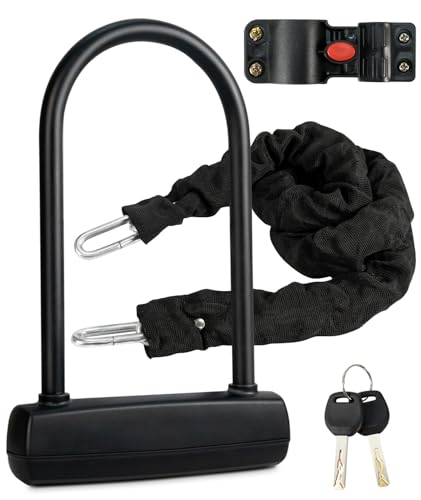
A U-lock gives you a rigid opening and a compact shape. The Master Lock 8320D is the simplest example in this group: it has a hardened-steel body, double-locking shackle, disc-keyed mechanism, vinyl coating, and carrier bracket. U-locks can be convenient when the rack and frame fit within the opening, but the fixed dimensions make measurement important.
A U-lock paired with a cable or chain adds reach. Sportneer supplies a 17mm U-lock and a 5-foot steel cable, while Hapleby combines its U-lock with a 6-foot cable. Weogine uses an 18mm U-lock with a 4-foot chain. These combinations let the rigid lock handle the main connection while the cable or chain can pass through a wheel or reach an anchor that would otherwise be awkward. They also add weight and more parts to carry.
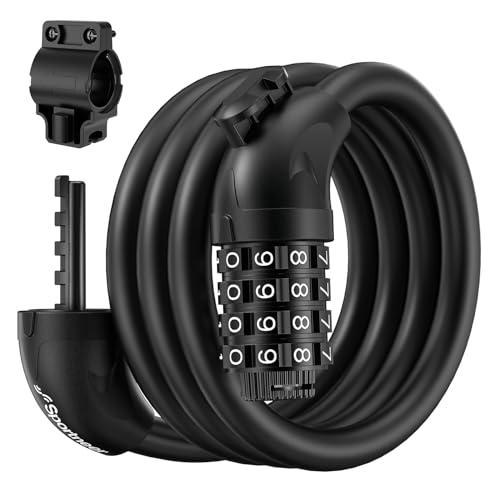
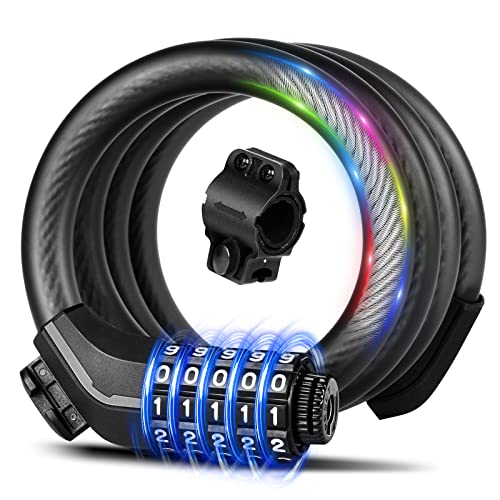
Cable locks are flexible and generally easy to route through frames, wheels, racks, and posts. MARQUE offers a 7-foot straight cable, and Master Lock’s 8154DPF offers six feet. Diyife and Titanker use coiled cable formats that are intended to reduce storage space. Cable locks are useful for routine stops and lower-risk situations, but the listing evidence does not establish a universal security level for any cable design. Consider whether your parking location calls for the additional rigidity of a U-lock or chain.
Chain locks occupy a middle ground. They can bend around posts and multiple bikes while offering a different construction from braided cable. INTEKIN documents an 8mm steel chain with a solid-metal deadbolt, and Titanker lists an 8mm chain with a protective cloth sleeve. Short chains can be easier to carry, but their reach may be limited around broad racks or thick posts. Check the usable length, not only the chain thickness.
Check thickness and construction claims
Thickness is one useful specification, but it should not be treated as a complete security rating. Sportneer lists a 17mm shackle, Weogine lists an 18mm shackle, and the selected chain locks document 8mm links. Cable products in this group list diameters from 3/8 inch to 12mm. These numbers describe the supplied listing data; they do not replace independent testing or guarantee resistance to a particular tool.
Also look at the stated lock architecture. Sportneer identifies a zinc alloy lock core and alloy-steel lock head. Master Lock describes a disc-keyed mechanism, while INTEKIN describes a deadbolt and blade-style cylinder. These details help distinguish products that otherwise look similar. Avoid assuming that a marketing phrase such as heavy duty means the same thing across brands unless the listing supplies a comparable dimension or material statement.
Match reach to your parking setup
Measure the rack, post, and frame positions you commonly use. A four-foot cable may work well for a nearby rack but fail to reach a distant post. MARQUE’s seven-foot cable offers the greatest documented reach among the selected products, and Hapleby’s six-foot cable gives a U-lock set more routing options. The 3.3-foot Titanker chain and approximately three-foot INTEKIN chain are more compact choices.
Longer is not always better. Extra cable can create loops that are harder to manage, and a longer chain can add carrying bulk. If you normally lock close to a standard rack, a shorter product may be easier to store. If you secure an e-bike, scooter, or more than one bicycle, the added reach of a cable or chain combination can be more useful than a compact standalone lock.
Look for frame and weather protection
Protective coverings serve two practical purposes: they can reduce contact between the lock and paint, and they can shield portions of the lock from routine outdoor exposure. The selected products document vinyl, PVC, silicone, nylon, or fabric coverings. Sportneer specifies a silicone exterior, Weogine specifies silicone on the U-lock and nylon around the chain, and Titanker describes a cloth sleeve and dust cover.
These features do not make a lock maintenance-free. Several listings recommend attention to the keyhole or lubrication. Keep the key mechanism clean and follow the manufacturer’s care instructions. A dust cover can help, but it is not evidence that a lock is waterproof under every condition.
Plan for keys and carrying
Every selected product uses keys, but the included quantity varies. Most list two keys; INTEKIN and one Weogine chain listing provide three. Keep a spare in a secure location rather than carrying every key on the bike. A keyed lock avoids remembering a combination, but losing the key can prevent access, so the spare matters.
Mounting hardware is another useful distinction. Sportneer, Hapleby, Master Lock, Diyife, and Titanker list brackets or carriers. Hapleby additionally lists straps for managing its cable, and the Titanker 4-foot cable bracket includes rubber inserts. Check the stated tube-size range where provided. A bracket that does not fit your frame is not a substitute for a bag or other storage method.
Final recommendation
Sportneer 17mm U-Lock with 5ft Cable ranks first overall in this specification-based comparison under the published weighted criteria.
Sportneer 17mm U-Lock with 5ft Cable is the first overall specification-based choice among these best keyed bike locks. Its documented 17mm shackle, included steel cable, two keys, bracket, and protective silicone coating create the most versatile package in the comparison. Hapleby is a close alternative when six-foot cable reach and cable-management accessories matter more. Weogine suits riders who prefer a chain-assisted U-lock, while Master Lock 8320D is the more focused compact rigid option.
For chain buyers, INTEKIN emphasizes an 8mm chain and deadbolt-style construction, while Titanker offers a covered 8mm chain in a compact format. For flexible cable use, MARQUE gives the longest reach, Diyife balances a 12mm cable with a coiled profile, and the Titanker and Master Lock cable models provide shorter, simpler choices. The top keyed bike locks are not interchangeable: verify length, opening dimensions, tube compatibility, and the type of anchor you use most often.
Frequently Asked Questions
Among the best keyed bike locks, are keyed bike locks better than combination locks?
A keyed design avoids remembering a numeric combination and lets you carry a spare key. The trade-off is that access depends on keeping the key available. The products in this comparison all specify keyed mechanisms and include at least two keys, but the supplied evidence does not establish that keys are universally more secure than combinations.
Should I choose a U-lock, cable, or chain?
Choose a U-lock when a rigid opening fits your frame and rack. Choose a cable when flexibility, low bulk, or extra reach is most important. Choose a chain when you want flexible routing with a chain construction. Combination sets such as Sportneer, Hapleby, and Weogine can cover more anchoring situations but generally add components to carry.
How long should a keyed lock be?
The right length depends on the rack, post, frame, and wheels you need to connect. Measure those parts before buying. MARQUE lists seven feet, Hapleby lists a six-foot cable, and the compact chain options are about three feet. Do not select by length alone: an oversized lock may be harder to carry and manage.
Do protective sleeves make a lock weatherproof?
Sleeves and covers can help protect a frame and reduce exposure to rain, dust, and abrasion when those features are stated. They do not prove complete waterproofing or eliminate maintenance. Keep the keyhole clean and follow care guidance, especially for a lock used outdoors regularly.
Can one keyed lock secure two bikes?
Some listings specifically describe use with multiple bikes, and longer cables or chains generally provide more routing room. Actual fit depends on frame size, wheel position, the anchor, and the usable length. Confirm that the lock can pass through the parts you intend to secure before relying on it for two bicycles.