Buying Guide
Choosing among the best wood garment racks starts with the way you plan to use the rack. A bedroom organizer for a weekly outfit rotation has different needs from a rolling rack for a large coat collection, a temporary display, or a small entryway. The products above are compared from their supplied listing descriptions and specifications, not from hands-on testing. Treat stated capacities as manufacturer or listing claims and check the available room before ordering.
Choose the wood construction
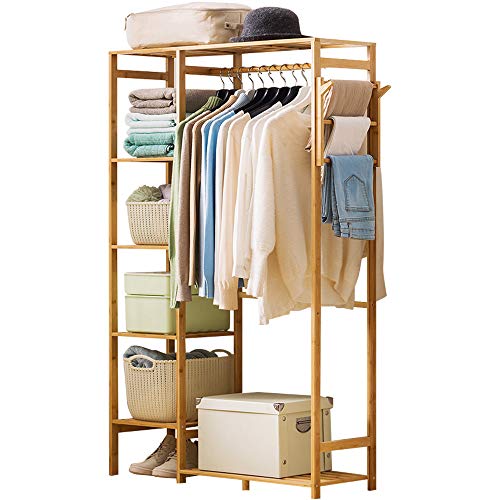
The selected products use solid rubberwood, natural wood, or bamboo in different ways. Muwuele, Wamhom, both selected Yoobure racks, Taitiy, HomeStock, and Tangkula document rubberwood or solid wood construction. Ufine uses bamboo, while Honey-Can-Do identifies natural wood. Wood species and finish affect appearance, but the listings do not provide a common testing standard for durability, so construction claims should not be treated as directly interchangeable performance results.
A polished or coated surface can be useful around clothing. Muwuele describes a polished, lacquered, burr-free surface; Yoobure describes smooth coating or polished details; Tangkula lists a splinter-free surface; and Ufine describes varnished bamboo. These details may reduce snag concerns, but they are design descriptions rather than independent test results. If delicate garments are important, inspect the finish and edges when the rack arrives.
Match hanging space to the wardrobe
Rod length, height, and stated garment capacity are the most useful comparison points. Wamhom documents a 116-centimeter rod and a 55-kilogram capacity. Taitiy lists a 1.2-inch rod and support for up to 12 garments. HomeStock states a 30-pound capacity, while Ufine describes a 52-inch hanging area and a 100-pound maximum overall load. Muwuele also supplies a 350-pound tested load claim, the highest stated figure in this selection.
Those figures are not a universal measurement system: some refer to total capacity, some to a rod, and some to a tested load claim. Avoid assuming that a larger overall number means the rod alone can hold that amount. For dresses and long coats, compare vertical clearance. Yoobure’s 70.3-inch and 70.9-inch designs offer taller profiles, while Honey-Can-Do and Tangkula are closer to 58 inches.
Decide whether shelves and hooks matter
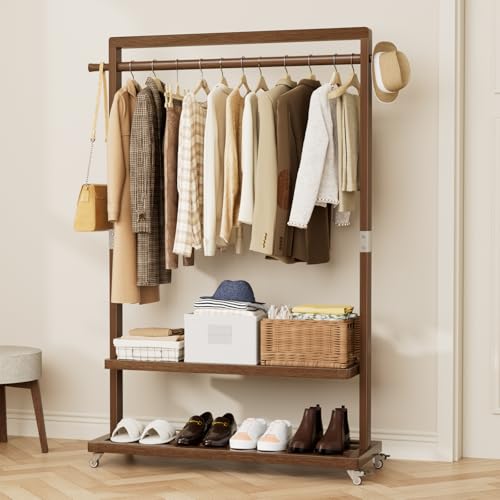
A simple rod keeps garments visible, but shelves and hooks can reduce the need for separate storage furniture. Yoobure’s eight-hook rack adds two shelves, and the six-hook Yoobure model also includes two shelves. Taitiy supplies five hooks and two shelves. Wamhom provides two shelves, while Honey-Can-Do uses two slatted shelves with separate stated load information.
For mixed storage, the Yoobure 4-in-1 model adds pants racks alongside six hooks, a hanging rod, and a shelf. Ufine’s six shelves are better suited to folded clothing, shoes, bins, or accessories than to maximizing open rod space. HomeStock and Tangkula are more focused on hanging garments, with no comparable multi-hook layout documented. Consider what must be stored beside the clothing before choosing a rack.
Rolling, folding, or stationary?
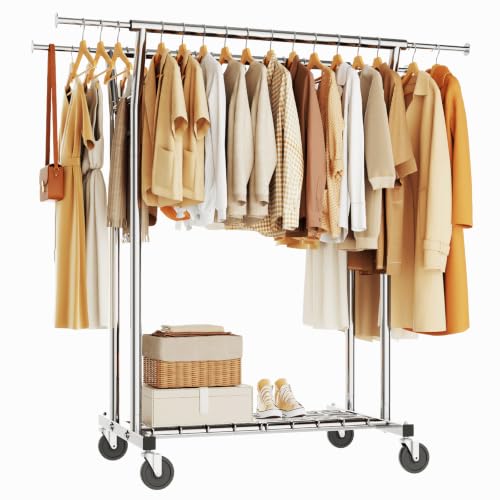
Rolling racks are useful when you regularly clean, rearrange, or move clothes. Muwuele has removable wheels, and Wamhom and both selected Yoobure rolling models describe 360-degree casters with locking functions. Wheels add convenience, but the listing evidence does not establish how each rack behaves on every floor surface when fully loaded.
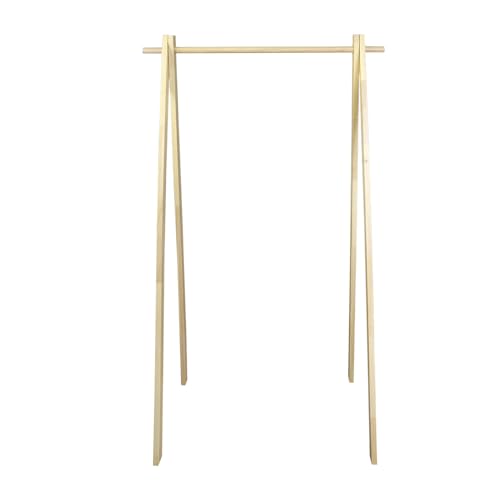
Folding racks solve a different problem. Tangkula lists a folded depth of three inches, and HomeStock collapses into wooden slats for storage or transport. These designs are appropriate for temporary wardrobes, craft or event use, guest spaces, and rooms where the rack will not remain out all the time. A foldable frame may offer less built-in organization than a hall-tree-style rack.
Stationary designs are often simpler. Taitiy uses a reinforced frame, thickened base, and lower shelves, while Honey-Can-Do uses an interlocking connector system. If a rack will stay in one place, prioritize its footprint, base design, and the type of floor on which it will stand. If you need to move clothing between rooms, a locking-wheel model is more convenient.
Measure the room and plan assembly
Compare width, depth, and height rather than relying on product photos. Taitiy is listed at 26 inches wide, Honey-Can-Do at 27.95 inches, and Ufine at 34.3 inches long by 11.8 inches wide. Muwuele is 39.7 inches wide, while the first Yoobure model is 46.1 inches wide. A wider rack may provide more room for garments, but it can crowd a narrow walkway.
Assembly varies from tool-free designs to models supplied with instructions, hardware, or tools. HomeStock and Honey-Can-Do document tool-free setup. Yoobure, Taitiy, and Wamhom describe included instructions or tools, and Yoobure also mentions a setup video. Assembly claims describe the intended process; they do not guarantee a particular setup time for every buyer. Check package contents and tighten connections according to the supplied instructions.
Final recommendation
Yoobure Rolling Coat Rack with 8 Hooks ranks first overall in this specification-based comparison under the published weighted criteria.
The final choice among the best wood garment racks depends on the documented features that match your intended use.
Muwuele Solid Wood Rolling Clothes Rack is the highest-scoring returned product and the first overall specification-based choice. Its FAS rubberwood construction, stated 350-pound tested load capacity, removable wheels, shelves, and bracing give it the broadest documented combination of strength, storage, and flexibility.
Wamhom is the better fit for shoppers who want a long hanging rod with two shelves and lockable wheels. Choose Yoobure’s eight-hook model for entryway organization, or the six-hook version when adjustable feet and a stationary setup are more useful. Taitiy is a sensible compact hall-tree option, while HomeStock and Tangkula are better for folding storage or temporary use.
For a shelf-focused wardrobe, Ufine offers six storage tiers and a stated 100-pound maximum load. Honey-Can-Do is a slim, tool-free alternative with two shelves and clearly listed shelf capacities. Yoobure’s 4-in-1 rack is the most function-rich choice for pants, accessories, and bins in one frame. These top wood garment racks cover different room layouts, so the best match depends on whether you prioritize load claims, storage variety, mobility, or fold-away convenience.
Frequently Asked Questions
What should I look for in the best wood garment racks?
Start with the material, overall dimensions, hanging height, and any stated capacity. Then decide whether you need shelves, hooks, pants storage, wheels, or a folding frame. A compact rack such as Taitiy or Honey-Can-Do may suit a small entryway, while Muwuele or Wamhom offers more capacity-oriented features.
Are wood garment racks better with wheels?
Wheels are useful when the rack must move between rooms, during cleaning, or for rearranging. Muwuele has removable wheels, and Wamhom and Yoobure document rolling casters with locking functions. A stationary rack may be preferable when mobility is unnecessary or when you want a simpler fixed layout.
Which selected rack is best for a small room?
Compare the actual footprint and storage priorities. Honey-Can-Do is listed at 27.95 inches wide and 10.03 inches deep, while Taitiy is listed at 26 inches wide and 14.2 inches deep. Tangkula’s folding design can also help when the rack must be stored after use. Leave clearance for doors, walkways, and garment access.
Do all wood garment racks include shelves?
No. HomeStock is primarily a collapsible hanging rack and does not list shelves or hooks. Other selected models add one or more shelves, while Ufine emphasizes six storage tiers. Choose a rod-focused design for open hanging space, or a shelf-heavy model when folded clothing and accessories are equally important.
Can a wood garment rack replace a closet?
It can provide supplemental or open wardrobe storage, but the listings do not establish that every model replaces a built-in closet. Capacity, dust exposure, garment length, and available floor space vary. Measure your clothing collection and use the supplied capacity information cautiously, especially when a figure refers to total rack load rather than the hanging rod alone.