Buying Guide
The best compact camera cases are not interchangeable: a case for a slim point-and-shoot may not suit a camera with a pronounced grip, a larger battery, or a non-retractable lens. Start with the camera’s length, width, and depth, then compare those measurements with the case’s documented interior or limiting size. A close fit helps reduce movement, while excess room can make accessory separation more important.
Choose the protection level first
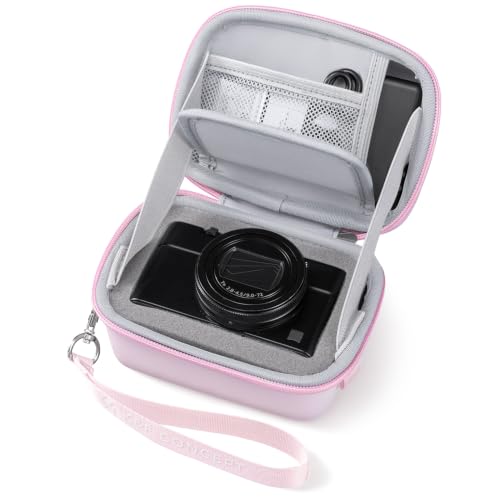
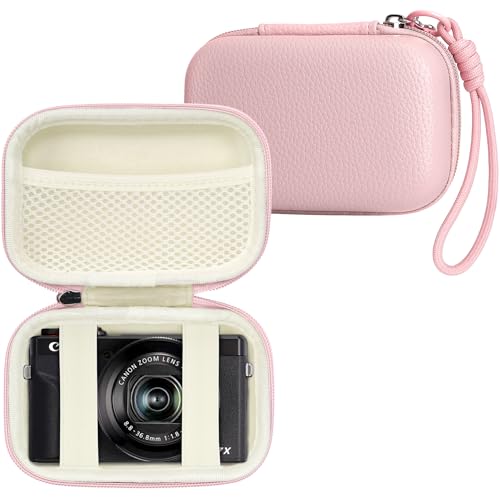
Hard EVA cases dominate this selection because they provide a structured outer layer for travel, storage, and everyday handling. The JJC Hard Belt Compact Camera Travel Pouch, K&F CONCEPT Hard Shell Protective Camera Case, Canboc Case for Canon PowerShot G7 X, and Linpr Digital Camera Case all document hard-shell construction. Several add soft fabric, fleece, foam, or velvet linings to reduce contact between the camera and the case interior.
A hard shell is useful when a case may be pressed inside a backpack or suitcase. The K&F CONCEPT model goes further with custom-fit foam inserts and a divider, while the ProCase Small Digital Camera Case lists a padded divider and two layers of anti-shock material. These designs are more structured than a flexible sleeve, but they can occupy more space.
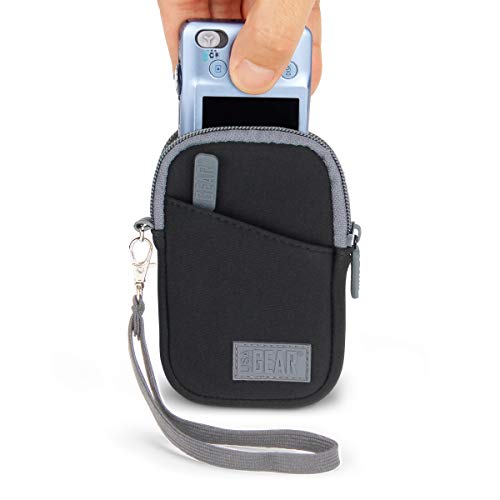
These are suitable formats when a lightweight layer and quick access are priorities. The supplied evidence does not establish the same crush resistance as the hard cases, so they are better matched to less demanding carry conditions.
Match the case to the camera
Compatibility lists are helpful, but dimensions remain decisive. The CVVD Hard EVA Case for Kodak PIXPRO is listed at 4.7 x 3.6 x 1.8 inches externally, and the ProCase case is listed at 4.9 x 3.4 x 2.4 inches. These details make the two cases easier to compare against a small Kodak PIXPRO-style camera.
For Canon PowerShot G7 X users, the Canboc Case for Canon PowerShot G7 X and Linpr Digital Camera Case for Canon G7X both document compatibility with G7 X Mark II and Mark III models. The JJC pouch and K&F CONCEPT hard case list wider compatibility across models such as Ricoh GR, Sony RX100, Sony ZV-1, and Canon G7 X. Wider compatibility does not mean universal fit, however; lens position, controls, and camera depth still matter.
The BAGSMART Small Puffy Digital Camera Case lists a 5.51 x 3.40 x 2.56-inch internal dimension and warns that it is not suitable for 4K cameras or non-retractable lenses. That kind of limitation is useful information rather than a defect: it tells shoppers when to move to a different design. The YINKECASE case does not provide case or interior dimensions in the supplied specifications, so buyers should rely particularly heavily on the listed camera-model guidance.
Consider how much you carry
A case with only a main compartment is appropriate when the camera travels alone. Dedicated storage becomes more useful when you carry a charging cable, spare battery, memory card, or card reader. The JJC pouch has a lower camera compartment and upper mesh pocket. K&F CONCEPT provides top and side pockets plus a divider. Linpr lists an inner mesh pocket for batteries, cables, and card readers.
The CVVD, ProCase, Comecase, and YINKECASE designs also document accessory storage. YINKECASE is the clearest option for card organization because it lists a dedicated SD-card slot alongside mesh pockets. ProCase adds a clear pocket for a memory card or adapter, while Comecase separates cables and a charger in a zippered mesh pocket. Keep hard accessories away from the camera body when possible; a divided layout makes that easier.
Pick the carry method that fits your routine
A wrist strap works well for quick hand carry and short outings. Belt loops add hands-free access: USA Gear includes one, and the JJC pouch offers belt-style carrying along with handheld, diagonal, and hook options.
For longer walks or travel, a shoulder strap can distribute the case differently. JJC and BAGSMART list shoulder straps, and the K&F CONCEPT hard case includes both shoulder and wrist straps. A removable strap is useful when the case will spend part of the trip inside a larger bag. The choice is mainly about access and handling, not a universal performance advantage.
Compare shape and portability
Compactness depends on both dimensions and internal layout. The USA Gear pouch has a particularly small listed interior, while the CVVD case lists a slim 1.8-inch exterior height. The Linpr case measures 5.3 x 3.7 x 2.4 inches, and the JJC pouch lists a 5.1181-inch length and width with a 1.41732-inch height in its specifications. Always compare the same measurement type: some listings provide external dimensions and others provide interior or limiting dimensions.
Padded cases can be more comfortable for accessories but may be larger. BAGSMART lists a 6.1-inch length, 3.15-inch width, and 3.94-inch height in its specifications, while its stated interior is smaller. The K&F CONCEPT case also uses foam inserts that can affect usable room. If the case will go into a small purse, jacket pocket, or tightly packed day bag, prioritize the documented exterior dimensions.
How this comparison was made
This is a specification-based comparison using public listing data, not a hands-on test and not a summary of customer opinions. The editorial criteria assess protective construction, camera fit and compatibility, accessory organization, carry and access design, compact portability, and materials or finish. Products were selected only when their titles, features, and specifications independently established them as compact-camera cases. The rankings reflect the completeness and usefulness of the supplied product evidence; they do not claim tested durability or confirmed fit for every camera model.
Final Recommendation
JJC Hard Belt Compact Camera Travel Pouch ranks first overall in this specification-based comparison under the published weighted criteria.
The JJC Hard Belt Compact Camera Travel Pouch is the highest-scoring returned product and the first overall specification-based choice among the best compact camera cases. Its hard EVA construction, protective lining, model coverage, accessory pocket, and four carrying methods give it the broadest documented utility in this comparison.
Choose the K&F CONCEPT Hard Shell Protective Camera Case if structured foam protection and separated storage matter most. For a Canon G7 X, the Canboc Case for Canon PowerShot G7 X and Linpr Digital Camera Case offer clearly documented compatibility. Kodak PIXPRO users can compare the CVVD, ProCase, Comecase, and YINKECASE cases by interior guidance and storage layout.
The top compact camera cases differ mainly in shell structure, fit guidance, and carrying method. Use USA Gear when a lightweight neoprene pouch is sufficient, or BAGSMART when you want a padded case with both shoulder and wrist carrying. In every case, verify the camera dimensions before selecting a model.
Frequently Asked Questions
What should I measure before choosing one of the best compact camera cases?
Measure the camera’s full length, width, and depth with its battery and any attached strap hardware removed if those parts affect the fit. Compare the result with the case’s stated interior or limiting size. A listed compatibility model is helpful, but it does not replace a dimension check.
Are hard EVA cases better for travel?
Hard EVA cases provide a structured outer layer and are documented on models such as the JJC Hard Belt Compact Camera Travel Pouch, K&F CONCEPT Hard Shell Protective Camera Case, and Canboc Case for Canon PowerShot G7 X. They may take more room than neoprene. Select the format that matches how the camera will be carried and stored.
Which selected cases store memory cards or cables?
The JJC, K&F CONCEPT, Linpr, CVVD, ProCase, Comecase, and YINKECASE cases document pockets or compartments for accessories. YINKECASE specifically lists an SD-card slot, while ProCase lists a clear pocket for a memory card or adapter. The K&F CONCEPT case adds multiple pockets and a divider.
Which case is easiest to carry by hand?
The JJC pouch offers a hand strap, shoulder strap, belt-style carry, diagonal carry, and hook-style carry. Choose based on whether you want quick hand access, hands-free carry, or storage inside another bag.
Is a neoprene pouch suitable for every compact camera?
No. They may be less suitable when rigid crush protection is important. Check the camera size and choose a hard EVA design when the supplied fit and protection details better match your carrying conditions.