Buying Guide
The best large camera cases are not all built for the same job. A sealed hard case is usually the better fit for checked transport, wet locations, or equipment that must remain inside a protective shell. A camera backpack is often more practical for walking, stairs, and quick access. Start by deciding whether you need a rigid enclosure, a padded soft-sided bag, or a compromise such as a hardshell backpack.
Choose the case type first
Rigid cases such as the NANUK 935, Pelican Vault V525, Monoprice Weatherproof Hard Case, VEVOR Weatherproof Hard Case, Lykus PVC1, and STARTRC VCR use hard outer shells and protective interiors. These designs are the most specification-aligned match when impact resistance, dust control, or water sealing matters. The NANUK, Lykus, and STARTRC listings specifically document IP67 protection; the VEVOR listing documents IPX67, while the Monoprice case is also listed as IP67. The Pelican case is described as weather resistant rather than with a stated IP rating.
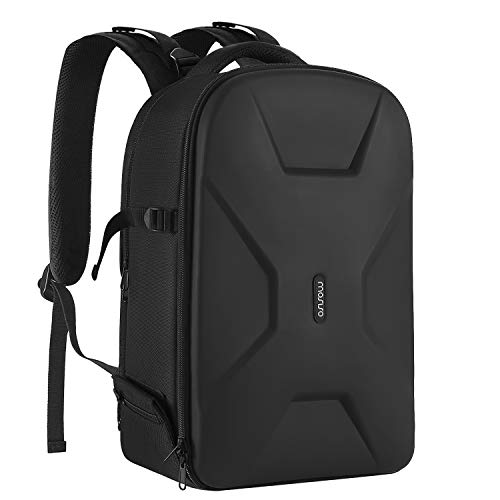
Backpacks such as the two MOSISO models, CADeN D6, and Cwatcun emphasize mobility and access. They use padded inserts, dividers, pockets, or straps instead of a sealed enclosure. This can make them easier to carry during a full day, but the listings should be read carefully: water-resistant, splash-proof, and rain-cover language is not equivalent to an IP-rated waterproof shell.
Match the interior to your equipment
Check interior dimensions where they are supplied, not only labels such as “large.” The NANUK 935 lists a 20.5 x 11.3 x 7.5-inch interior, while the Pelican Vault V525 lists 19.9 x 10.6 x 7.3 inches. Monoprice lists a 20.1 x 10.9 x 6.8-inch interior and a 1,497-cubic-inch volume. These figures are useful starting points for camera bodies, long lenses, drones, and chargers, but the arrangement of the inserts matters just as much as raw space.
Padded dividers are convenient when equipment changes frequently. They let you create compartments without cutting material and are used by the NANUK, Pelican, Lykus, STARTRC, and backpack selections. Pick-and-pluck or pre-cut foam can create a close-fitting layout, as seen with Monoprice and VEVOR, but the fit may be less convenient to revise later. For small accessories, the Lykus mesh pockets and the backpacks’ lid or front pockets provide more dedicated organization than a plain foam block.
Consider weight and transport
A large case can become difficult to move once loaded. Wheels and telescoping handles make the NANUK, Pelican, and VEVOR options better suited to airports, vehicles, and smooth surfaces. They also add structure and weight. The handheld STARTRC case and Lykus case are more compact to carry by hand, while the backpacks distribute weight across the shoulders and can be easier for walking between locations.
The MOSISO backpacks add trolley compatibility or a luggage strap, depending on the model. The CADeN and Cwatcun options focus on lightweight carrying. These designs are useful when mobility is more important than a sealed shell, but photographers should leave room around the camera body and lens rather than filling every compartment to capacity.
Check travel and closure details
Air travelers should compare the outside dimensions with their airline’s current rules. The NANUK 935 and Pelican V525 listings both describe carry-on positioning, but airline limits can vary. Lock-ready eyelets or lock hasps can help secure a case, although a lock may be a separate purchase.
Build a fit checklist
Before choosing, measure the longest lens with its hood orientation, the tallest camera body, and the combined height of any charger or drone accessories. Then compare those measurements with the stated internal dimensions. Confirm whether the case includes foam, padded dividers, or only an empty compartment. Also consider whether you need a tripod holder, laptop space, side access, or a mesh pocket for cards and batteries.
For a wet or dusty environment, prioritize a documented IP rating and a hard shell. For city travel and frequent access, prioritize removable dividers, padded shoulder straps, and external organization. For airport movement, wheels and a retractable handle may justify additional bulk. These practical distinctions matter more than a “large” label alone.
Final recommendation
NANUK 935 Hard Case ranks first overall in this specification-based comparison under the published weighted criteria.
The final choice among the best large camera cases depends on the documented features that match your intended use.
NANUK 935 Hard Case is the highest-scoring returned product and the first overall specification-based choice. Its IP67 shell, adjustable padded divider system, wheels, retractable handle, lid stays, and listed carry-on positioning give it the most balanced specification set for serious travel and mixed camera equipment.
The Pelican Vault V525 is a close alternative for a rolling padded-divider layout. Choose the Monoprice case when a large foam interior and IP67 protection are the priority, or choose the VEVOR case when pre-cut foam, wheels, and a pressure-equalization valve fit the assignment. The Lykus PVC1 and STARTRC VCR are compelling handheld hard cases, especially when divider flexibility matters.
Among the top large camera cases in backpack form, the newer MOSISO model offers the most complete access and weather-cover package, while the older MOSISO model adds tripod and trolley features. CADeN D6 and Cwatcun are sensible lightweight choices for multi-lens daily carrying. Overall, select by equipment dimensions and weather needs first, then refine the decision around transport style and accessory organization.
Frequently Asked Questions
What makes the best large camera cases different from ordinary bags?
The best large camera cases provide a documented combination of protective construction, usable internal capacity, and a way to keep gear separated. Hard cases such as the NANUK 935 and Pelican Vault V525 add rigid shells and padded divider systems. Backpacks such as the MOSISO models use padded inserts and quick-access pockets instead. The right choice depends on whether impact and sealing or walking comfort and access matter more.
Are all large camera cases waterproof?
No. The selected hard cases with IP67 or IPX67 documentation provide clearer sealing claims than fabric backpacks. The MOSISO, CADeN, and Cwatcun listings describe rain covers, water resistance, or water-repellent fabric rather than an IP-rated enclosure. Review the exact protection language and avoid treating light-rain protection as equivalent to a sealed hard case.
Is foam or a padded divider system better?
Foam can provide a close-fitting arrangement, while padded dividers are easier to rearrange for changing equipment. Monoprice and VEVOR document foam-based interiors. NANUK, Pelican, Lykus, STARTRC, and the selected backpacks document adjustable or removable divider systems. Foam is useful for a stable setup; dividers are usually more flexible for photographers who change lenses or carry different kits.
Which large case is easiest to move through an airport?
The NANUK 935, Pelican Vault V525, and VEVOR case have wheels and pull handles documented in their listings. The NANUK and Pelican also describe carry-on positioning, although travelers should confirm current airline dimensions. A backpack may be easier on stairs or uneven ground, but it does not provide the same rolling convenience or rigid-shell format.
How should I verify that a case will fit my camera gear?
Measure the camera body, attached lens, longest loose lens, and tallest accessories. Compare those measurements with the case’s interior dimensions when available, then account for divider thickness and the shape of the lid. Do not rely on the word “large” or a camera compatibility list alone. A flexible divider layout can help, but it cannot create additional height or length inside a closed case.