Buying Guide
The best copper screw terminals are selected by matching the terminal’s physical interface, conductor range, and protection to the installation. A battery post, a bus bar, a ring lug, an audio binding post, and a PCB terminal block all use screw-based fastening, but they are not interchangeable. Start with the connection type, then verify the conductor size, stud or pitch dimensions, insulation, and documented electrical limits.
Battery and junction posts are intended to provide a stud or threaded connection point. The AYWGZL, Jiozermi, and MARSTEK products are in this group. Their red-and-black identification can help with polarity, while the stated M8, M6, or 1/4-inch sizing gives you a starting point for checking hardware compatibility. Jiozermi provides especially useful length and thread-hole measurements; AYWGZL documents an M8 or 5/16-inch size; MARSTEK offers a larger assortment of detachable posts.
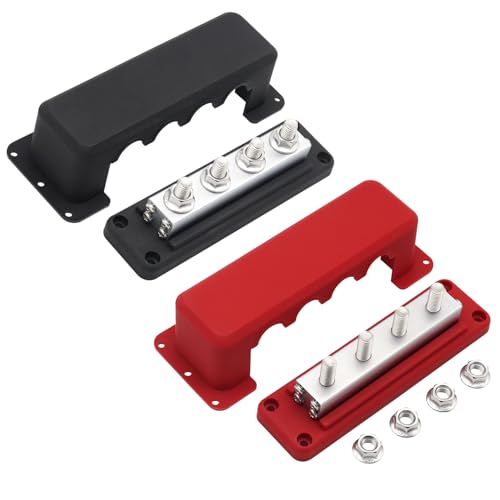
Bus bars are better when several circuits must share an organized distribution point. Ambuker uses four terminal studs and a covered distribution-block design for 12–48V DC applications. Bonsicoky provides 10 positions per bar, while RLECS provides eight positions per bar and lists mounting-hole spacing. These layouts can reduce scattered connections, but the absence of a stated current rating on Bonsicoky and RLECS means the installer should not infer a safe load from the position count alone.
Ring lugs are a different format. Ancor’s product is a 4 AWG tinned copper lug with a 5/16-inch screw hole, rather than a complete binding post. It is appropriate when a cable end must be fastened under a separate screw or stud. The listing specifies a seamless barrel, closed end, and UL 486A, but it also makes clear that the lug is intended to be crimped. That makes tool selection and correct crimping part of the installation.
Match wire size and interface dimensions
Do not select a terminal based only on the word copper. Check whether the product accepts the wire gauge, cable lug size, screw diameter, or board pitch required by the project. Tanbupu is documented for 6, 8, and 10 AWG wire and includes screw hardware for its splice connectors. E-Simpo covers 24–12 AWG wire at a 2.54 mm pitch, making it a much smaller-format choice. DIYhz is aimed at speaker wiring and combines a 4 mm banana socket with a 3.5 mm bare-wire through-hole.
For bus bars and battery posts, compare the terminal stud with the cable lug opening and the available clearance around the connection. Ambuker lists M10 studs that are also suitable for M8, while the AYWGZL posts are listed as M8 or 5/16 inch. These details may look close, but metric and fractional hardware should still be checked directly before ordering. Confirm the mounting-hole pattern for a bus bar; RLECS supplies an 83 mm center distance, whereas other listings may leave that measurement unspecified.
Consider material claims carefully
The supplied listings use pure copper, tinned copper, brass, and copper contact material. Ancor specifies annealed tinned copper, which adds a documented finish intended to resist salt and moisture. Ambuker identifies a tinned copper distribution block. Brass appears in MARSTEK, Bonsicoky, and Tanbupu, while Bonsicoky and RLECS separately identify copper contact material.
Material wording alone does not establish a complete electrical rating. A product can document copper construction without stating current capacity. Where capacity matters, prefer listings with an explicit rating, such as Ambuker’s stated 600A continuous figure, Tanbupu’s 80A figure, or E-Simpo’s 6A and AC 150V figures. For products without a documented rating, use the terminal only after consulting the manufacturer’s complete installation information and applicable electrical requirements.
Review insulation and environmental protection
Insulation may be part of the terminal body, a separate cover, or an included accessory. Ambuker uses a flame-retardant nylon fiberglass base and cover. MARSTEK describes insulation and flame-retardant material, while Jiozermi specifies bakelite insulating material. Bonsicoky and RLECS use plastic insulating bases. DIYhz uses insulated ABS housings with red-and-black markings.
Moisture protection is especially relevant in marine, automotive, and outdoor work. Ancor’s closed-end tinned copper lug is described as sealing out moisture, and Tanbupu includes heat-shrink tubing with a corrosion-focused finish. Those features can support environmental protection, but they do not replace proper cable preparation, enclosure selection, tightening, or inspection. E-Simpo and the bus bars are better understood as component-level products for an appropriate panel, board, box, or enclosure.
Verify ratings before installation
A stated rating is useful only when the application matches its conditions. E-Simpo’s AC 150V and 6A figures apply to its small PCB terminal blocks. Tanbupu states up to 80A for its wire connectors. Ambuker provides the most detailed high-current claim in this selection, including 600A continuous capacity and 12–48V DC applications. Do not transfer one product’s rating to another product with a similar appearance.
Also check whether the terminal needs crimping, a screwdriver, an Allen wrench, or separate mounting hardware. Tanbupu includes an Allen wrench, E-Simpo is a screw terminal block for PCB use, and Ancor’s lug requires a suitable crimping process. Disconnect power before wiring and follow the product’s specified wire-strip length and tightening instructions when available.
Final Recommendation
Ambuker 600A Copper Distribution Bus Bar ranks first overall in this specification-based comparison under the published weighted criteria.
Ambuker 600A Copper Distribution Bus Bar is the highest-scoring returned product and the first overall specification-based choice. Its documented tinned copper block, four M10 studs, protective cover, broad vehicle and marine applications, and stated current and voltage limits make it the most specification-aligned fit for high-current distribution.
The best copper screw terminals for smaller battery-post projects are AYWGZL, Jiozermi, and MARSTEK, with size and package quantity determining the better match. Choose Ancor when a crimped tinned-copper ring lug is the correct interface. Tanbupu is the most clearly equipped splice kit, while Bonsicoky and RLECS suit organized multi-position wiring. DIYhz is the specialized audio choice, and E-Simpo is the compact PCB option.
These top copper screw terminals cover several designs rather than one universal terminal. Before buying, confirm the wire gauge, stud or pitch, mounting pattern, current and voltage requirements, and whether the connection needs environmental sealing or a separate crimping tool.
Frequently Asked Questions
What are the best copper screw terminals for high-current distribution?
Ambuker is the most specification-aligned documented choice in this comparison for high-current 12–48V DC distribution because its listing states a 600A continuous capacity, identifies a 19 mm tinned copper block, and provides four M10 studs with a protective cover. Confirm that the stated rating and dimensions match your wiring system before installation.
Are brass terminals the same as pure copper terminals?
No. The listings distinguish between pure copper, tinned copper, brass, and copper contact material. MARSTEK and Tanbupu describe brass components, while AYWGZL and Jiozermi explicitly describe pure copper. Bonsicoky identifies brass construction and copper contact material. Compare the complete specification rather than treating these terms as identical.
Which terminal should I use for a PCB?
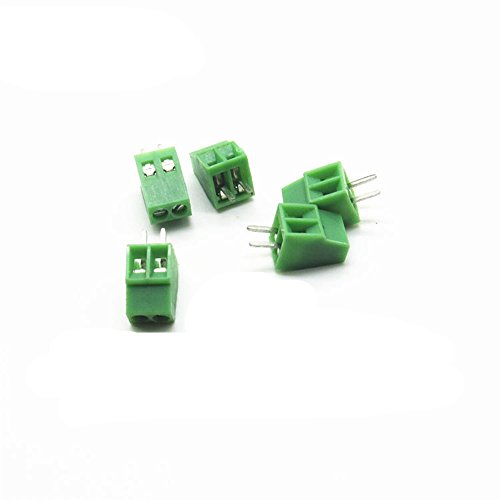
E-Simpo is the clearest PCB-oriented option here. It documents a 2.54 mm pitch, 24–12 AWG wire range, brass pins, and AC 150V and 6A ratings. Check the board footprint and the listing’s note that the blocks cannot be spliced. Large battery posts and bus bars are not substitutes for a PCB terminal block.
Do copper screw terminals need crimping?
It depends on the design. Ancor’s ring lugs are intended to be crimped, while Tanbupu’s screw connectors are designed for inserting wire and tightening screws. Binding posts and bus bars generally provide a stud or screw connection point. Follow the specific product instructions and use compatible wire, hardware, and tools.
How should I choose between a bus bar and a battery stud?
Choose a bus bar when you need multiple organized connection positions, such as Ambuker, Bonsicoky, or RLECS. Choose a battery stud when you need a smaller connection point for one or more cables, such as AYWGZL, Jiozermi, or MARSTEK. Compare the number of circuits, stud size, mounting space, insulation, and documented capacity before selecting one.