Buying Guide
Choosing the best car tweeters with crossovers starts with the electrical handoff between the tweeter and the midrange driver. A crossover blocks lower frequencies from reaching the small high-frequency driver. In this comparison, that protection appears as an in-line crossover, a built-in capacitor, or an external passive network. These terms describe related filtering approaches, but they do not provide identical adjustment or installation possibilities.
Match the crossover type to the system
An external passive network, such as the MB Quart FT1-25 design, gives the installer more visible system information. Its listing documents a Butterworth topology and a 12 dB/octave slope. That can make wiring and planning more deliberate when the system has separate midrange and tweeter paths.
Several other selections use a built-in capacitor or in-line filter. The Rockville RT6, PRV TW150SD-4, and DS18 bullet models fall into this general group. These arrangements are compact and can simplify a passive installation, but the listing may not provide a complete slope or adjustable output range. The AudioControl A1 is more adjustable because its passive in-line filter includes 0 to +3 dB control.
Do not assume that every included filter is interchangeable with an active crossover. The AudioControl listing recommends a 4,500 Hz high-pass filter, while the PRV listing describes response above 2 kHz and the Rockville listing gives a 1.3 kHz–24 kHz range. Treat those figures as product documentation, then compare them with the crossover point already used by your head unit, amplifier, or DSP.
Consider driver material and sound-system design
The selected products document several driver approaches. Silk and soft-dome designs appear in the Rockville RT6, Orion COTW1, Orion CT-T15, NVX VSPTW, PRV TW150SD-4, and AudioControl A1. Aluminum or titanium bullet designs appear in the DS18, MB Quart, and BONCHIZIA models. The material alone does not establish a listening result, but it is a useful way to distinguish designs and anticipate installation priorities.
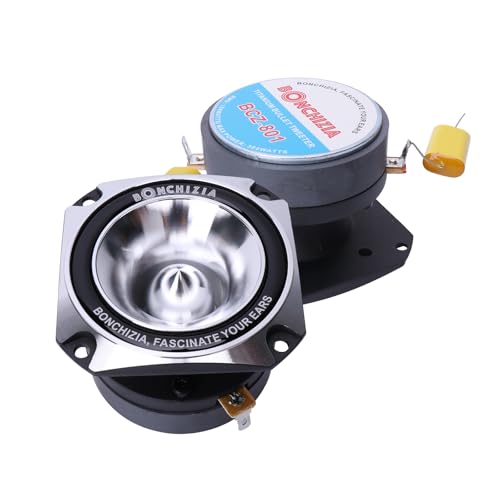
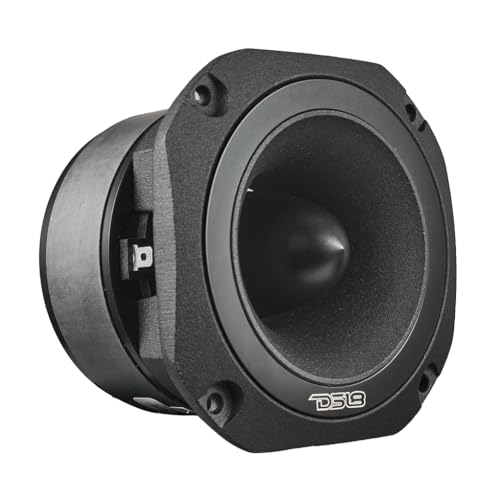
A bullet tweeter may suit a system where high output and a prominent physical format are part of the design. The DS18 PRO-TW220 lists 225W RMS handling, while the BONCHIZIA BCZ-801 lists 150W RMS per tweeter and 104 dB SPL. By contrast, compact silk domes generally offer more restrained physical designs. The AudioControl A1 lists a 1.67-inch housing diameter and a 0.39-inch mounting depth.
Check power handling and impedance together
Power figures should be read with impedance and package quantity. The Rockville RT6 lists 60W RMS per pair, the NVX VSPTW lists 150W RMS per pair, and the DS18 PRO-TWX1 lists 120W RMS per tweeter at 4 ohms. The MB Quart FT1-25 lists 50W RMS and 4-ohm impedance. These are not directly interchangeable figures because some are stated per pair and others per individual driver.
The Orion COTW1 and CT-T15 both document 4-ohm impedance, but their RMS figures differ: 50W for the COTW1 and 30W for the CT-T15. AudioControl lists 50W RMS at 4 ohms. Use the RMS specification when comparing amplifier compatibility, and avoid treating maximum or peak figures as continuous handling.
Measure the mounting location
Physical fit can decide between otherwise similar products. The AudioControl A1 is specifically documented for shallow mounting. The PRV TW150SD-4 also has a shallow profile, while the MB Quart FT1-25 lists a 0.70-inch chassis depth. Rockville provides flush, surface, and angle hardware, and NVX provides surface, angle, and flush mounting.
Bullet formats can occupy more visible or rear clearance. The BONCHIZIA BCZ-801 listing gives dimensions of 2.36 by 2.56 by 3.11 inches, and the DS18 PRO-TW220 lists a 3.46-inch length and width. Check the cutout, housing diameter, depth, terminal clearance, and grille or panel clearance before selecting a replacement location.
Decide between a pair and a larger package
Package quantity varies across the category. Rockville, Orion, PRV, DS18 PRO-TW220, DS18 PRO-TWX1, AudioControl, NVX, and BONCHIZIA are presented as pairs in their titles or evidence. MB Quart lists four tweeters, while the individual power figures help clarify how that set is configured. A larger package may suit multiple rows or a multi-zone system, but it can be unnecessary for a standard front-stage installation.
Final recommendation
Rockville RT6 Silk Dome Tweeters ranks first overall in this specification-based comparison under the published weighted criteria.
Rockville RT6 is the highest-scoring returned product and the first overall specification-based choice for the best car tweeters with crossovers. Its combination of a 1.3 kHz–24 kHz stated range, in-line crossover, 4-ohm design, ferro-fluid cooling, and three mounting approaches gives it unusually broad documented coverage.
For a more detailed external filter, the MB Quart FT1-25 is one of the top car tweeters with crossovers to consider because its listing identifies the topology, slope, depth, and response range. AudioControl A1 is the more suitable direction when shallow fitment and adjustable filter output matter most. NVX VSPTW offers a well-documented silk-dome alternative with three mounting positions, while DS18 PRO-TW220 and BONCHIZIA BCZ-801 focus on aluminum or titanium bullet construction and higher stated handling.
Before installation, confirm the amplifier’s continuous output, the intended crossover point, the tweeter’s impedance, package quantity, and the available mounting depth. Those checks are more useful than relying on a single headline power number.
Frequently Asked Questions
They include a documented filtering component intended to limit lower frequencies reaching the tweeter. The filtering may be an in-line capacitor, a passive in-line network, or an external crossover. The products in this comparison use different implementations, so check whether the listing provides a slope, high-pass recommendation, or adjustment range.
Neither material is automatically better for every installation. Silk and soft-dome products in this guide emphasize compact formats, while aluminum and titanium bullet models document higher output-oriented specifications. Match the design to the available space, amplifier system, crossover arrangement, and the type of driver construction you want to use.
How should I match tweeter power handling?
Compare RMS handling rather than maximum or peak handling, and check whether the figure applies to one tweeter or a pair. Also verify impedance. For example, the Orion COTW1 lists 50W RMS at 4 ohms, while the AudioControl A1 lists 50W RMS and the DS18 PRO-TWX1 lists 120W RMS per tweeter at 4 ohms.
Fit depends on the vehicle opening and the product dimensions. AudioControl documents a shallow 0.39-inch mounting depth, and PRV describes its model as suitable for tight spaces. Rockville, NVX, Orion, and other selections document flush or surface options. Measure the cutout and clearance before wiring or modifying a panel.
Why does the crossover frequency matter?
The crossover frequency determines where the tweeter begins receiving content. A lower handoff can expand the tweeter’s duties, while a higher handoff can reduce the low-frequency load. The listings differ: AudioControl recommends a 4,500 Hz high-pass filter, while Rockville documents a range beginning at 1.3 kHz. Use the product documentation alongside your system’s existing settings.