Buying Guide
The best 1-ohm car mono amplifiers are not interchangeable simply because their titles mention the same load. A useful comparison starts with the amplifier’s documented RMS output at 1 ohm, then considers whether the controls, inputs, cooling, and chassis fit the intended vehicle and subwoofer system. The figures below come from public listing data, not bench testing.
Match RMS output to the subwoofer system
Start with the subwoofer manufacturer’s recommended power range and final wired impedance. A 1-ohm amplifier should be connected only after the subwoofer configuration is confirmed to present the intended load. The Alpine R2-A150M is described as a 1500-watt-at-1-ohm model and is positioned for two 10- or 12-inch R-Series subwoofers, or four 8-inch R-Series subs in a documented configuration. That system-matching detail makes it different from a generic high-output listing.
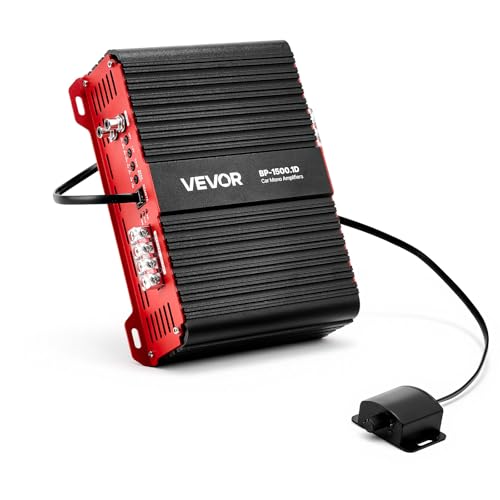
For higher-output bass systems, the Stetsom Bravo Attack 3000 and Timpano TPT-BASS3000 list 3000 watts RMS for a 1-ohm or bass-focused setup. PRV Audio’s RS2200 BASS lists 2200 watts RMS for bass applications, while the Stinger MT20001 and VEVOR BP-1500.1D occupy a lower stated output tier. Do not treat a larger number as automatically better: the amplifier, subwoofer, electrical system, enclosure, and wiring must be compatible.
Check how clearly the output is specified
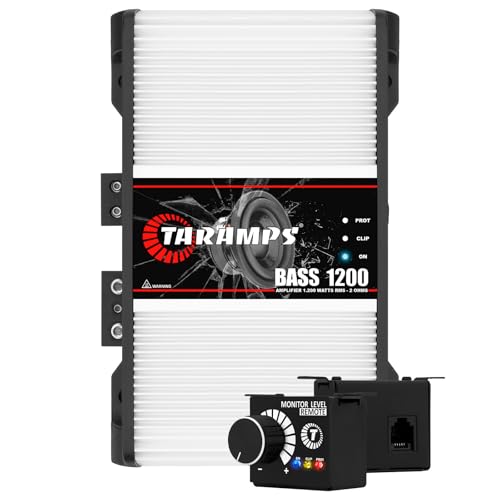
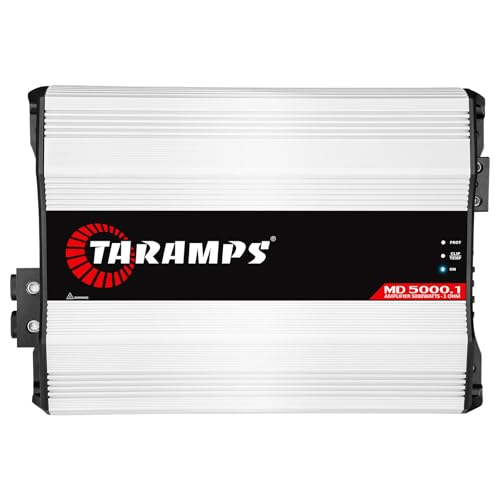
Output documentation is especially important at 1 ohm because sellers may present peak, maximum, and RMS figures together. Taramps gives a useful specification by stating 1200 watts RMS at 1, 2, and 4 ohms. Orion also provides a multi-load table: 800 watts RMS at 1 ohm, 450 watts at 2 ohms, and 300 watts at 4 ohms. These tables make it easier to anticipate how the amplifier relates to a future impedance change.
The Stinger listing includes a 2000-watt RMS description but also contains conflicting impedance and output wording. That does not make the model unusable, but it does mean the final manual or manufacturer documentation should be checked before installation. A clear listing is helpful, yet the published number remains a specification rather than a guarantee of a particular in-car result.
RCA line-level input is common in aftermarket systems, but it may not be available from a factory head unit without an adapter. High-level input can simplify integration with speaker wires when it is explicitly supported. NVX documents speaker-level input and signal-sensing turn-on. PRV Audio’s RS2200 BASS and VEVOR’s BP-1500.1D also document high-level compatibility. Taramps lists both RCA and high-level inputs, which gives it added flexibility when the source unit may change.
By contrast, the supplied evidence for Orion identifies low-level RCA input, and the Stinger listing identifies one RCA line-level input. Those models may still be appropriate for aftermarket receivers with preamp outputs, but the connection plan should be established before choosing an amplifier.
Look for practical tuning controls
A low-pass filter helps direct low frequencies to a subwoofer, while a subsonic filter can be useful when the enclosure and system design call for limiting very low content. Bass boost is an adjustment rather than a substitute for correct gain setting. NVX lists a 50-to-250Hz low-pass filter, a 10-to-55Hz subsonic filter, and adjustable bass boost. PRV Audio’s RS2200 BASS lists a 5-to-40Hz subsonic range, a 50-to-200Hz low-pass range, and bass boost at 35Hz.
The Stetsom Bravo Attack 3000 provides broad HPF and LPF controls and multiple boost modes, making it adaptable to a full-range or specialized system. Orion lists low-pass, subsonic, bass boost, and phase shift. The PRV Audio MDX1800.1 is a different design: it is presented as a full-range amplifier for midbass, midrange, full-range speakers, drivers, and tweeters, but the supplied evidence does not list detailed crossover ranges. That distinction matters if the goal is a straightforward subwoofer-only installation.
Evaluate cooling and protection
Class-D construction appears throughout this group and is commonly associated in the listings with efficient operation and reduced heat. It should not, however, remove the need for ventilation, correct wiring, and secure mounting.
Among the selected models, Stetsom documents smart coolers and LED diagnostic patterns. Timpano lists smart silent coolers, power and protection indicators, and four-way protection. VEVOR lists a built-in fan plus temperature, overcurrent, and overvoltage protection. NVX lists thermal, overload, speaker-short, and DC-offset protection. These features are useful evidence for installation planning, but they do not replace the manufacturer’s wiring and ventilation instructions.
Measure the available mounting space
Physical dimensions can eliminate an otherwise suitable amplifier. The PRV Audio MDX1800.1 has a compact stated footprint of 6.6 by 5.9 by 2.6 inches. NVX lists a 9.37-by-4.42-by-1.73-inch design, while VEVOR lists 6.89 by 8.86 by 2.95 inches. PRV Audio’s RS2200 BASS is 8.5 by 5.9 by 2.6 inches.
Larger high-output options need more careful planning. Orion lists a 14-by-8-inch chassis, and Alpine lists a 15.5-by-10-by-5-inch enclosure weighing the current price. Leave room for cables, ventilation, adjustment access, and mounting hardware rather than measuring only the amplifier body.
Plan the electrical installation
Higher-output 1-ohm systems can require substantial current. The Stetsom listing specifies a 150A fuse and 4 AWG power and ground connections. Taramps recommends a 65A circuit breaker or fuse and identifies 5 AWG power cable. These details are useful planning references, not universal requirements for every vehicle or wiring run. Fuse selection, cable gauge, grounding, and charging-system capacity should follow the amplifier documentation and the installer’s requirements.
A remote level control can also affect cable routing. PRV Audio supplies a 19-foot wired remote, VEVOR lists a 16.4-foot controller cable, and Stinger includes a remote knob with dash or flush-mount options. Those features may be helpful when the amplifier is installed in a trunk or behind a rear seat.
Final Recommendation
Stetsom Bravo Attack 3000 ranks first overall in this specification-based comparison under the published weighted criteria.
Stetsom Bravo Attack 3000 is the highest-scoring returned product and the first overall specification-based choice.
It combines stated 3000-watt RMS output at 1 ohm with full-range stability, broad crossover controls, bass-boost adjustment, smart cooling, LED diagnostics, and documented heavy-gauge connections. It is best suited to a carefully planned high-output installation rather than a minimal subwoofer upgrade.
Alpine R2-A150M is a strong choice among these best 1-ohm car mono amplifiers because its listing combines stated 1-ohm output, Class-D design, system-matching guidance, integrated mounting brackets, and organized controls. It is especially compelling for an Alpine R-Series build rather than as a universal choice for every vehicle.
For higher documented output, the Stetsom Bravo Attack 3000 and Timpano TPT-BASS3000 suit bass systems with cooling and tuning features for more elaborate installations. PRV Audio’s RS2200 BASS is a strong choice when high-level input, a compact chassis, and a long remote cable matter. NVX offers a balanced feature set for a compact aftermarket or factory-integration project, while Taramps is useful when clear multi-impedance output information is a priority.
The top 1-ohm car mono amplifiers still require careful matching. Confirm the subwoofer’s final impedance, compare RMS ratings rather than headline maximum figures, verify available input types, and measure the mounting area before ordering. The PRV Audio MDX1800.1 is suited to space-limited vehicles, Orion provides a clear multi-load option, and VEVOR is a factory-system-oriented alternative. These recommendations reflect the supplied specifications only, not customer feedback or hands-on performance testing.
Frequently Asked Questions
What should I confirm before installing one of the best 1-ohm car mono amplifiers?
Confirm that the subwoofer wiring presents a 1-ohm load supported by the amplifier, then compare the amplifier’s documented RMS output with the subwoofer’s recommended range. Check input compatibility, fuse and cable guidance, ventilation, mounting clearance, and whether a remote level control is included or supported.
Is a 1-ohm amplifier always better than a 2-ohm amplifier?
No. A 1-ohm design may provide a useful match for a particular subwoofer wiring configuration, but the correct choice depends on the subwoofer’s final impedance, required power, vehicle electrical system, and available installation space. Taramps and Orion illustrate why it is useful to examine output at several impedances rather than focusing on one headline number.
Not necessarily, but high-level input can simplify connection to speaker wires when a factory receiver lacks RCA preamp outputs. NVX, PRV Audio’s RS2200 BASS, VEVOR, and Taramps document high-level support. An amplifier listing that identifies only RCA input may require a separate signal-conversion approach, so verify the source unit and installation plan first.
What do subsonic and low-pass filters do?
A low-pass filter limits higher frequencies sent toward a subwoofer, while a subsonic filter limits very low frequencies below the selected point. Their useful settings depend on the enclosure, subwoofer, and system design. NVX, PRV Audio, Timpano, Stetsom, Stinger, and Orion document some combination of these controls, but the ranges and available functions differ by model.
Which selected model fits a tight space?
The PRV Audio MDX1800.1 has a compact stated footprint at 6.6 by 5.9 by 2.6 inches. NVX and VEVOR also provide compact dimensions. Always allow additional room for wiring, airflow, adjustment access, and secure mounting; the listed amplifier dimensions alone do not define the complete installation space.