Buying Guide
Picking among the best digital metronomes is mostly about matching documented specs to the way you practice. Every model here states its tempo range, beat subdivisions, and power source up front, so use those numbers as your compass rather than relying on feel alone. The sections below walk through the criteria that actually change daily use, from tempo control to vocal counting.
Understanding Tempo Range and Rhythm Patterns
Tempo range defines how slow or fast a metronome can go, while beat patterns define how each measure is subdivided. The Ulumac AM-709 covers 30-250 BPM with named time signatures like 3/4 and 6/8, which is friendlier than cryptic numbered beat modes. The Korg KDM-3 stretches beat variety with 19 patterns including triplets and claves, making it a strong fit for Latin and odd-meter work. For very fast ensemble passages, the Donner DBM-100 reaches 280 BPM, the highest documented ceiling on this list.
Tap Tempo, Visual Feedback, and Display Clarity
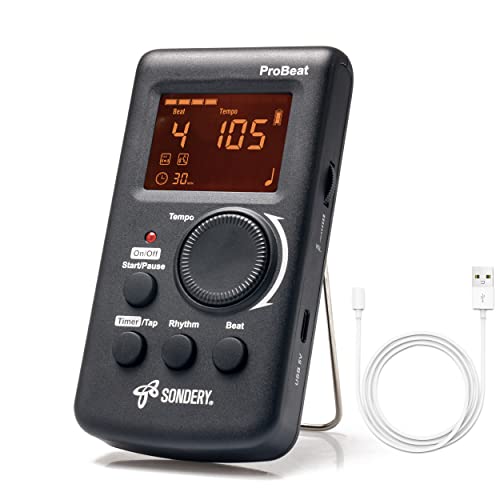
Tap tempo lets you set BPM by tapping a button in time with the music, which is faster than scrolling through numbers. The Sondery ProBeat documents this clearly, while the Ulumac AM-709 uses a front scroll wheel for smooth tempo changes. Visual feedback matters in loud rooms, and LED beat lights on the Ulumac AM-709, Sondery ProBeat, and Sondery iClick give a silent cue when the speaker is muted. Larger color displays like the VA HD LCD on the Donner DBM-100 stay readable in strong light.
Sound Choices, Vocal Counting, and Headphone Output
Standard click sounds cover most needs, but vocal counting is a strong learning aid because spoken numbers reinforce beat placement. The Ulumac AM-709, Sondery ProBeat, and Sondery iClick all document English voice counting, with the iClick offering a softer female option.
Power Design, Runtime, and Portability
Rechargeable lithium batteries are now common and reduce waste, with the Ulumac AM-709 lasting about 8 hours per 1.5-hour charge and the Sondery ProBeat stretching to roughly 10 hours. The Korg MA-2 runs on alkaline cells for up to 400 hours, which is appealing for long rehearsal seasons. For sheer portability, the KLIQ MicroNome is the lightest model on the list and slips into almost any gig bag.
Build Quality, Stands, and Warranty
A folding kickstand makes a metronome easier to read on a piano, and the Ulumac AM-709, EROK AMT-600, and Donner DMT-01 all document some form of stand or bracket. Build weight is a trade-off: heavier units like the Korg KDM-3 sit more steadily on a music desk but are less pocket-friendly.
Instrument Coverage and Time Signatures
If you play more than one instrument, look at how a metronome labels its time signatures. The Ulumac AM-709 lists 1/4, 2/4, 3/4, 4/4, 3/8, and 6/8 directly, while the Korg MA-2 uses numbered beats 0-9 that cover the same ground. Combo devices like the Donner DBM-100, Donner DMT-01, Wegrower unit, and EROK AMT-600 add tuners with modes for guitar, bass, violin, ukulele, and common wind instruments, which saves space in a practice bag.
Timer functions support structured sessions, and the Sondery ProBeat documents 15, 30, 45, and 60 minute timers. Sound out mode and reference tones help with ear training, and the Korg MA-2, Korg KDM-3, and EROK AMT-600 all document some form of pitch reference. The Donner DBM-100 stands out with a trainer rhythm mode that listens through the microphone and flashes feedback, turning the metronome into an interactive coach.
Final Recommendation
Ulumac AM-709 Rechargeable Digital Metronome ranks first overall in this specification-based comparison under the published weighted criteria.
The Ulumac AM-709 Rechargeable Digital Metronome stands out as the first overall specification-based choice among the best digital metronomes thanks to its 30-250 BPM range, named time signatures, English vocal counting, and USB-C power in a folding stand. It balances rhythm flexibility, audio feedback, and portability better than most peers. Players who want a built-in learning layer should also consider the Donner DBM-100, while orchestral users who prioritize battery life may prefer the Korg MA-2. Together these three represent the top digital metronomes covered in this guide.
Frequently Asked Questions
What BPM range should I look for in the best digital metronomes?
Most practice work sits between 40 and 208 BPM, which covers slow ballads to fast etudes. If you play advanced repertoire or need headroom for ensemble work, look for models like the Donner DBM-100 that reach 280 BPM, or wider units like the Korg MA-2 that document tap tempo for setting any pace you can tap.
Do digital metronomes with vocal counting actually help beginners?
Vocal counting reinforces beat placement because spoken numbers add an auditory anchor beyond the click. Models like the Ulumac AM-709, Sondery ProBeat, and Sondery iClick document English voice counting, and the Sondery iClick even offers a softer female voice option for longer sessions.
Is a rechargeable metronome better than one that uses AA batteries?
Rechargeable units such as the Ulumac AM-709 and Sondery ProBeat reduce battery waste and typically charge over USB-C in 1.5 to 3 hours. AA powered models like the Korg MA-2 can run for hundreds of hours on a single set, which suits touring musicians who may not have regular charging access.
Can I use one digital metronome for piano, guitar, and violin?
Yes, as long as the metronome documents wide instrument coverage.
Tap tempo, timer mode, and memory backup make daily practice smoother. The Sondery ProBeat documents all three, the Korg MA-2 adds sound out mode for ear training, and the Donner DBM-100 introduces a trainer rhythm mode that listens and flashes feedback. Among the digital metronomes, those extra tools often decide which model feels best over months of use.