Buying Guide
Choosing among the best studio microphone acoustic treatments comes down to how each product shapes reflections around your microphone and how it fits your recording space. The category spans open reflection filters, foldable multi-panel shields, fully enclosed vocal booths, and room-style acoustic panels, each addressing a slightly different part of the problem. Below are the practical factors that matter most when comparing options for a home or project studio.
Understanding the Main Design Types
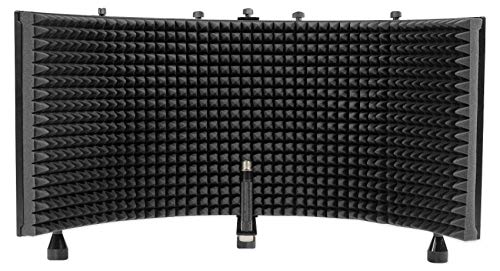
Portable reflection filters and isolation shields are the most common entry point into the best studio microphone acoustic treatments. Models such as the sE Electronics RF-X Reflexion Filter, Aokeo AO-403, and Rockville ROCKSHIELD 3 use layered foam panels to absorb reflections arriving from the sides and rear of a cardioid microphone. They mount on a desk or a mic stand and are ideal when you need a quick, portable solution that turns an untreated room into a workable recording space.
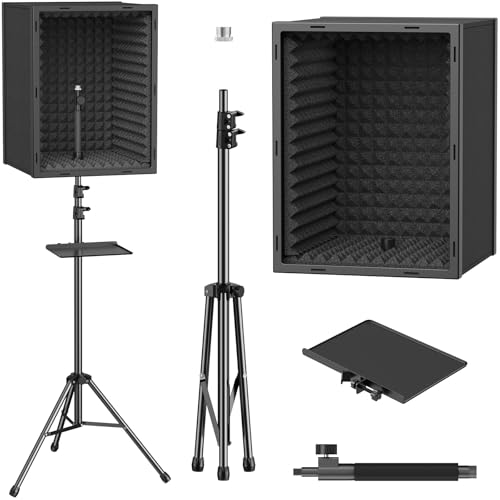
Enclosed vocal booths add a full 360-degree enclosure around the microphone. The TONOR Microphone Isolation Shield, TroyStudio Enclosed Vocal Booth, and Pyle Wood Microphone Isolation Shield form a literal box around the mic, combining foam and dense panels with structural frames. This geometry typically reduces ambient noise and reflections more aggressively than open shields, which is useful for untreated bedrooms, closets, or shared offices.
They complement a microphone-side shield rather than replacing it, helping control slap-back and flutter echo across the entire room. For a complete treatment, many creators combine a mic-side isolation shield with a few wall panels.
Panel Materials and Layering
Layered acoustic design is the core technical story behind the best studio microphone acoustic treatments. Single-density foam panels can absorb mid and high frequencies but may leave low-mid reflections untouched. Multi-layer designs such as the sE Electronics RF-X combine a vented composite panel, wool fabric, an air gap, and foam to broaden absorption across the spectrum.
When comparing layered designs, look for evidence of distinct material types, air gaps, and panel thicknesses of at least 1.5 to 2 inches, since these elements shape how the shield performs across frequencies rather than at one specific band.
Coverage geometry determines how much of the microphone’s pickup pattern is shielded from room reflections. Open shields with two or three panels cover the rear hemisphere of the microphone and work well for cardioid and hypercardioid patterns. Five-panel designs such as the Rockville ROCKSHIELD 3, Aokeo AO-505, and XTUGA MIS02 expand to roughly 50 inches wide, giving wider wraparound coverage in front of the mic.
Fully enclosed booths push coverage further by surrounding the microphone on all sides. The TroyStudio Enclosed Vocal Booth and Pyle Wood Microphone Isolation Shield document 360-degree isolation, and the TONOR booth states prevention of 96 percent of indoor reverb in its product description. If your recordings suffer from obvious room ambience, an enclosed booth often performs more consistently than an open shield alone.
Mounting and Microphone Compatibility
The best studio microphone acoustic treatments work with the stands and microphones you already own. Most shields ship with 5/8-inch adapters, and several include 3/8-inch threads for European-style stands. Bundled kits such as the Aokeo AO-504 and AO-505 add adjustable stands up to about 182 to 187 centimeters, which simplifies setup for seated or standing sessions.
For larger microphones, check the documented internal dimensions of enclosed booths. The TONOR booth lists an interior of roughly 12 by 13.6 by 16.7 inches and supports microphones up to 4.4 pounds. The Pyle wood booth offers adjustable mic depth from about 1 to 4 inches, accommodating different body sizes without crowding the capsule.
Build Quality, Portability, and Setup
Build quality influences how long a shield holds its shape and how it survives transport. Steel-framed shields such as the Aokeo AO-504 and Rockville ROCKSHIELD 3, and wood-framed booths such as the Pyle Wood Microphone Isolation Shield, offer rigid structures that resist flex during use. Foam and fabric shields are lighter and easier to fold but may need careful handling.
Portability is closely tied to weight and folded dimensions. The TroyStudio Enclosed Vocal Booth weighs about 2.7 pounds and folds to roughly 12 by 12 by 10 inches, while the Rockville ROCKSHIELD 3 folds to 20 inches wide and weighs about 5 pounds. Lighter shields are well suited to mobile creators, while heavier booths tend to stay in fixed studio setups.
Matching Treatments to Your Workflow
A solo podcaster in a quiet home office may find that an open reflection filter such as the sE Electronics RF-X or Aokeo AO-403 delivers enough control without dominating the desk. A vocalist recording loud sources in an untreated bedroom may benefit from a fully enclosed booth such as the TONOR or TroyStudio Enclosed Vocal Booth.
Final Recommendation
TONOR Microphone Isolation Shield with Tripod ranks first overall in this specification-based comparison under the published weighted criteria.
Across panel design, enclosure geometry, mounting flexibility, and build quality, the sE Electronics RF-X Reflexion Filter stands out as the first overall specification-based choice among the best studio microphone acoustic treatments, thanks to its documented four-layer acoustic shield and adjustable bracket. For users who need a fully enclosed booth, the TONOR Microphone Isolation Shield and TroyStudio Enclosed Vocal Booth offer the most specification-aligned 360-degree coverage, while the Rockville ROCKSHIELD 3 and TroyStudio Large Foldable Acoustic Panel serve creators who want wider wraparound shielding on a desktop. These top studio microphone acoustic treatments cover the most common home studio workflows, from compact reflection filters to enclosed booths, and can be paired with wall panels when broader room treatment is required.
Frequently Asked Questions
Among the best studio microphone acoustic treatments, what is the difference between an isolation shield and a vocal booth?
An isolation shield is typically an open panel or multi-panel design that sits behind and around the microphone to reduce side and rear reflections. A vocal booth fully encloses the microphone on all sides, providing stronger isolation in untreated rooms. Both are valid approaches among the best studio microphone acoustic treatments, depending on how much ambient noise you need to control.
Do I still need acoustic panels if I use a microphone isolation shield?
Yes, in most cases. Combining a shield with room panels is a common way to get cleaner recordings from the studio microphone acoustic treatments.
Which mounting option works best for a home studio?
Most home studios benefit from a shield that can mount on both a desktop and a standard mic stand. Models such as the Rockville ROCKSHIELD 3 and the Aokeo AO-504 include multiple adapters for this reason. Bundled stands are useful when you do not already own a heavy-duty boom arm or floor stand.
How important is foam thickness in an isolation shield?
Foam thickness influences how much mid and high frequency energy the shield can absorb. Two-inch foam, used in the Rockville ROCKSHIELD 3, TroyStudio Large Foldable Acoustic Panel, and Pyle Wood Microphone Isolation Shield, generally provides stronger absorption than thinner foam. Multi-layer designs add further control across the spectrum, which is why the studio microphone acoustic treatments often combine several material types.
Are portable reflection filters enough for podcast recording?
For many home podcasters, a portable reflection filter such as the sE Electronics RF-X Reflexion Filter or Aokeo AO-403 is enough to capture clean dialogue in a reasonably quiet room. If your space has noticeable echo or background noise, stepping up to an enclosed booth such as the TONOR Microphone Isolation Shield or TroyStudio Enclosed Vocal Booth can produce more consistent results.