Buying Guide
A wind-up metronome is a mechanical tempo reference: you wind its spring, set the pendulum weight, and follow the repeating audible beat and visual swing. The best wind-up metronomes are not identical, however. Some emphasize beat accents and bells, some expose the mechanism through a transparent case, and others reduce the body size for lessons or travel.
This comparison uses listing features and specifications only. It does not represent hands-on testing, independent timing measurements, or a summary of customer opinions. Because the products are selected from public listing data, treat undocumented features as unknown rather than assuming that a similar-looking model includes them.
Match the tempo range to your practice
A listed 40-208 BPM range appears on many of the full-size models here, including NALU, Rhymo, Aurikall, YDuupxe, LiebeWH, RiToEasysports, Alomejor, and DuskHaven. That range covers slow exercises and relatively fast practice settings on paper. It does not by itself prove that every unit produces identical timing accuracy, so it is best viewed as a documented adjustment range.
The mini SUNGOOYUE and Btuty listings emphasize portability and beat guidance but do not provide the same explicit tempo-range detail. Choose one of those when size or sound preference matters more than a published speed specification.
Decide whether beat accents matter
Beat selection can help when practicing waltz-like patterns, compound meter, or exercises where the first beat needs emphasis. NALU and Aurikall list five settings: 0, 2, 3, 4, and 6. Rhymo lists four modes, including 2/4, 3/4, 4/4, and 6/8. YDuupxe also documents 0, 2, 3, 4, and 6 settings, while several other models mention an audible beat without identifying selectable patterns.
A bell or accent is useful only if it fits your practice environment. NALU and Rhymo specifically describe bell accents. Btuty is the contrasting option: its listing describes a softer sound and no bell. That may be preferable for individual practice but less useful when you want a strongly marked first beat.
Consider the mechanical construction
Battery-free operation is a central reason to choose this category. Every selected product is described as wind-up or hand-wound, so each can be used without charging or replacing batteries according to its listing. The movement descriptions differ. NALU identifies an all-metal mechanical mechanism, Rhymo describes full-metal gears, YDuupxe and RiToEasysports identify brass movement, and LiebeWH specifies a copper metal movement.
Construction language should be read carefully. A brass, copper, or metal movement describes the mechanism, not necessarily the entire outer case. YDuupxe, Alomejor, and SUNGOOYUE document plastic or ABS elements. Those materials can support a lighter design, while a plastic body may not feel as substantial as a heavier traditional housing. The supplied evidence does not establish drop testing or long-term durability for any model.
Choose a full-size tower or mini body
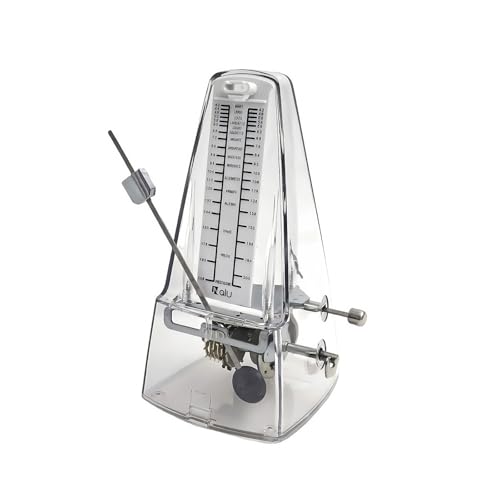
Classic tower and pyramid designs generally provide a familiar pendulum presentation and a desk-oriented format. NALU, YDuupxe, RiToEasysports, and Alomejor explicitly use classic or pyramid styling. Aurikall takes a different visual approach with a transparent shell, and its detachable cover is intended to protect the internal mechanism.
For transport, look first for actual dimensions rather than relying on the word portable. DuskHaven supplies dimensions of about 4.33 by 1.97 by 1.38 inches. SUNGOOYUE Mini lists approximately 11 by 5.3 by 3.5 cm, and Btuty describes an approximately 11 cm height. These models are easier to consider for an instrument bag or small practice area. The other listings describe compact or lightweight use without giving complete measurements.
Think about sound and visual feedback
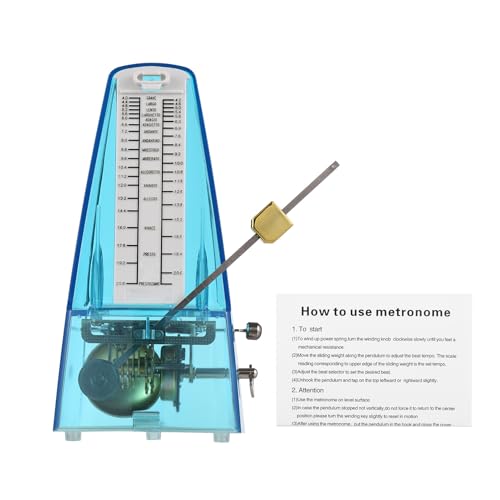
Mechanical metronomes provide two kinds of feedback: the click or beat you hear and the pendulum movement you see. Rhymo specifically discusses rhythm visualization, while LiebeWH, Btuty, and several classic designs document swinging pendulums. A clear scale, such as the one listed for DuskHaven and SUNGOOYUE, can make tempo adjustment easier before practice begins.
Sound preference is personal, but the evidence still identifies useful differences. Rhymo describes a penetrating traditional tick, NALU describes a distinctive bell sound, and Btuty describes a soft sound without a bell. If you practice near other people, the softer Btuty design may be worth considering. If you need strong audible guidance, compare the models that explicitly mention loud or clear beats, such as Rhymo, Aurikall, and SUNGOOYUE Mini.
Select based on your instrument and routine
Most selected models support several instruments rather than one dedicated setup. NALU, Rhymo, YDuupxe, and Aurikall mention combinations including piano, guitar, violin, drums, and other instruments. For a student sharing one metronome among instruments, the multi-instrument descriptions are more relevant than a narrow title.
For daily desk practice, choose the controls you will actually use: tempo range, beat pattern, bell, and a readable scale. For lessons or travel, prioritize documented dimensions and weight-related claims. For a teaching studio, a visible pendulum and strong audible beat may be more useful than the smallest housing.
Final recommendation
NALU Classic Mechanical Metronome ranks first overall in this specification-based comparison under the published weighted criteria.
NALU Classic Mechanical Metronome is the highest-scoring returned product and the first overall specification-based choice among the best wind-up metronomes. Its 40-208 BPM range, five rhythm patterns, metal movement, protective cover, and bell accent give it the most complete documented control set in this comparison.
Rhymo RM01 is a close alternative for beginners because it lists four beat modes, full-metal gears, visual rhythm guidance, and a stated run time after winding. Choose Aurikall if the transparent shell and five beat settings appeal to you. YDuupxe is another practical classic tower option, while LiebeWH offers a documented copper movement.
For portability, compare SUNGOOYUE Mini, DuskHaven, and Btuty. SUNGOOYUE Mini has the clearest small-format dimensions and loud beat; DuskHaven lists the smallest detailed dimensions; Btuty is the distinctive soft-sound, no-bell choice. RiToEasysports and Alomejor suit shoppers who want a lightweight pyramid form with a broad published tempo range. These are the top wind-up metronomes for different specification priorities, not claims based on hands-on performance.
Frequently Asked Questions
Are wind-up metronomes better than electronic models?
They are different tools rather than a universally better choice. The selected wind-up models operate without batteries or charging and provide a physical pendulum with an audible beat. That can be useful for visual rhythm practice and simple setup. Electronic models may offer features not documented here, but this comparison covers only mechanical wind-up products.
Which of the best wind-up metronomes has the most beat settings?
NALU, Aurikall, and YDuupxe each list 0, 2, 3, 4, and 6 beat or accent settings. Rhymo lists four modes: 2/4, 3/4, 4/4, and 6/8. The specific control layout may differ, so check the product listing before choosing one for a particular meter.
What is the best compact option for lessons?
DuskHaven supplies the most detailed small dimensions, at about 4.33 by 1.97 by 1.38 inches. SUNGOOYUE Mini lists approximately 11 by 5.3 by 3.5 cm, and Btuty describes an approximately 11 cm height. DuskHaven and SUNGOOYUE Mini are better fits when a clear scale or loud beat is important; Btuty is the option with a documented softer sound and no bell.
Do all these metronomes include a bell?
No. NALU and Rhymo explicitly describe bell accents. Btuty explicitly states that it has no bell. The other selected listings describe beats, accents, or rhythm controls without consistently confirming a bell, so do not assume one is included.
How should I maintain a mechanical metronome?
The supplied evidence confirms winding, tempo adjustment, and protective covers on some models, but it does not provide a universal maintenance schedule. Follow the included instructions where available, keep the mechanism protected from dust when a cover is supplied, and avoid claiming calibration or service intervals that the listing does not document.