Buying Guide
The best dungeons & dragons board games differ mainly in how they use the setting. Some provide a guided introduction with characters, monsters, maps, and quick-start instructions. Others focus on campaign progression, tactical miniatures, mysteries, city building, or classic dungeon exploration. This comparison uses public listing evidence only, so the scores reflect documented specifications and features rather than hands-on play or customer sentiment.
Choose the game style first
For a broad introduction, Dungeons & Dragons: Heroes of the Borderlands is the most complete starting point in this selection. Its listing combines character class boards, dice, maps, tokens, cards, handouts, and a combat tracker with three adventure booklets. It also specifically includes combat, social interaction, and exploration, making it a balanced choice for a group still deciding what kind of D&D experience it wants.
Dungeons & Dragons: Adventure Begins is another approachable entry. It is designed for ages 10 and up, supports two to four players, and lets the group choose a journey and a final boss. That makes it a practical family option, although experienced players may prefer a title with more progression or scenario detail.
Match cooperative or competitive play
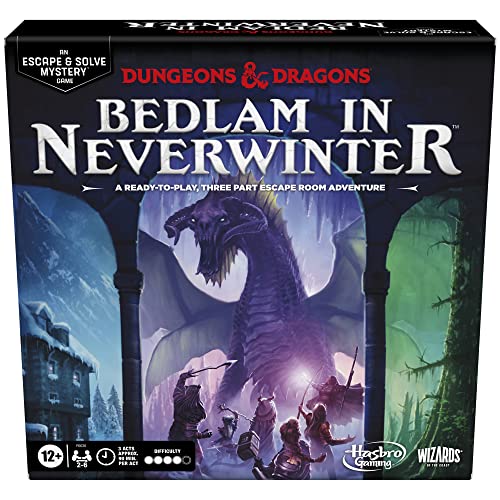
Most selected games are cooperative. Ravensburger Horrified: Dungeons & Dragons asks players to defend Waterdeep and Undermountain together against four different monsters. D&D: Bedlam in Neverwinter also requires teamwork, but its focus is investigation, clues, and puzzles as well as battles. Dragonlance: Warriors of Krynn is cooperative too, with a linked 12-scenario campaign and battles ranging from skirmishes to sieges.
If direct competition is the priority, Dungeons & Dragons Onslaught: Lichen Lich Starter Set is the clearest match. It is a head-to-head miniatures game with three-character teams, rival adventurers, factions, and changing scenario maps. Its standalone starter format is convenient, but its competitive structure is a meaningful difference from the shared-objective games.
Consider campaign commitment
Campaign games reward groups that can return to the same title. Dragonlance: Warriors of Krynn documents 12 connected scenarios and rewards that improve capabilities in later sessions. Dungeons & Dragons: Wrath of Ashardalon offers multiple scenarios and challenging quests, while D&D: Dungeon of the Mad Mage adds level progression to level four along with environment and Bane or Boon cards.
A campaign can make each session feel connected, but it may be less convenient when players change frequently. For a more self-contained evening, Horrified: Dungeons & Dragons lists sessions of about 60 minutes and gives each monster unique tactics. Bedlam in Neverwinter has a three-act structure, so it is better suited to players who want a defined mystery rather than an open-ended campaign.
Look at player count and age
Player count can narrow the choice quickly. Heroes of the Borderlands is positioned for friends and family, while Horrified: Dungeons & Dragons supports one to five players. Wrath of Ashardalon and Dungeon of the Mad Mage also support one to five, making them flexible for solo players and small groups. Bedlam in Neverwinter accommodates two to six, and Builders of Baldur’s Gate supports two to five.
Age guidance also signals the intended audience. Adventure Begins is listed for ages 10 and up, while Bedlam in Neverwinter is for ages 12 and up. Warriors of Krynn, Dungeon of the Mad Mage, and Builders of Baldur’s Gate are aimed at ages 14 and up or described for adventurers in that range. Check the listed age before choosing a game for a mixed-age table.
Decide whether components matter
Component-heavy games can make the table feel more like an adventure map. Heroes of the Borderlands includes maps, tokens, handouts, cards, and a combat tracker. Horrified: Dungeons & Dragons adds sculpted monster miniatures, hero markers, a board, and a custom d20. Onslaught includes a tile system for changing maps, while Builders of Baldur’s Gate lists building tiles, cards, miniatures, tokens, and player cubes.
The older classic-format listings provide a different component profile. Wrath of Ashardalon emphasizes scenarios and quests, while D&D: Dungeon Board Game lists a board, dice, 165 cards, eight hero standees, and 139 tokens. These can suit shoppers who want a dedicated tabletop game without the city-building or puzzle emphasis found elsewhere.
Compare session length and complexity
Shorter sessions are easier to fit into a regular game night. Heroes of the Borderlands specifically promotes hour-long sessions, Horrified: Dungeons & Dragons lists approximately 60-minute sessions, and D&D: Adventure Begins is described as quick gameplay. D&D: Dungeon Board Game lists 45 minutes or longer. Builders of Baldur’s Gate lists approximately 90 minutes, while campaign and puzzle games may require more planning across sessions.
Complexity is not stated as a formal rating in the supplied evidence, so it should not be assumed. Instead, use concrete signals: quick-start guides and learn-as-you-play components suggest a gentler entry, while linked campaigns, multiple factions, character advancement, or changing effects suggest more systems to track. The best dungeons & dragons board games are therefore the ones whose documented structure matches your group’s available time and experience.
Final recommendation
Dungeons & Dragons: Heroes of the Borderlands ranks first overall in this specification-based comparison under the published weighted criteria.
The final choice among the best dungeons & dragons board games depends on the documented features that match your intended use.
Dungeons & Dragons: Heroes of the Borderlands is the highest-scoring returned product and the first overall specification-based choice. It combines an all-in-one component set, quick character creation, learn-as-you-play support, and several types of encounters without limiting the group to only combat.
For the top dungeons & dragons board games by play style, choose Horrified: Dungeons & Dragons for cooperative monster challenges, Dragonlance: Warriors of Krynn for a connected campaign, Onslaught for competitive miniatures, Bedlam in Neverwinter for puzzles, or Builders of Baldur’s Gate for city-building strategy. Adventure Begins is the most family-oriented gateway, while Wrath of Ashardalon and Dungeon of the Mad Mage suit classic dungeon-focused groups. D&D: Dungeon Board Game is the compact classic-format choice.
Frequently Asked Questions
What are the best dungeons & dragons board games for beginners?
Heroes of the Borderlands is the most specification-aligned beginner-oriented option because its listing includes a quick-start guide, speedy character creation, and learn-as-you-play components. Adventure Begins is another accessible choice for families, with a stated ages-10-and-up audience, cooperative play, hero customization, and selectable journeys.
Which selected game supports solo play?
Horrified: Dungeons & Dragons, Wrath of Ashardalon, and Dungeon of the Mad Mage each list support for one player. That makes them the clearest solo-friendly options in this comparison. Their structures differ: Horrified centers on monster challenges, while the other two emphasize scenarios and dungeon adventure.
Which game is best for a long campaign?
Dragonlance: Warriors of Krynn documents 12 connected campaign scenarios and rewards that improve later capabilities. It is the clearest choice for a group that wants continuity between sessions. Wrath of Ashardalon and Dungeon of the Mad Mage also offer scenario-based adventure, but the supplied evidence gives less specific campaign length.
Are any of these games competitive rather than cooperative?
Yes. Dungeons & Dragons Onslaught: Lichen Lich Starter Set is explicitly a competitive skirmish game in which players control adventuring parties from different factions. The other selected titles are described as cooperative, or their listings emphasize shared adventure rather than direct player-versus-player play.
Which D&D board game is best for puzzles?
D&D: Bedlam in Neverwinter is the clearest puzzle-focused pick. It is a three-act cooperative mystery involving clues, wordplay, visual riddles, character creation, monster battles, and a board that changes as locations unlock. It is a better fit for investigation-oriented groups than a conventional dungeon crawl.