Buying Guide
The best end-grain wood cutting boards are defined by how their grain, dimensions, and features fit your preparation habits. End-grain construction places the exposed fiber ends on the cutting surface. Several selected listings describe this arrangement as helping knife edges move between fibers and reducing visible cutting marks. Those are product claims in the supplied evidence, not results from an independent test, so treat them as design guidance rather than a performance guarantee.
Match board size to your prep routine
Start with counter space, sink size, and the ingredients you handle most often. Compact choices such as the Ziruma and New M Way Teak board occupy roughly 16-by-11-inch footprints and can suit smaller kitchens or quick preparation. Their smaller surfaces also limit how much food can remain on the board at one time.
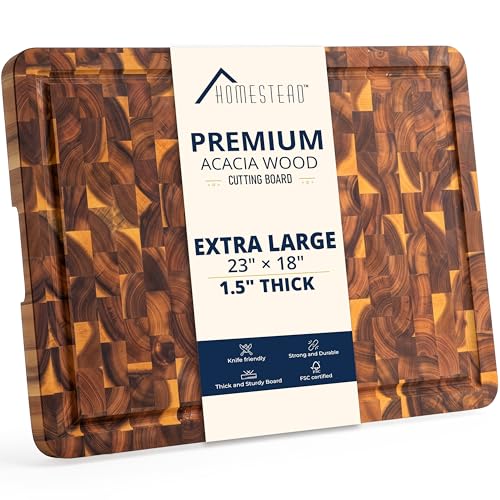
A middle size, such as the 17-by-13-inch Bevel & Bond or Sonder Alfred, is a practical compromise for general chopping and carving. The Boardsmith provides an 18-by-12-inch surface, while the WoodForChef extends to a listed 18-by-16-inch work area. For especially large cuts, the HOMESTEAD reaches a listed 23-by-18 inches. Large boards offer more room for sorting and carving, but they also need more counter and storage space.
Consider thickness and stability
Thickness can affect how substantial a board feels and how easy it is to move. The selected products range from a 1.25-inch Ironwood Gourmet board to 2 inches for The Boardsmith. Bevel & Bond, Ziruma, New M Way, and HOMESTEAD are listed at 1.5 inches, while the WoodForChef listing states 3 inches in its specification field but describes an 18-by-16-inch board in the features. Because the supplied listing contains conflicting dimensional information, verify the exact variant before ordering.
Feet are useful when you want a board that stays raised from the counter. The Boardsmith, WoodForChef, Bevel & Bond, Sonder Alfred, and Socisen document feet or non-slip elements. Bevel & Bond also lists a 10-pound weight, and the HOMESTEAD lists an 11.3-pound weight, both of which may help explain their planted feel but can make relocation harder. Boards without documented feet, including the Ironwood Gourmet and New M Way models, may be better for cooks who prefer a reversible surface or need to slide a board away after use.
Choose wood and sourcing details carefully
Maple is represented by The Boardsmith, WoodForChef, and Bevel & Bond. Their listings emphasize hardwood construction, while Bevel & Bond specifically identifies North American hard maple. Walnut appears in the Sonder Alfred, offering a darker appearance and documented American black walnut. Acacia is used by Ironwood Gourmet, HOMESTEAD, Ziruma, and Socisen. Teak distinguishes the Teakhaus and New M Way models.
Material names alone do not determine which board is right. Look for sourcing information if it matters to you: WoodForChef, Teakhaus, and Ziruma document FSC-related sourcing, while The Boardsmith describes sustainably harvested maple and Sonder describes sustainably sourced American black walnut. These statements come from the supplied listings and should not be expanded into broader environmental conclusions.
Decide whether grooves, wells, and handles help
A juice groove is useful when you regularly carve meat or cut juicy fruit. Bevel & Bond, Sonder Alfred, HOMESTEAD, New M Way, and Socisen document grooves, while the Ironwood Gourmet Charleston lists a channel that holds up to 10 fluid ounces. Grooves can reduce runoff onto the counter, but they also reduce the uninterrupted flat area available for chopping.
Ingredient wells and compartments add a different kind of utility. Sonder Alfred has three built-in wells, and the Socisen set uses multiple surfaces and sizes for organizing preparation. The HOMESTEAD and New M Way boards emphasize serving as well as cutting, while the Teakhaus board documents reversible use and an optional plate cut-out. Handles are specified on the HOMESTEAD and Socisen boards and can help move larger boards from counter to table.
Plan for hand washing and conditioning
The selected listings consistently point toward hand washing rather than dishwasher use. Ironwood Gourmet advises washing with warm soapy water, drying immediately, avoiding soaking, and applying oil periodically. Bevel & Bond specifies hand washing, towel drying, and monthly conditioning. Sonder calls for hand washing and oiling every few weeks. HOMESTEAD advises hand washing, upright drying, and occasional food-grade mineral oil.
Some boards arrive with care materials or conditioning already applied. WoodForChef includes food-safe mineral oil, Bevel & Bond says its board arrives pre-conditioned, and Ziruma documents a beeswax, flaxseed-oil, and lemon-oil treatment. The Boardsmith describes a food-grade mineral-oil and beeswax finish. Always follow the selected product’s care directions, particularly because wood boards should not be soaked or placed in a dishwasher unless the manufacturer specifically says otherwise.
Final Recommendation
Bevel & Bond Maple End-Grain Board ranks first overall in this specification-based comparison under the published weighted criteria.
The final choice among the best end-grain wood cutting boards depends on the documented features that match your intended use.
The Boardsmith Maple End Grain Board is the highest-scoring returned product and the first overall specification-based choice. Its 2-inch maple construction, beveled edges, shock-absorbing feet, food-safe finish, and sustainably harvested wood provide a well-rounded specification set for everyday cooks who have room for a substantial board.
Among the top end-grain wood cutting boards, Bevel & Bond is the stronger pick for carving and liquid-heavy preparation because its listing documents a deep juice groove, finger grips, non-slip feet, pre-conditioning, and a 1.75-inch maple build. Sonder Alfred is the feature choice for ingredient organization, with three wells, removable feet, a groove, and walnut construction.
Choose HOMESTEAD when maximum work area is the priority. Choose WoodForChef when a broad maple surface and included care oil matter most. Teakhaus and New M Way suit shoppers who prefer teak, while Ziruma offers a compact acacia format with a distinctive natural conditioning blend. The Ironwood Gourmet Charleston and Socisen set round out the selection for large serving-oriented prep and two-size flexibility.
Frequently Asked Questions
What makes the best end-grain wood cutting boards different from other wood boards?
End-grain boards expose the ends of wood fibers on the cutting surface. Supplied listings commonly associate that orientation with knife-friendly use, reduced visible marks, and a surface that can appear to close around cuts. Those are design descriptions, not independent test findings. Thickness, feet, wood species, and care requirements still vary substantially between models.
Which selected board is best for large meat preparation?
The HOMESTEAD has the largest documented work area in this selection at 23 by 18 inches, plus a deep juice groove and integrated handles. Bevel & Bond is another strong option because its listing documents a deep groove, finger grips, non-slip feet, and a 10-pound weight. Either choice requires enough counter and storage space for a large, heavy board.
Should I choose a board with a juice groove?
Choose one if you often carve roasts, cut juicy fruit, or want a channel to catch runoff. Bevel & Bond, Sonder Alfred, HOMESTEAD, New M Way, and several other selected boards document grooves. A groove may reduce the uninterrupted cutting area, so a flat board such as The Boardsmith may be preferable if you mostly chop vegetables and herbs.
How should an end-grain wood cutting board be maintained?
The supplied listings generally recommend hand washing with warm soapy water, immediate or upright drying, avoiding soaking, and periodic conditioning. Do not assume a board is dishwasher-safe. The Boardsmith, WoodForChef, Bevel & Bond, and Ziruma each document different finishing or conditioning details, so follow the care instructions for the exact board you select.
Is a thick cutting board always the best choice?
Not necessarily. Thicker boards may provide a more substantial format, but they can be heavier and harder to store. Compact boards such as Ziruma and New M Way are easier to fit into smaller spaces, while the 2-inch Boardsmith and larger HOMESTEAD prioritize substantial preparation room. Balance thickness against lifting, cleaning, counter space, and the size of your usual ingredients.