Buying Guide
The best three-prong business report covers should match the document load, handling frequency, and presentation style of your office. Every selected product is presented as a report cover or presentation folder with three-prong fastening, but the supporting details vary considerably. Some listings specify capacity and plastic thickness; others focus on pockets, colors, or pack size.
Start with the fastener design
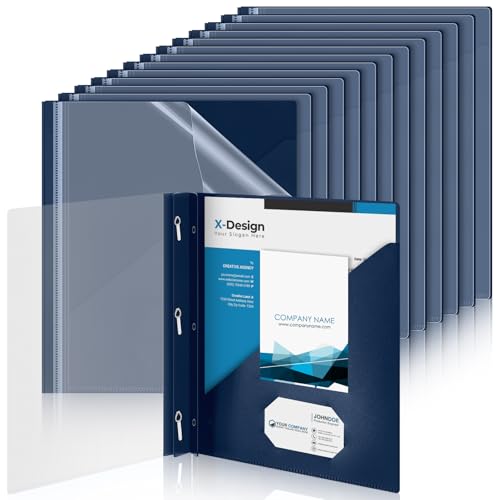
Three-prong fasteners secure punched pages without the bulk of a ring binder. Concealed fasteners, documented by Binditek, COIDEA, HAUTOCO, and offgrow, keep the metal hardware less visible from the front. That can create a cleaner appearance for proposals, resumes, and client handouts. A conventional three-prong arrangement may be enough for routine filing, but buyers should check whether the listing states that the prongs are metal and concealed.
Fastener design does not replace correct punching. These products are intended for three-hole-punched pages, and the listings generally frame them around standard letter documents. If papers are not punched, use a pocket when the selected model includes one or choose a different folder format.
Match capacity to the report
Capacity is one of the most useful differences among these folders. Binditek, Paper Plan, COIDEA, Ndsox, and Feifeiya state capacities of up to or around 100 sheets. Teling lists up to 90 sheets. Those figures can help distinguish a cover for a short memo from one intended for a substantial proposal or training packet, although they are listing specifications rather than independent measurements.
A stated capacity should also be considered alongside the cover material. A folder may accept many pages but still be less convenient to carry when filled. Category fit matters more than a large capacity claim.
Compare plastic and pressboard construction
Most selected products use polypropylene or PP plastic. The clear-front folders typically pair a transparent front with a black, navy, or colored back. This lets the first page remain visible while the rear panel provides a contrasting presentation surface. Binditek provides unusually specific thickness details: an 8-mil front and 16-mil back and side panels. Blue Summit lists 0.42-millimeter PP plastic, while Paper Plan identifies 0.18-millimeter and 0.3-millimeter sections.
Thickness can be helpful when a folder will be handled often, but it does not alone establish long-term performance. Listings also mention features such as sealed edges, reinforced edges, scratch resistance, water resistance, or protection from bends. Treat those as documented design claims, not as results from independent testing.
Decide whether pockets matter
A pocket can hold pages that cannot or should not be punched. Paper Plan and offgrow identify a 2.5-inch or 5.1-inch back pocket, while HAUTOCO, Ndsox, and BotleFlow also provide pocket storage. BotleFlow adds a business-card slot, and Teling describes three pockets plus a slash pocket. These features are useful for receipts, notes, handouts, cards, or supplemental proposal materials.
If every page belongs inside the fastened report, a pocket may be unnecessary. If a meeting packet includes loose reference sheets, pockets can reduce the need for a second folder. Look for a clearly described pocket rather than assuming that every clear-front report cover includes one.
Choose a pack size and color strategy
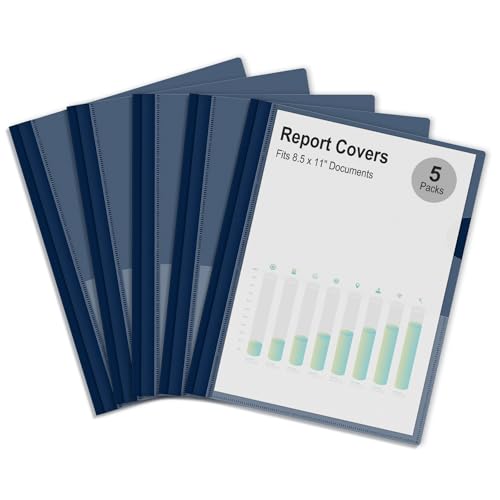
Pack size should reflect how many reports you create and whether folders remain assigned to specific projects. The comparison includes small five-packs, a six-pack, 24- and 25-packs, and larger 30- and 48-packs. A smaller set avoids storing excess supplies, while bulk packs may simplify recurring office work.
Color can support sorting. Feifeiya lists navy, black, and clear designs, while Ndsox uses a navy back and several office-oriented models use black backs. For external presentations, black or navy may suit a conventional professional format; for internal filing, multiple colors can make categories easier to identify.
Confirm dimensions before ordering
Letter-size compatibility is central to this category. The selected listings commonly identify support for 8.5 by 11-inch documents, with outer dimensions around 9.4 to 9.5 inches wide and 11.5 to 11.6 inches tall. That extra margin allows the cover to surround the paper, but it also affects how many folders fit in a drawer or bag.
Check the listing’s dimensions if your papers include tabs, oversized inserts, or unusually thick packets. Also distinguish US letter from A4. Teling describes suitability for A4 and letter-size paper, but other products are framed specifically around US letter. A cover that fits standard pages may not accommodate wide tabs or bulky attachments.
How this comparison was scored
The editorial criteria were selected for this category: fastener security at 25 percent, document capacity at 20 percent, material and protection at 20 percent, visibility and organization at 20 percent, and letter-size practicality at 15 percent. Scores use only supplied listing features and specifications. No customer sentiment, review information, popularity indicators, or hands-on testing was used. Products with missing capacity or thickness details were scored more cautiously rather than receiving assumed specifications.
Final Recommendation
Binditek Heavy-Duty 3-Prong Report Covers ranks first overall in this specification-based comparison under the published weighted criteria.
Binditek Heavy-Duty 3-Prong Report Covers is the first overall specification-based choice among these best three-prong business report covers. Its stated 100-sheet capacity, concealed prongs, clear front, thick polypropylene back and side panels, reinforced edges, and sealed spine give it the most complete documented specification set for frequent business use.
For extra loose-paper organization, BotleFlow is the most specification-aligned alternative because it combines a 100-sheet claim with a back pocket and business-card slot. Paper Plan and COIDEA are also well suited to polished reports, while Feifeiya is a sensible bulk option when mixed colors help separate files. Ndsox fits smaller portable sets, and Teling is worth considering when a 90-sheet capacity and multiple pockets are preferable.
The top three-prong business report covers are not identical in purpose. Choose by capacity and material when the folder will be handled repeatedly, by pockets when loose inserts are common, and by pack size or color when your workflow involves multiple projects. For occasional use, offgrow keeps the quantity small; for mixed-color sorting, Feifeiya provides the clearest documented assortment.
Frequently Asked Questions
What are the best three-prong business report covers for a 100-page report?
Binditek, Paper Plan, COIDEA, Ndsox, and Feifeiya all state capacities at or around 100 sheets. BotleFlow also states a 100-sheet capacity. These claims apply to punched pages and should be treated as listing specifications rather than independent capacity tests.
Are clear-front report covers suitable for client presentations?
Yes, a clear front can show the title page without opening the folder. COIDEA, Binditek, Paper Plan, and several other selected products pair that visibility with black or navy backs. The most appropriate choice depends on the desired color, pocket needs, and stated construction details.
Do three-prong report covers include pockets?
Not always. BotleFlow, HAUTOCO, Ndsox, Paper Plan, Teling, and offgrow document pockets or supplemental storage, while some other selected products do not provide that detail. Confirm the listing before relying on a pocket for loose pages or business cards.
What size paper do these folders hold?
Most of the selected folders are designed for standard US letter paper measuring 8.5 by 11 inches. Outer dimensions are typically larger to surround the pages. Check the specific listing when using tabs, thick inserts, or A4 sheets.
Is a bulk pack better for an office?
A bulk pack can be practical when reports are created regularly or multiple files need consistent covers. Smaller five- or six-packs may be more suitable for occasional use. Pack size should be selected alongside color, storage space, and whether each folder will be assigned to a separate project.