Buying Guide
Choosing among the best forged paring knives starts with how the knife is built and how the steel is treated. Forged paring knives are shaped from a single bar of steel under heat and pressure, which generally yields a denser blade with a continuous bolster and a more balanced feel than lighter stamped alternatives. Each product in this list goes through the same editorial rubric: steel quality and hardness, edge geometry, forging construction, handle design, blade size, and warranty or manufacturing origin.
Steel Quality and Hardness
For a paring knife, the steel has to take and hold a fine edge, but it also needs enough toughness to avoid chipping on small bones, seeds, and stems. Hardness is usually stated on the Rockwell C scale; many of the forged options here sit in the 56 to 62 HRC band. Higher numbers can mean longer edge life between sharpenings, while lower numbers can mean easier resharpening. Look for stainless alloys with chromium for corrosion resistance and molybdenum or vanadium for grain refinement.
Edge Geometry and Sharpness
Paring knives work close to your fingertips, so geometry matters more than raw length. Most of the German-forged entries use a wider edge angle near 20 to 26 degrees total for durability. More precise examples such as the XINZUO 4.2-Inch Hand-Forged Damascus Paring Knife list 15 degrees per side for paper-thin slicing. A satin finish helps food release and reduces drag during repeated peeling.
Forging Construction and Balance
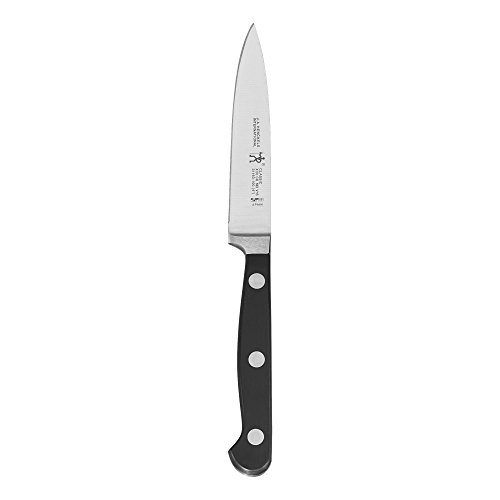
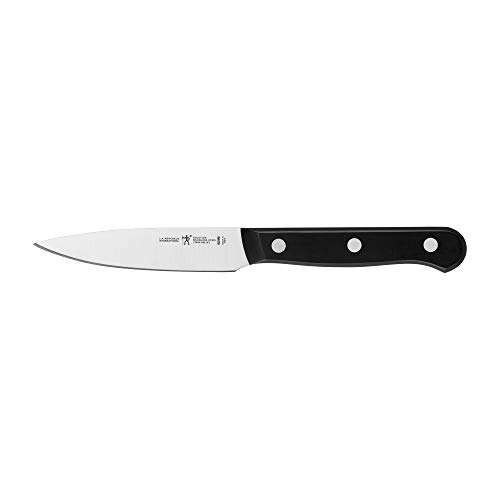
A continuous forged bolster gives a seamless transition from blade to handle, supports the pinch grip, and adds forward weight for control. The Mercer Culinary Renaissance 3.5-Inch Forged Paring Knife and Mercer Culinary Genesis 3.5-Inch Forged Paring Knife pair precision-forged high-carbon steel with triple-riveted handles. The HENCKELS Forged Accent 3.5-Inch Paring Knife and HENCKELS Forged Premio 3-Inch Paring Knife lean on a forged bolster for added balance in a lighter, more compact package.
Handle Ergonomics and Grip
The in-hand tool feel comes down to handle shape and tang. POM and pakkawood handles tend to feel balanced and warm, while olive wood and burnt-oak handles offer a more natural look but may need a touch more drying time. If you prep with damp hands frequently, prioritize a handle explicitly listed as non-slip.
Blade Size and Task Fit
A 3-inch paring knife suits very small work like strawberries, garlic, and shallots, while a 4-inch paring knife gives more reach for apples, tomatoes, and chicken trim. The curved 3-inch profile of the All-Clad Forged 3-Inch Curved Paring Knife is well matched to rolling cuts on round produce.
Warranty and Manufacturing Origin
Lifetime warranties, even limited ones, signal a manufacturer’s confidence in forging and tempering. HENCKELS entries typically carry a lifetime warranty against manufacturer defects, Mercer Culinary lists a lifetime limited manufacturer’s warranty, and All-Clad backs its forged line with a limited lifetime warranty. Manufacturing origin varies from German factory-made steel to blades assembled in China, Spain, or other cutlery hubs, all of which can be acceptable when the steel, hardening, and handle assembly are documented.
Final Recommendation
All-Clad Forged 3-Inch Curved Paring Knife ranks first overall in this specification-based comparison under the published weighted criteria.
If you want a single specification-based choice with strong balance and a curved blade, the All-Clad Forged 3-Inch Curved Paring Knife earns the top spot among the best forged paring knives thanks to its cryo-hardened German stainless steel and tight edge geometry. For buyers who prefer a forged bolster in a slightly longer profile, the HENCKELS Forged Accent 3.5-Inch Paring Knife is a strong runner-up. Together, these two cover the curved-peeling and general-prep use cases that make up much of the demand for top forged paring knives.
Frequently Asked Questions
What makes the best forged paring knives different from stamped paring knives?
Forged blades are shaped from a single heated bar of steel, which generally produces a denser cutting edge, a continuous bolster, and better balance than stamped blades cut from flat steel sheets.
Which blade size should I choose for a forged paring knife?
A 3-inch blade is well suited to small produce and garnishing, while a 3.5-inch blade is the most versatile size. A 4-inch or 4.2-inch blade, like the XINZUO 4.2-Inch or the HENCKELS Classic 4-Inch Paring Knife, gives more reach for apples, tomatoes, and chicken trim.
A wider edge angle, near 26 degrees total, supports durability for general peeling. A tighter edge, such as the 15-degree-per-side XINZUO, supports finer slicing but may need more careful handling to avoid chipping.
Are forged paring knives dishwasher safe?
Several forged options, including the HENCKELS Forged Premio 3-Inch Paring Knife and HENCKELS x EMERIL Lagasse Nola 4-Inch Paring Knife, are listed as dishwasher safe. Hand-washing and drying, however, remains the gentlest care for any forged blade.
Do forged paring knives need a bolster?
A forged bolster is not strictly required, but it adds balance, finger protection, and structural strength at the blade-handle joint. Most premium forged paring knives in this roundup include a continuous forged bolster.