Buying Guide
The best outdoor low-voltage halogen transformers should be matched to the lighting system rather than chosen only by wattage. Start with the lamp and cable requirements, then compare output, controls, protection, and enclosure details.
Confirm AC output and lamp compatibility
Halogen landscape lamps commonly require low-voltage AC, so check whether the transformer provides 12V AC or another supported output. The 12Vmonster 100W model explicitly identifies G4, MR11, and MR16 lamp compatibility and a 10W minimum load. The Best Pro Lighting 150W-BK listing directly identifies both LED and halogen use and converts 120V input to 12V output.
Several selected landscape models document wider output choices. DEWENWILS 150W provides 12V/15V AC, while SUNVIE 120W and SUNVIE 200W provide 12V/14V AC. WILAWELS 300W, WILAWELS 600W, and SURAIELEC 300W also document 12V/14V or 12V/15V operation. Do not assume that a DC-only transformer will work with halogen lamps: the excluded DC models are intended for 12V DC lighting, and one listing specifically says it is not for halogen use.
Size the load with headroom
Add the wattage of every connected lamp before selecting a transformer. A higher rating can support more fixtures, but the supplied listings do not establish that every system should be loaded to its maximum. DEWENWILS 120W advises keeping the total lighting below 80% of capacity, while SURAIELEC documents a 240W recommended load for its 300W unit. These published limits illustrate why headroom matters.
For small systems, a 100W or 120W product may be sufficient if the calculated load stays within its documented operating range. Medium installations may fit the 150W or 200W class. Larger layouts can benefit from the 300W WILAWELS or SURAIELEC units, while the WILAWELS 600W is designed around three separate zones and extensive capacity. Capacity alone does not prove better results; it simply gives more documented room for connected fixtures.
Compare automation modes
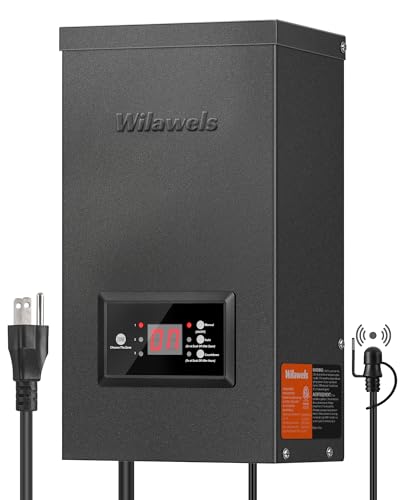
Photocells automate operation by switching lights on at dusk and off at dawn. Many selected products add countdown timers, which can turn the system off after a specified period. SUNVIE 120W lists five modes, including manual, automatic, countdown, timer, and photocell-on/timer-off operation. WILAWELS 300W lists six modes and includes a test mode, which can help verify sensor behavior during setup.
Zone control is useful when different areas need different schedules. SUNVIE 200W has two independently controlled output zones, SURAIELEC 300W has two zones, and WILAWELS 600W has three. A single-zone transformer is simpler when all fixtures should follow the same schedule. Also check whether the photocell is detachable or replaceable; SUNVIE 120W and SUNVIE 200W document replaceable external sensors, while several other models specify external sensor cables.
Check protection and outdoor construction
Look for documented circuit protection, overload protection, or a circuit breaker. SUNVIE 120W and SUNVIE 200W describe protection that disconnects the power during an abnormal condition. DEWENWILS 150W specifies short-circuit protection, and the WILAWELS 600W listing identifies an overload protector with manual reset. These features do not replace correct wiring or load sizing, but they are useful specification points.
Outdoor construction varies. DEWENWILS 150W uses a stainless steel housing and describes it as waterproof and corrosion resistant. DEWENWILS 120W and 200W use metal housings described as weather resistant or waterproof. WILAWELS 300W documents resistance to corrosion and heat, while SURAIELEC 300W identifies a flame-retardant PC housing for outdoor use. Confirm the installation instructions and mounting position before exposing any transformer to weather.
Plan mounting and wiring
Compare cord length, sensor-cable reach, terminal design, and mounting hardware. SURAIELEC 300W includes wall screws and quick-snap terminals. WILAWELS 600W uses a push-connect terminal block. SUNVIE 120W includes a six-foot UL-listed power cord and a 6.8-foot sensor cord, while DEWENWILS 150W lists a six-foot power cord and a 6.8-foot sensor cord.
Keep the total load, output voltage, lamp type, and wiring method aligned with the product documentation. A transformer that fits the wattage may still be unsuitable if its output is DC, if the system needs a different AC voltage, or if the lamp load falls below a stated minimum.
Final Recommendation
WILAWELS 300W D12LT06 Transformer ranks first overall in this specification-based comparison under the published weighted criteria.
WILAWELS 300W D12LT06 Transformer is the first overall specification-based choice in this comparison.
It is also the leading choice among these best outdoor low-voltage halogen transformers because its 300W rating, 12V/14V AC output, ETL listing, photocell, six operating modes, memory, circuit protection, and corrosion- and heat-resistant construction create a strong documented specification profile.
Choose SUNVIE 200W Two-Zone Transformer when separate areas need independent schedules. Choose WILAWELS 600W Three-Zone Transformer when three independently managed areas and substantial capacity are central requirements. For a smaller halogen setup, the 12Vmonster 100W offers the clearest lamp-specific documentation, including its stated minimum-load requirement. DEWENWILS 150W is a balanced alternative when 12V/15V AC output and a stainless steel housing are useful.
Among the top outdoor low-voltage halogen transformers, the right choice depends on AC compatibility and actual connected wattage first. After those checks, use control modes, sensor placement, protection, housing, and mounting details to narrow the selection.
Frequently Asked Questions
Verify that the transformer accepts 120V input, supplies the required low-voltage AC output, supports the lamp type, and has enough capacity for the complete connected load. Also check any stated minimum load or recommended maximum, such as the 12Vmonster 100W minimum and the SURAIELEC 300W recommended-load guidance.
Not automatically. The selected products document different output choices: some provide 12V only, while others provide 12V/14V or 12V/15V AC. Match the transformer setting to the lighting system documentation rather than assuming that every low-voltage fixture accepts every output.
No. The selected products vary. DEWENWILS 150W, SUNVIE 120W, SUNVIE 200W, and WILAWELS models document photocell and timer-related modes, while the Best Pro Lighting 150W-BK listing specifically documents a dusk-to-dawn sensor but fewer detailed control modes. Review the exact mode list before buying.
A multi-zone model is useful when separate lighting areas need different schedules or modes. SUNVIE 200W and SURAIELEC 300W document two independent zones, while WILAWELS 600W documents three. A single-zone model is generally simpler when all connected lights should operate together.