Buying Guide
The best low-voltage outdoor deck lights are chosen by matching the fixture design to the deck structure, power system, desired light pattern, and control needs. The products above fall into three useful formats: surface-mounted fixtures for posts and railings, elongated panels or bars for risers and hardscape edges, and recessed kits that sit inside drilled openings. A specification-based comparison can narrow the field, but the final fit still depends on your deck dimensions and existing transformer.
Surface-mounted lights are usually the most adaptable when you want to illuminate a railing, post, fence, or stair riser without cutting a circular opening. Surface mounting also leaves the light accessible for future replacement or repositioning.
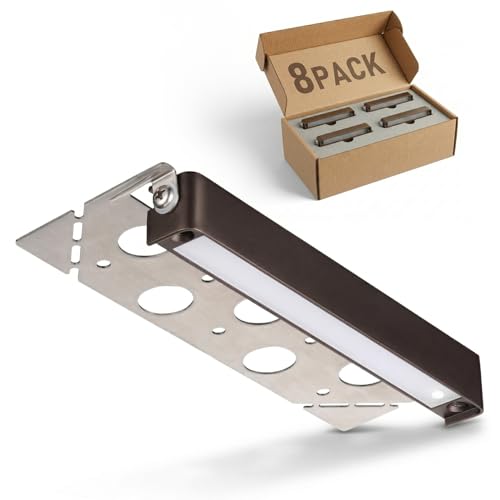
Long panels and bars are better suited to wide step faces, retaining walls, and hardscape borders. The E ENERGETIC LIGHTING 8-inch option and Tuedp 9-inch panel use an extended face, while the LEONLITE hardscape light uses a 7-inch bar that can be rotated. These formats can create a more continuous band of downward light than several small point fixtures, but measure the available riser or wall space before ordering.
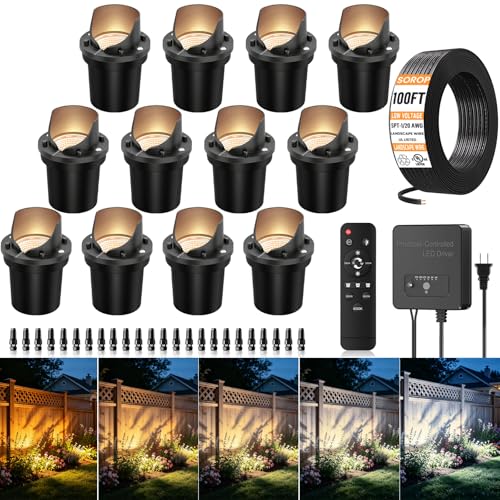
Recessed kits create a less prominent appearance because the light body sits in a drilled opening. Recessed installation requires careful attention to cutout size, spacing, cable routing, and the material beneath the deck. Confirm that the supplied dimensions match your drill plan before beginning.
Low-voltage does not mean every fixture uses the same operating range. Several surface lights document 12-24V AC/DC compatibility, which can suit many landscape-lighting systems. Other products use 9-15V, 8-12V, or a 12V system. Check the transformer output, connector type, total wattage, cable length, and installation instructions together rather than relying only on the phrase low voltage.
A transformer is not included with every selected product. It is specifically documented with the JUABREY and SMY Lighting recessed kits, while many surface-mounted options state that a compatible transformer is required or do not identify one in the supplied listing. If you are starting from scratch, account for the transformer and outdoor-rated wiring as separate planning items. If you already have a landscape transformer, confirm both voltage range and available capacity.
Voltage drop can matter on larger decks because fixtures farther from the transformer may receive less consistent power if the wiring layout is not appropriate. The evidence supplied here does not provide installation-specific voltage-drop calculations, so use the manufacturer’s wiring guidance and consider the total run before committing to a large perimeter layout.
Compare light color and control
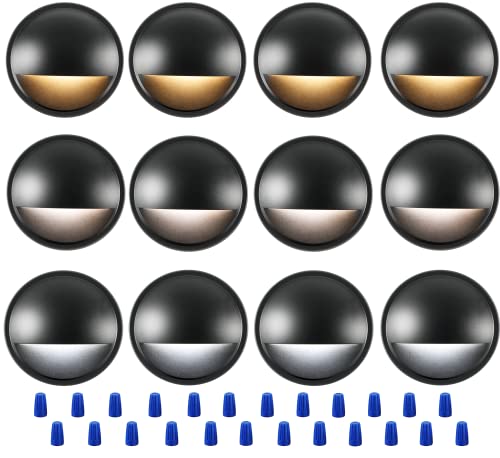
Color temperature affects the appearance of wood, railings, plants, and adjacent hardscape. The selected LEONLITE 12-pack offers five settings from 1800K to 5000K, while the E ENERGETIC LIGHTING option offers five settings from 2200K to 5000K. CLOUDY BAY provides three settings, and the Tuedp panel provides 2700K, 4000K, and 6500K. Fixed 2700K or 3000K fixtures are simpler when you already know that a warm appearance is wanted.
Dimming and automation solve a different problem from color selection. The JUABREY and SMY Lighting recessed kits document photocell operation, timers, dimming, and memory. These features may reduce the need for manual switching and let you adjust brightness after installation. They also add controls that need to be placed where they remain accessible. For a straightforward wired installation, a fixed-color surface fixture may be easier to specify and operate.
Do not compare lumen figures without considering fixture size and light direction. The SUNVIE product states 500 lumens, and both the E ENERGETIC LIGHTING and Tuedp products document 500-lumen figures, but each uses a different form factor. MULANDI lists 48 lumens and is designed for gentle downward step definition. Output, beam direction, lens or louver design, and spacing all influence the final appearance.
Check outdoor protection and construction
IP65 and IP67 are technical protection ratings documented by the listings and are useful comparison points. IP65 appears on multiple surface-mounted and panel-style products, while the recessed JUABREY and SMY Lighting kits document IP67. These ratings do not remove the need for correct installation, sealed connections, and adherence to the product’s stated use limitations.
Die-cast aluminum appears across many of the surface fixtures and light bars. It can provide a rigid housing, while powder-coated or oil-rubbed finishes influence how the fixture coordinates with a deck. Recessed kits use combinations of acrylic or ABS and 304 stainless steel. Consider whether the light will be stepped on, exposed at a floor opening, or mounted out of the walking path.
Warranty terms also vary. Several products document two- or three-year coverage, while the E ENERGETIC LIGHTING model lists five-year manufacturer service and SUNVIE lists lifetime support language. Treat warranty length as a documented service feature, not a guarantee of a particular lifespan or performance result.
Plan the installation details
Review lead-wire length, connector type, mounting hardware, and whether a gang box is needed. CLOUDY BAY states that its surface fixture needs no gang box and includes waterproof wire connectors. SUNVIE uses Fastlock2 connectors, while MULANDI documents a quick-connect system. The recessed kits require drilling and use parallel wiring, which can allow partial installation and independent operation if one light fails according to the supplied descriptions.
Lay out the fixtures before drilling or fastening them. Keep light spacing consistent, avoid placing a fixture where it can be struck by furniture or foot traffic, and route cable away from sharp edges. For any connection exposed to weather, use the supplied waterproof components as directed and follow applicable electrical requirements. The listings provide product features, not a substitute for local code guidance or professional electrical advice.
Final Recommendation
JUABREY 20-Pack Dimmable Recessed Deck Light Kit ranks first overall in this specification-based comparison under the published weighted criteria.
The final choice among the best low-voltage outdoor deck lights depends on the documented features that match your intended use.
LEONLITE 12-Pack 5CCT Low Voltage LED Deck Lights is the highest-scoring returned product and the first overall specification-based choice for shoppers prioritizing color flexibility, CRI90, outdoor protection, and broad 12-24V compatibility. It is a strong fit for a larger surface-mounted deck, railing, porch, or trellis project, provided the transformer and wiring plan are suitable.
For recessed installations, SMY Lighting 20-Pack Smart Recessed Deck Lights and JUABREY 20-Pack Dimmable Recessed Deck Light Kit offer the most extensive documented automation. Their timers, photocell modes, dimming, and parallel layouts make them useful when the goal is scheduled or dusk-to-dawn operation. The top low-voltage outdoor deck lights are not all interchangeable: choose a recessed kit only when the deck can accept the required openings.
If the project needs a long visual line across a riser, the E ENERGETIC LIGHTING 8-Inch Step Lights, Tuedp 9-Inch Step Lights, or LEONLITE 7-Inch Hardscape Light Bars provide documented extended formats. For compact localized lighting, MULANDI and the compact LEONLITE 12-pack are easier matches. Across all choices, verify voltage, transformer inclusion, fixture dimensions, and wiring before installation.
Frequently Asked Questions
What are the best low-voltage outdoor deck lights for a recessed installation?
SMY Lighting and JUABREY are the most specification-aligned selected recessed options because both document 20-light kits, IP67 protection, parallel wiring, dimming, and automatic-control features. JUABREY specifically lists a UL transformer, while SMY Lighting also documents multiple timer modes and memory. Confirm the required opening size before drilling.
Some do and some do not. The JUABREY and SMY Lighting recessed kits document included 12V transformers. Many surface-mounted products either state that a transformer is required or do not identify one in the supplied evidence. Check the exact package contents and match the transformer voltage to the fixture range.
Is IP67 better for deck lighting than IP65?
IP67 indicates a different level of enclosure protection than IP65, but the appropriate choice depends on the installation. The recessed JUABREY and SMY Lighting kits document IP67, while several surface fixtures and panels document IP65. Either way, connectors, cable routing, mounting, and installation conditions still need to follow the product instructions.
Are selectable color temperatures useful outdoors?
They can be useful when you want to change the appearance of a deck or coordinate lighting with different areas. LEONLITE, E ENERGETIC LIGHTING, CLOUDY BAY, and Tuedp document selectable settings. Fixed 2700K or 3000K products may be preferable when a consistent warm-white appearance is the priority.
Can recessed deck lights be installed partially?
The JUABREY and SMY Lighting listings document detachable, parallel-connected lights, which supports installing only part of the set according to the supplied descriptions. Plan the cable route and spacing first, and confirm the manufacturer’s limits before leaving unused connections in an exposed location.