Buying Guide
The best outdoor low-voltage led transformers should be matched to the lighting system, not selected by wattage alone. Start with the fixture requirements, then compare capacity, output type, controls, protection, and installation details. The products in this comparison are landscape-lighting transformers or power packs that document conversion from household voltage to a lower-voltage output for outdoor fixtures.
Match the output to the lighting system
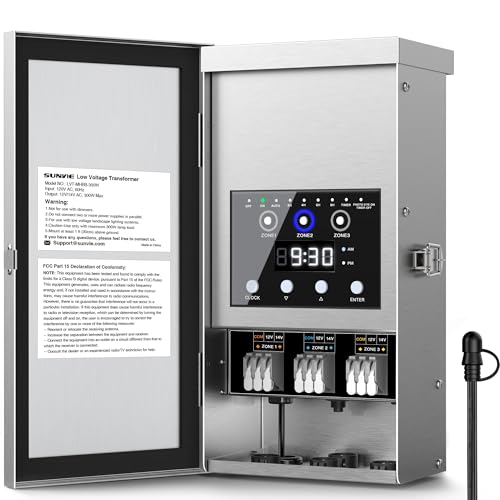
First identify whether the connected fixtures require 12V AC, 12V/14V AC, 12V/15V AC, or 12V DC. AC and DC outputs are not interchangeable assumptions. The SUNVIE 300W 3-Zone Transformer, SUNVIE 300W 2-Zone Transformer, SUNVIE 300W 3-Zone Clamp-Connection, WILAWELS 300W D12LT06, and DEWENWILS 300W Wi-Fi Transformer document 12V/14V AC output and compatibility with 12V/14V AC LED systems. The DEWENWILS 150W Stainless Steel Transformer documents 12V/15V AC output. Several compact models, including the Moonrays 120W Transformer, use the listing’s more limited specifications, so check the fixture documentation before connecting them.
Some products in this group convert to 12V DC instead. They are relevant category products, but they were not all selected for the final ten. The important buying point is to confirm the required current type rather than treating every low-voltage transformer as equivalent.
Choose capacity with headroom
Add the wattage of the fixtures you intend to run, then leave operating headroom. A 60W transformer can suit a small pathway or accent arrangement, while 120W and 150W units provide more room for a larger group of fixtures. The 200W models are a middle option, and the 300W models are designed for more substantial systems. The DEWENWILS 300W Countdown Transformer specifically says the total lighting power should not exceed 80% of the power pack’s capacity. That documented guidance is useful when planning a connected load.
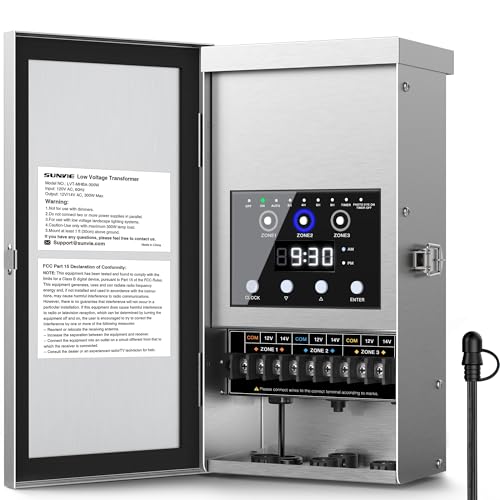
Capacity is not the same as zone control. The SUNVIE 300W 3-Zone Transformer and SUNVIE 300W 3-Zone Clamp-Connection provide three independently controlled outputs. The SUNVIE 300W 2-Zone Transformer provides two. This can let front-yard, backyard, garden, or other areas use different operating modes. The DEWENWILS 300W Wi-Fi Transformer also documents three independent zones and lets each zone select 12V or 14V AC. If every fixture should follow the same schedule, a single-output model may be simpler.
Compare sensors and timer modes
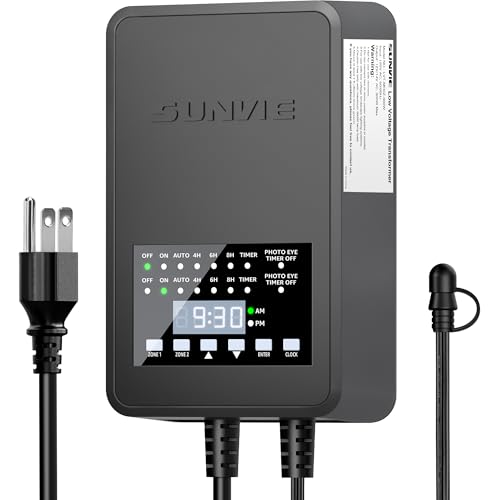
A photocell or dusk-to-dawn sensor automates switching based on outdoor light. An integrated sensor keeps the arrangement compact, while an external sensor may give more flexibility over where light detection occurs. The SUNVIE 300W 2-Zone Transformer and SUNVIE 200W Transformer document removable or replaceable external photocells. The WILAWELS 300W D12LT06 documents a detachable photocell and a dedicated test mode. Test functionality can be useful when setting up the sensor, but the listing does not establish how easy the process will be in practice.
Timer choices differ considerably. Basic models can offer always-on, automatic dusk-to-dawn, and countdown operation. Other products add scheduled on/off times, photocell-on/timer-off operation, or astronomical timing. The WILAWELS 300W D12LT06 lists six modes, while the DEWENWILS 300W Wi-Fi Transformer lists schedule, circulate, random, countdown, and astronomical modes through its app. The Moonrays 120W Transformer documents dusk-based shutoff choices of two, four, six, or eight hours. Select the control style that matches how you want the lights to operate; extra modes are useful only if you expect to use them.
Consider smart control and zones
Smart control is most useful when lighting schedules change often or when access to the transformer is inconvenient. The DEWENWILS 300W Wi-Fi Transformer supports app control and Alexa or Google Assistant voice control without a hub, but its listing specifies 2.4GHz-only Wi-Fi. Confirm that your network can provide that band before choosing it. For a conventional setup, buttons on the transformer may be preferable because they do not depend on an app or wireless connection.
Multiple zones also affect wiring and scheduling. Separate outputs can keep different parts of a property on different programs, but they may add planning complexity. A single-zone transformer can be adequate when all fixtures should turn on and off together. The evidence supplied here supports zone-count comparisons, but it does not provide detailed terminal-load limits for each individual zone, so follow the manufacturer’s installation instructions.
Check outdoor construction and protection
Outdoor placement exposes equipment to moisture, dust, temperature changes, and corrosion. Several selected transformers document weather-resistant or waterproof housings. The SUNVIE 300W 3-Zone Transformer and SUNVIE 300W 3-Zone Clamp-Connection specify 304 stainless-steel construction. The DEWENWILS 150W Stainless Steel Transformer also documents a stainless-steel housing, while the Moonrays 120W Transformer specifies a weather-resistant casing.
Protection features matter because a transformer may disconnect output during an overload or short circuit. Circuit protection is documented for the SUNVIE 300W models, WILAWELS 300W D12LT06, DEWENWILS 300W Wi-Fi Transformer, SUNVIE 200W Transformer, DEWENWILS 200W HOSL04A, DEWENWILS 150W Stainless Steel Transformer, and several compact products in the wider candidate pool. Do not interpret these descriptions as a guarantee against every electrical problem; use suitable wiring, connectors, mounting, and load planning.
Review installation details
Look for mounting holes, cord length, sensor-cable length, and terminal style before buying. The DEWENWILS 300W Countdown Transformer documents built-in hanging holes and a 3.3-foot power cord. The DEWENWILS 150W Stainless Steel Transformer lists a 6-foot power cord. External sensors can require a suitable location and cable route, while quick clamp terminals on the SUNVIE 300W 3-Zone Clamp-Connection are designed to accept wire without a screwdriver.
Electrical installation should follow the product instructions and applicable local requirements. Disconnect power before wiring, keep connections protected from moisture, and avoid exceeding the documented capacity. A transformer’s weather-resistant housing does not remove the need for correct mounting or protected cable connections.
Final recommendation
DEWENWILS 300W Wi-Fi Transformer ranks first overall in this specification-based comparison under the published weighted criteria.
The SUNVIE 300W 3-Zone Transformer is the first overall specification-based choice among these best outdoor low-voltage led transformers. Its 300W rating, three independently controlled zones, 12V/14V AC output, five modes, replaceable photocell, memory, and 304 stainless-steel housing give it the broadest blend of documented system flexibility.
The DEWENWILS 300W Wi-Fi Transformer is the better fit when app and voice control are priorities, while the WILAWELS 300W D12LT06 is compelling for buyers who want six modes and a test setting. For two separately scheduled areas, the SUNVIE 300W 2-Zone Transformer is a logical alternative. Smaller systems can step down to the Moonrays 120W Transformer, and systems requiring a documented 12V/15V AC choice should consider the DEWENWILS 150W Stainless Steel Transformer. These are the top outdoor low-voltage led transformers in this comparison based on listed specifications, not hands-on testing.
Frequently Asked Questions
Confirm the fixtures’ required output type and voltage first. Then total their wattage, leave appropriate headroom, and decide whether you need a photocell, countdown timer, scheduled operation, smart control, or multiple zones. Also review mounting, cord, sensor, and protection details.
No assumption should be made that they are interchangeable. The supplied products document both AC and DC designs, and the fixture manufacturer’s requirements should determine which output is appropriate. Check the transformer label and the lighting specifications before wiring.
The answer depends on the combined wattage of the connected fixtures. The selected products range from 120W to 300W, while other eligible listings document 60W, 100W, 150W, and 200W options. Add the fixture wattages and follow any stated operating limit; the DEWENWILS 300W Countdown Transformer recommends keeping the load at or below 80% of capacity.
Do I need multiple zones?
Multiple zones are useful when different areas need different schedules or modes. The SUNVIE 300W 3-Zone Transformer and DEWENWILS 300W Wi-Fi Transformer document three zones, while the SUNVIE 300W 2-Zone Transformer documents two. If every light should operate together, a single-output transformer may be sufficient.
Is a photocell better than a timer?
They serve different purposes. A photocell responds to dusk and dawn, while a countdown or scheduled timer controls how long the lights remain on. Several selected products combine both approaches, so choose a model whose documented modes match your preferred routine.