Buying Guide
The best hidden remote control extenders are usually infrared repeater systems rather than universal remotes. They capture an IR command in an open area, relay it through a cable or wireless link, and send it toward equipment placed behind a cabinet door or in another room. The right choice depends on the devices you need to control, the available power source, and how much installation flexibility your room requires.
Confirm that your remote uses infrared
Start with signal type. Bluetooth, Wi-Fi, and some radio-frequency remotes are not interchangeable with an IR repeater. The Nextgen listing is more specific about selected Chromecast, Alexa, and Roku remotes, so its named compatibility should be checked against your exact remote.
Frequency coverage is another useful specification. The TNP kit uses dual-frequency reception, and several distribution-block systems describe broadband or wide-frequency operation. These figures are useful screening information, but they do not independently establish compatibility with every device. Check the source equipment’s remote technology before installation.
Choose wired or wireless transmission
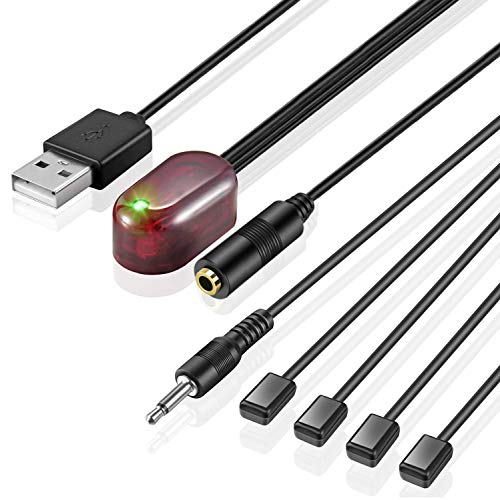
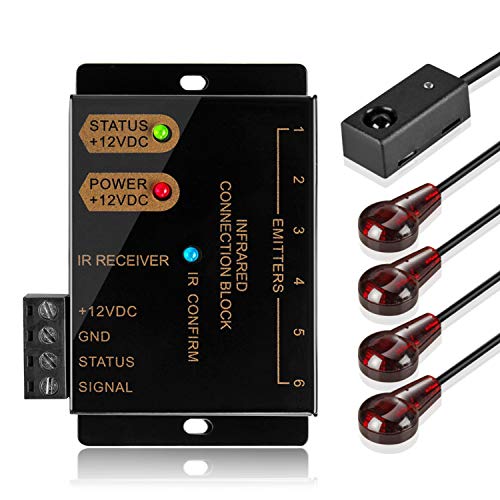
A wired repeater is generally the more direct cabinet approach. URWOOW, ICESPRING, Herfair, Cmple, TNP, and HdtvHookup use a receiver, a controller or distribution block, and emitter cables. This design is suited to a television console where the controlled components are together. Measure the path from the visible receiver to the hidden equipment and check the supplied cable lengths where the listing provides them.
Wireless models reduce the need for a cable between rooms. Sewell documents wireless transmission up to 200 meters, subject to obstacles, while SIIG lists up to 200 meters or 656 feet depending on surrounding obstructions. SPENFiLY WL-E1 documents more than 50 meters indoors and more than 200 meters outdoors. These are stated transmission specifications, not a guarantee for every home. Walls, floors, placement, and interference can affect the usable layout.
Wireless does not mean installation-free. The receiver and transmitter still need power, and IR devices may need an emitter cable or a close, correctly aligned transmitter. Sewell specifically describes directional receivers and recommends positioning an optional cable close to the device sensor. SIIG likewise says extension cables should be placed in line with the source sensor when used.
Match the emitter count to your equipment
Count the devices that must respond independently. URWOOW includes four emitters. ICESPRING and Herfair each list five emitters, while Cmple includes two dual emitters that control four devices and documents expansion to 18. TNP includes two dual emitters and supports up to six emitter outputs. HdtvHookup includes two dual emitters for four devices and states expansion to 12.
The distinction between emitters and devices matters. A dual emitter can serve two components, but the emitter must still be positioned at the relevant IR windows. If your receiver, cable box, disc player, amplifier, and satellite receiver are all hidden together, a distribution-block system may be more suitable than a small single-cable repeater.
Plan receiver and emitter placement
The receiver belongs where the handheld remote can reach it. A visible location near the television or cabinet edge is common, but the supplied evidence varies by model. URWOOW provides a two-meter receiver cable and one-meter emitter cables. ICESPRING lists a five-foot receiver cable and ten-foot emitter cables. Cables of different lengths can materially change how easily the system fits behind furniture.
The emitters belong near the IR sensors on the hidden devices. Some listings describe adhesive mounting, while Sewell includes mounting adhesive and rubber feet. Do not assume every kit uses the same mounting method; confirm what is in the package.
Receiver direction also deserves attention. A wide stated reception angle can make positioning easier, but the receiver still needs a clear signal path from the remote. Keep the receiver away from likely interference sources when the product instructions call for it; ICESPRING specifically mentions plasma displays as a possible interference concern.
Check power and status feedback
Power requirements can determine where the controller can be hidden. URWOOW uses a 5V USB power supply. Herfair includes a 12V DC adapter, and SIIG includes two power adapters. Some compact cable-based options use USB but do not include an adapter, so inspect the package contents rather than assuming a wall adapter is supplied.
Status indicators are useful during setup. URWOOW lists a confirmation LED, ICESPRING describes green power and flashing red transmission indicators, and Herfair documents separate power and signal indications. SIIG also lists an LED that illuminates when a signal is received. These indicators can help distinguish a remote-signal issue from an emitter-placement issue without changing the overall system design.
Compare expansion needs before installing
For four or fewer devices, URWOOW, TNP, and HdtvHookup provide clearly stated starting configurations. For larger systems, Cmple documents expansion to 18 devices, while ICESPRING and Herfair document expansion to 12. Expansion may require separately purchased emitters or additional receivers, so check which parts are included and which are optional.
Also consider whether separate rooms need separate control zones. SPENFiLY WL-E1 is documented for adding transmitters or receivers and for multi-zone control. A conventional distribution block may be better when all equipment is in one cabinet, while a wireless system may better fit equipment distributed across rooms. Select based on the documented layout features rather than on brand names alone.
Final Recommendation
Cmple Premium Hidden IR Control System ranks first overall in this specification-based comparison under the published weighted criteria.
Cmple Premium Hidden IR Control System is the first overall specification-based choice among these best hidden remote control extenders because it combines broad listed A/V compatibility, plug-and-play installation, dual-band reception, and documented expansion up to 18 devices. The top hidden remote control extenders otherwise divide into clear use cases: ICESPRING and Herfair suit larger wired cabinets, Sewell and SIIG suit wireless room-to-room layouts, and URWOOW suits a straightforward four-emitter installation.
Before choosing, verify IR compatibility, count the required emitters, measure the receiver and emitter paths, and confirm the available power connection. A wireless range figure is useful for planning but depends on obstacles, while wired kits require careful sensor placement. The best hidden remote control extenders are therefore the ones whose documented parts and signal method match the physical arrangement of your equipment.
Frequently Asked Questions
Among the best hidden remote control extenders, do hidden remote control extenders work with Bluetooth remotes?
Not generally. The selected products are described as infrared systems, and the Sewell listing explicitly says its BlastIR Pro works only with IR devices. Confirm the remote technology before selecting an extender.
How many devices can these IR repeaters control?
It depends on the kit. URWOOW includes four emitters, while ICESPRING and Herfair list five emitters and support up to 10 devices in their descriptions. Cmple controls four devices with the included dual emitters and documents expansion to 18. TNP lists up to six emitter output connections, and HdtvHookup documents expansion from four to 12 devices.
Is a wireless extender better than a wired repeater?
Neither design is universally better. Wired systems are a direct fit when the equipment sits in one cabinet and emitter cables can reach each IR window. Wireless models reduce the cable run between rooms, but they still require powered transmitter and receiver units and appropriate IR alignment. Use the room layout and documented range requirements as the deciding factors.
Where should the IR emitters be attached?
Place each emitter near the hidden device’s IR sensor. The Sewell listing recommends positioning its optional emitter cables directly over the device receiver, and other kits describe emitter placement at the component’s IR window. Follow the included instructions and avoid assuming that one emitter position works for every component.
Some include one or more adapters, while USB-powered models may require a compatible USB power source. URWOOW lists a 5V USB supply, Herfair includes a 12V adapter, and SIIG lists two power adapters. Check the package description and the power specification for the exact model before planning the installation.