Buying Guide
Choosing among the best wireless remote control extenders starts with the signal type of the equipment you want to operate. The selected products are infrared systems: they receive an IR command from an existing remote, send it wirelessly to a second unit, and then relay it toward the hidden component. This is different from a universal remote, a Bluetooth bridge, or a Wi-Fi smart-home controller.
Confirm IR compatibility first
Look for an infrared sensor on the cable box, disc player, amplifier, receiver, or other A/V component. OrangeLight, Fourair, Binken, SIIG, and TNP Products document broad 20–60 kHz support. SPENFiLY lists either 36–56 kHz or a transponder design centered on 433.92 MHz for the wireless link, while its system still handles IR devices. NEXTGEN specifically names certain streaming remotes but does not make every streaming platform universally compatible.
Do not assume that a remote works merely because it controls a television or streaming box. The supplied listings specifically exclude Bluetooth, Wi-Fi-only, app-controlled, or other non-IR devices in several cases. Verify the remote and the target component before selecting a kit.
Match the wireless distance to the layout
Published distance figures vary substantially. SIIG and Sewell list up to 200 meters or 656–650 feet, while Fourair lists 700 feet, Binken lists 800 feet, and OrangeLight lists 500 feet. These figures describe the wireless connection between the extender units, not necessarily the distance at which the handheld remote can be used. Sewell documents a 30-foot receiver distance, Fourair documents 30 feet, and Binken documents 40 feet.
NEXTGEN lists a 100-foot through-wall range, making it more appropriate for a modest room-to-room arrangement than a large property. SPENFiLY documents more than 50 meters indoors and more than 200 meters outdoors for its transponder systems. Treat published range as a planning reference rather than a guarantee: walls, furniture, building materials, and interference can affect the usable layout.
Consider receiver angle and placement
Receiver geometry matters when the remote is used from several seats or directions. The SPENFiLY Mini lists a 180-degree reception angle, and the WL-E1 lists 130 degrees. Binken lists a 90-degree area, while OrangeLight lists 45 degrees. Sewell cautions that its receiver is directional and should face the area where the remote will be used.
Emitter placement is equally important. Binken recommends placing the emitter within two inches of the device’s IR sensor. Sewell recommends attaching optional emitter cables directly over the device sensor, and SIIG gives similar line-of-sight guidance for its extension cable. These details favor kits with visible emitter probes when components sit behind cabinet doors.
Decide how many devices need control
A one-to-one wireless kit may be sufficient for a single hidden cable box or disc player. For several components, check the documented emitter arrangement rather than relying on the word “universal.” Sewell lists emitters for up to two devices. SPENFiLY’s WL-E1 offers model options for one, two, or four IR devices and supports adding transmitters or receivers. Its OWM-Series configuration is identified for one device but can also be expanded.
OrangeLight’s dual-channel design is useful when two nearby equipment zones must remain separate. The channel switches on the receiver and emitter are matched to reduce accidental cross-control. This is a distinct feature from a conventional single-channel kit.
Compare installation and power details
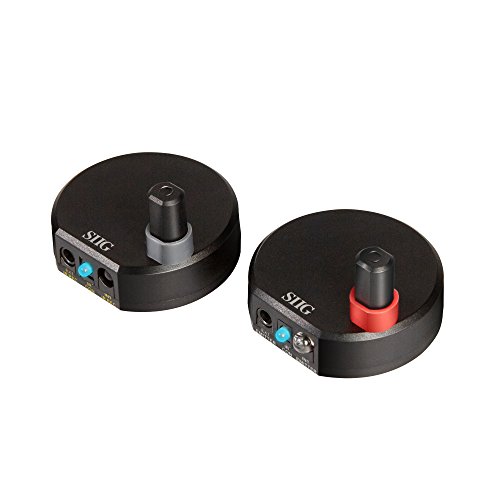
Most selected kits use a receiving unit, a transmitting unit, emitter hardware, and external power. OrangeLight includes both AC and USB adapters; Sewell includes USB and AC power cables; SIIG includes two power adapters; and the SPENFiLY systems include power cables or supplies. TNP Products describes a receiver, power adapter, emitter, and transmitter in its wireless kit.
The NEXTGEN design is different: its transmitter replaces one AA or AAA battery in the remote. That may suit an installation where the remote must send its command from a different location, but it is less like a conventional two-box repeater. The SPENFiLY Mini also differs by using a compact transponder arrangement without a separate transmitter-and-receiver connection.
Use the scoring structure appropriately
The comparison weights IR compatibility and wireless range most heavily because an extender must support the target signal and reach the intended location. Device capacity follows, since multi-component cabinets need enough emitter or expansion support. Reception flexibility accounts for angle and directional guidance, while setup and power practicality covers included adapters, cables, indicators, and installation notes.
These scores are specification-based. They do not represent hands-on testing, independent measurements, or customer experience. When two products appear close, use the documented layout details—especially angle, emitter placement, number of devices, and power method—to make the final choice.
Final Recommendation
SPENFiLY WL-E1 Wireless IR Transponder ranks first overall in this specification-based comparison under the published weighted criteria.
The final choice among the best wireless remote control extenders depends on the documented features that match your intended use.
OrangeLight 2CH IRBlast Wireless Repeater is the highest-scoring returned product and the first overall specification-based choice. It combines a 500-foot stated wireless range, 20–60 kHz support, dual-zone channel selection, a 45-degree receiver, and a complete accessory set. It is particularly compelling for a cabinet with adjacent equipment that needs separate control paths.
The top wireless remote control extenders differ mainly in layout priorities. Choose Sewell SW-32988 or SIIG when a long documented link is central. Choose Binken or Fourair when broad IR support and a generous receiver area matter. SPENFiLY WL-E1 is the better fit for expansion across multiple rooms, while the Mini emphasizes a 180-degree reception angle and compact transponder format. For a single device with expansion potential, the SPENFiLY OWM-Series configuration is clearly identified. NEXTGEN is worth considering when its named streaming-remote compatibility and battery-replacement transmitter match the installation.
Before ordering, identify the remote protocol, count the hidden components, measure the likely separation between extender units, and check where each emitter can sit relative to the target IR sensor. Those four checks will usually narrow the field more reliably than a generic range number alone.
Frequently Asked Questions
Are the best wireless remote control extenders compatible with Bluetooth remotes?
Generally, no. Fourair, OrangeLight, Binken, SIIG, and other selected listings describe IR operation and explicitly exclude Bluetooth or Wi-Fi-only control. Confirm that both the handheld remote and the target device use infrared before choosing a repeater.
Can one wireless extender control several hidden devices?
Some can, but the capacity varies. Sewell documents support for up to two devices through its emitter arrangement. SPENFiLY WL-E1 lists configurations supporting one, two, or four IR devices and allows additional transmitters or receivers. A system designed for several components may require separate emitter leads positioned over each device sensor.
Does the published wireless range equal the remote’s operating distance?
No. The published wireless figure usually describes the connection between the receiver and transmitter units. The handheld remote still has to reach the receiver, and that receiver may have a separate documented distance or angle. Fourair, Sewell, and Binken list receiver-use distances separately from their longer wireless links.
Which selected design is easiest to place in a tight area?
The SPENFiLY Mini is documented as an ultra-compact transponder with a 180-degree reception angle and no separate transmitter-and-receiver connection. SIIG also describes an ultra-compact design. Even with a compact unit, confirm that power cables and the emitter path can reach their intended positions.
Do these extenders need direct line of sight?
The wireless connection can pass between rooms or through obstacles according to several listings, but the IR portions still need suitable positioning. Place the receiver where the handheld remote can reach it, and place an emitter close to the target device’s IR sensor. Sewell, Binken, and SIIG all provide placement guidance for their emitters or receivers.