Buying Guide
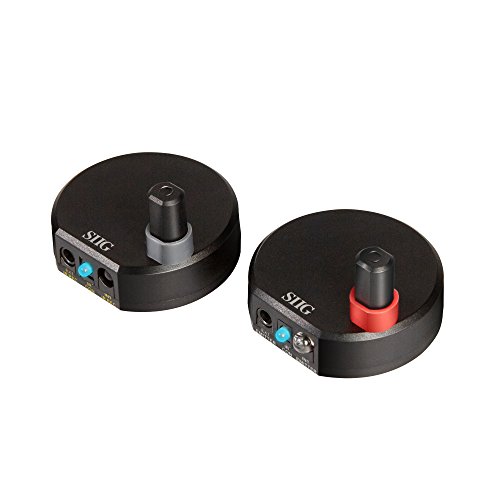
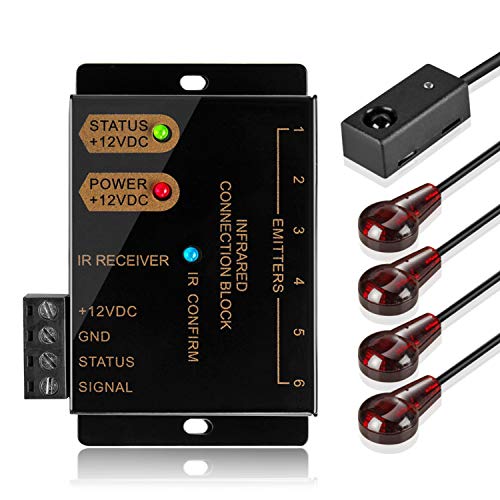
The best ir remote control extenders are defined by how they receive, relay, and deliver infrared commands—not simply by the distance printed in a listing. Start by identifying where the remote will be used, where the controlled equipment sits, and whether the system needs a cable run or a wireless connection. The products selected here document one or more of these designs: wireless transmitter-and-receiver pairs, wired distribution boxes, and compact USB-powered repeater cables.
Confirm that the equipment uses IR
An IR extender cannot replace an RF, Bluetooth, Wi-Fi, or app-only control path. Sewell, OrangeLight, Fourair, and Binken explicitly identify IR-only operation or exclude Bluetooth and Wi-Fi-only equipment. Before selecting a kit, check the remote and the front panel of the device for an infrared receiver. Cable boxes, DVD and Blu-ray players, receivers, amplifiers, and many traditional televisions are repeatedly listed as compatible device types.
Frequency information can also help narrow the choice. SIIG, OrangeLight, Fourair, and Binken specify a 20–60 KHz range, while the selected wired systems use broadband or dual-frequency descriptions to indicate support for multiple IR devices. A stated frequency range is useful evidence, but it does not remove the need to verify the particular device.
Choose wireless or wired transmission
Wireless kits are useful when the equipment is in another room, behind a wall, or far from the viewing position. SIIG lists transmission up to 200 meters, Sewell up to 650 feet, Fourair 700 feet, Binken 800 feet, and OrangeLight 500 feet, with some listings also giving open-air figures. These figures are specifications rather than confirmed room results; walls, floors, and other obstructions can affect the link.
A wired repeater is usually easier to plan when the equipment is in one cabinet. TNP, ICESPRING, Herfair, and Ensigear use receiver, controller, and emitter arrangements that place the sensor near the viewer and the emitters near individual device windows. This approach avoids a separate wireless span but requires cable routing and careful emitter placement.
Match emitter capacity to the equipment stack
Count the devices that must respond before choosing a kit. A basic one-emitter design may suit a single cable box or player. TNP supports up to six emitter connections, while ICESPRING and Herfair document control of up to 10 devices with expansion to 12. Ensigear states support for up to 32 AV components with four emitter outputs, making its architecture more specialized for a large installation.
Emitter count is not the only consideration. The emitter must sit close to the device’s IR sensor. SIIG, Sewell, OrangeLight, and Binken describe direct or near-sensor placement, and Binken specifies positioning within two inches. If the equipment has sensors in different locations, longer cables or multiple outputs can simplify the layout.
Check receiver angle and placement
Receiver geometry affects where the remote can be pointed. Binken lists a 90-degree receiver angle and Fourair also lists 90 degrees, while OrangeLight lists 45 degrees. A compact receiver placed below a television may be convenient, but a directional unit could need more deliberate alignment.
Look for visual feedback when troubleshooting matters. SIIG, OrangeLight, Fourair, TNP, ICESPRING, Herfair, and Ensigear document LEDs or signal indicators. These lights can show that a command reached the receiver, helping separate remote-position issues from emitter-placement issues. They do not prove that every connected device will respond.
Plan power and cable routing
Power arrangements vary. The selected wired distribution kits use dedicated adapters, while the NEXTGEN design uses a transmitter that replaces an AA or AAA battery. Confirm that the chosen location has a suitable outlet or USB source and that the cable lengths reach both ends of the setup.
Keep emitters aligned with the equipment’s IR windows and avoid placing receivers where direct sunlight or other environmental interference may affect reception. ICESPRING specifically advises distance from plasma displays. These details are more useful than a generic claim of universal operation because they describe the installation conditions that the listings identify.
Compare the selected designs
For broad wireless coverage, SIIG, Sewell, OrangeLight, Fourair, and Binken provide the clearest documented long-distance specifications. SIIG adds 20–60 KHz support and two power adapters; OrangeLight adds dual channels; Binken documents a wide receiver angle; and Fourair combines long range with a 90-degree receiver.
For a cabinet with many components, ICESPRING, Herfair, TNP, and Ensigear provide the clearest capacity evidence. ICESPRING and Herfair include five emitters and document expansion to 12 devices. TNP supports up to six emitter outputs, while Ensigear states support for up to 32 components. NEXTGEN suits a simpler room-to-room arrangement where existing AA or AAA remotes are central to the setup.
Final Recommendation
ICESPRING Infrared Repeater System ranks first overall in this specification-based comparison under the published weighted criteria.
SIIG CE-RC0014-S1 is the highest-scoring specification-based choice among these best ir remote control extenders because it combines 200-meter wireless transmission, 20–60 KHz IR support, two power adapters, extension cables, and LED feedback. It is a practical starting point for standard AV equipment when the receiver can be positioned directionally.
The top ir remote control extenders divide into two practical groups. Choose Sewell, OrangeLight, Fourair, or Binken when the equipment is separated by a substantial wireless span. Choose ICESPRING, Herfair, TNP, or Ensigear when several devices share a concealed cabinet and emitter capacity matters more than wireless reach. NEXTGEN suits a simpler setup using AA or AAA remotes and a documented 100-foot through-wall range.
Before installation, verify IR operation, count devices, check receiver direction and angle, identify the power source, and place each emitter near its device sensor. Those checks will make the specification comparison more relevant to the actual AV layout.
Frequently Asked Questions
What should I verify before choosing the best ir remote control extenders?
Verify that both the remote and the controlled equipment use infrared. Also check the listed frequency range, receiver angle, transmission distance, emitter count, and power method. Wireless specifications may vary with walls and other obstructions, so treat stated distances as reference points rather than confirmed room performance.
Are wireless IR repeaters better than wired kits?
Neither design is universally better. Wireless repeaters such as SIIG, Sewell, OrangeLight, Fourair, and Binken are documented for room-to-room or long-span links. Wired systems such as TNP, ICESPRING, Herfair, and Ensigear can be easier to organize inside one cabinet and often provide multiple emitter outputs. The layout determines which design is more suitable.
How many emitters do I need?
Use at least one emitter for each independently controlled device unless the system documents another arrangement. TNP supports up to six emitter connections, ICESPRING and Herfair document up to 10 devices with expansion to 12, and Ensigear states support for up to 32 components. Place each emitter close to the corresponding IR sensor.
Do IR extenders work with Bluetooth streaming devices?
Not generally. OrangeLight, Fourair, and Binken explicitly exclude Bluetooth or Wi-Fi-only devices. NEXTGEN lists compatibility with certain Chromecast, Alexa, and Roku remotes, but compatibility is device-specific. Confirm the remote’s signal type instead of relying only on the device category.
Why do some kits include an LED indicator?
An LED can show that the receiver detected a command or that the system has power. SIIG, OrangeLight, Fourair, TNP, ICESPRING, Herfair, and Ensigear document this type of feedback. It can help identify receiver placement or emitter alignment issues, but it does not establish compatibility with every AV component.