Buying Guide
The best hi-vis safety vests are not interchangeable. A vest for a surveyor carrying markers, a vest for a utility worker facing arc-flash requirements, and a simple visitor vest have different specification priorities. This comparison uses public listing information only: no hands-on testing, laboratory verification, or customer-opinion summary was used. The rankings weigh stated safety classifications, reflective construction, storage, materials, and work-oriented features.
Start with the required safety classification
First identify the class and type required by the job, site, employer, or safety program. Several selected products state ANSI/ISEA 107-2020 Class 2 compliance, including the Kishigo S5002, Dib Safety vest, Ekkosafety EK175, Neopelta vest, JKSafety BX360, BX331, and BX310. Kishigo additionally specifies Class 2 Type R, while Oberon documents ANSI/ISEA 107-20 Class 3 Type R.
Those labels should not be treated as interchangeable. Confirm that the exact color and size variant you intend to use carries the needed documentation. Oberon is distinct because its listing describes flame-resistant construction, arc-flash PPE Category 2, and a 10 cal/cm² ATPV. That makes it a specialized candidate for utility or response work where FR and arc-rated requirements apply. A general mesh vest should not be substituted for that type of protective apparel.
Compare reflective coverage, not just color
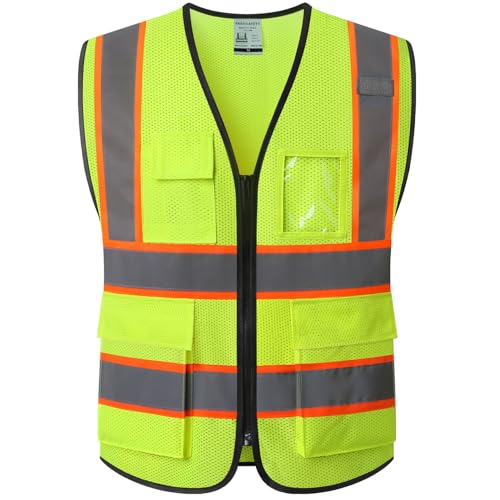
A fluorescent yellow, orange, or lime base helps the vest stand out in daylight, but the reflective layout is also important. Look for documented tape width and placement. The JKSafety models and Ekkosafety listing describe 2-inch reflective elements, while the Kishigo listing describes 2-inch high-performance reflective material laminated onto wider contrasting material. Neopelta specifies reflective tape with orange mesh and yellow trim.
Coverage across the shoulders, chest, waist, and back is more informative than a color name alone. Use the supplied coverage descriptions as a checklist, then inspect the actual garment and employer rules before relying on it for a particular roadway or night-work situation.
Choose the right pocket system
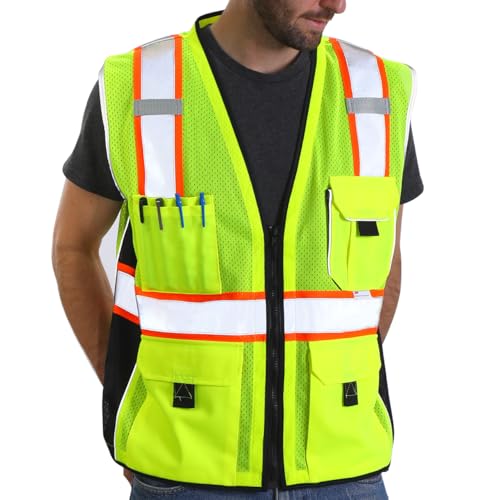
Pocket count can be useful, but layout matters more than a headline number. The Kishigo S5002 is a field-storage design with a two-tier chest pocket, gusseted chest pocket, lower pockets, stake pockets, spray-paint pockets, and additional compartments. ZUJA also describes 10 functional pockets, a phone-sized deep pocket, pen slots, and a D-ring. Uno Mejor lists 11 pockets, including inner, expandable, pen, pointer, and ID storage.
For a more moderate load, the JKSafety BX360 has eight compartments, while Dib Safety and Neopelta provide chest, cargo, interior, phone, ID, or pencil storage. Ekkosafety, BX331, and BX310 are better suited to workers who need a smaller collection of everyday items. More pockets can add organization, but they may also add bulk when filled. Consider the actual tools, phone, badge, radio, and writing implements you carry rather than selecting solely by count.
Match material and closure to the shift
Mesh polyester appears throughout the selected group because breathability is a recurring listing feature. The JKSafety BX360, BX331, and BX310, Ekkosafety, Dib Safety, and Neopelta all describe polyester mesh or breathable mesh construction. ZUJA uses a hybrid build with Oxford cloth, polyester, and sandwich mesh at the sides and back, while Kishigo combines a solid polyester front with a lightweight mesh backing.
A hybrid or solid-front design may make sense when you want more structured storage or reinforcement. An all-mesh design may be preferable for warm conditions, but the supplied listings do not provide comparative temperature testing. Check whether the closure, pocket flaps, and fit leave room for the clothing worn underneath.
Check fit and layering guidance
The supplied products are listed in particular sizes, so do not assume that one selection represents every available fit. Neopelta explicitly advises ordering one size larger when wearing the vest over a jacket. ZUJA describes sizes from S to 5XL and oversized options for layering.
The Uno Mejor vest is described as a women’s snug-fit design with an elastic hem, unlike the straight-cut or unisex descriptions attached to several other products. That may help shoppers looking for a more shaped silhouette, but measurements remain more reliable than gender labels. For every vest, compare chest measurements, intended layering, and the required movement range before ordering.
Consider specialized job features
Surveyors and field crews may benefit from stake pockets, spray-paint pockets, mic tabs, ID windows, and D-rings. Kishigo, Neopelta, JKSafety, ZUJA, and Dib Safety document several of these features. Radio users should pay attention to mic tabs or radio clip straps: the Kishigo S5002, JKSafety BX360, JKSafety BX310, Neopelta, and Oberon listings provide relevant access features.
For utility work, Oberon is the selected product with supplied FR and arc-rated claims. For general roadwork, construction, warehouses, airports, and surveying, the Class 2 mesh vests offer more conventional designs. Always separate visibility apparel from other protective equipment requirements; a vest’s listed reflective class does not automatically establish anti-static, FR, or arc protection.
Final recommendation
Kishigo Premium Black Series S5002 ranks first overall in this specification-based comparison under the published weighted criteria.
Kishigo Premium Black Series S5002 is the first overall specification-based choice in this comparison.
The final choice among the best hi-vis safety vests depends on the documented features that match your intended use. Among the top hi-vis safety vests, Kishigo S5002 has a strong documented blend of Class 2 Type R visibility, reflective material, extensive storage, mesh ventilation, and surveyor-oriented details. Oberon is the better match when FR and arc-rated documentation is specifically required, while Dib Safety and ZUJA suit workers who prioritize reinforced or high-capacity storage.
For a lighter general-purpose option, compare the JKSafety BX360, BX331, and BX310 with Ekkosafety’s EK175. Neopelta adds a contrast-color layout and communication features. Uno Mejor is the selected fit-focused option for women who want a large pocket system. Verify the exact class, size, color variant, closure, and workplace requirements before use.
Frequently Asked Questions
What are the best hi-vis safety vests for construction work?
For general construction, the Kishigo S5002, Dib Safety vest, JKSafety BX360, Ekkosafety EK175, and JKSafety BX310 document combinations of reflective materials, mesh or breathable construction, and work-oriented storage. The right choice depends on whether the job needs many tool pockets, a lighter basic design, mic access, or a specific ANSI class. Confirm the employer’s required classification before buying.
Is a Class 2 vest enough for every job?
No. The selected listings show different classifications and specialized claims. Several vests specify Class 2, while Oberon specifies Class 3 Type R and also describes FR and arc-rated protection. The required class depends on the work environment and governing safety requirements. A Class 2 general-purpose vest should not be assumed to satisfy a job calling for Class 3, FR, or arc-rated apparel.
Which selected vest has the most storage?
Uno Mejor lists 11 pockets, while Kishigo S5002 and ZUJA each describe 10-pocket systems. Kishigo’s layout includes stake pockets and spray-paint pockets, while ZUJA describes pen slots, a deep phone pocket, and a D-ring. Uno Mejor provides inner, expandable, pen, pointer, and ID storage. Select based on pocket placement and the tools you carry, not count alone.
Are mesh safety vests suitable for hot weather?
Many selected listings describe polyester mesh or breathable mesh, including the JKSafety, Ekkosafety, Dib Safety, Neopelta, and Uno Mejor vests. That evidence supports choosing mesh when airflow is a priority, but it does not provide comparative temperature testing. Layering, fit, and the amount of pocket contents can affect comfort. Check the garment’s material and size guidance for the intended conditions.
What should I check before ordering a hi-vis vest?
Confirm the required ANSI class or other workplace specification, then check the exact size, color, reflective coverage, closure, pocket arrangement, and material. If the vest will be worn over a jacket, review layering guidance; Neopelta specifically addresses sizing up for that use. Also check whether the task requires FR, anti-static, or arc-rated protection, because ordinary visibility features do not establish those properties.