Buying Guide
Choosing among the best high-visibility safety shirts starts with the visibility classification required for your task, then moves to reflective coverage, fabric, storage, sleeve length, and care. The products above are compared from public listing evidence. They were not physically tested, and this article does not summarize customer opinions.
Start with the documented ANSI class
ANSI language is one of the most important distinctions in this category. The JKSafety TS400, DPSAFETY, WEFEYUV, Besentinels, and both L&M entries state Class 3 compliance or a Class 3 designation in their supplied listings. The SKSAFETY and TICONN shirts state Class 2. Class references are not interchangeable, so confirm the requirements of your employer, site, or safety program before buying.
The Uno Mejor and TCCFCCT listings require extra attention because their titles and feature text use different class references. Uno Mejor is titled Class 2 while its description says ANSI/ISEA Class 3. TCCFCCT has a similar Class 2 title and Class 3 feature claim. These products can still be considered, but buyers should verify the applicable documentation rather than relying on one conflicting line.
Compare reflective-strip coverage
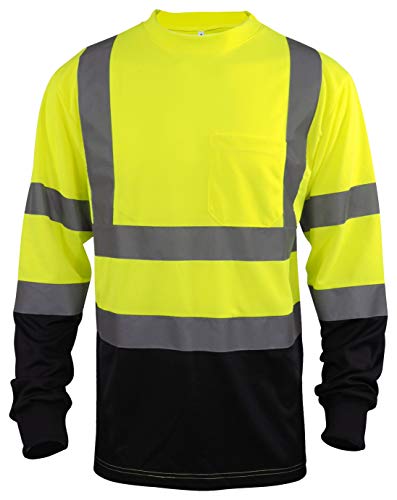
Reflective placement affects how much of the wearer’s outline is described as visible from different directions. JKSafety stands out for its stated eight 2-inch strips across the shoulders, chest, and arms. WEFEYUV specifies a 2-inch strip and adds elastic cuffs to its long-sleeve design. Besentinels uses a sewn 2-inch H-back pattern covering the arms, chest, waist, and back.
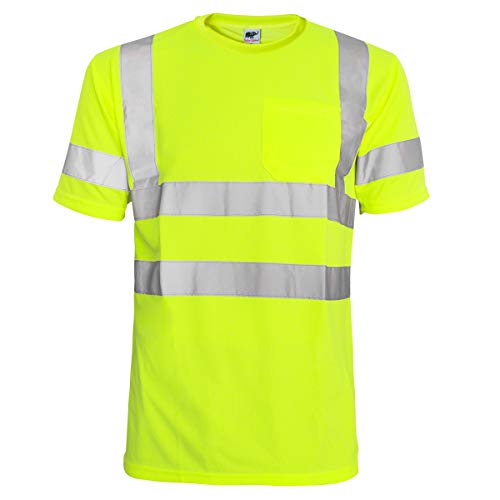
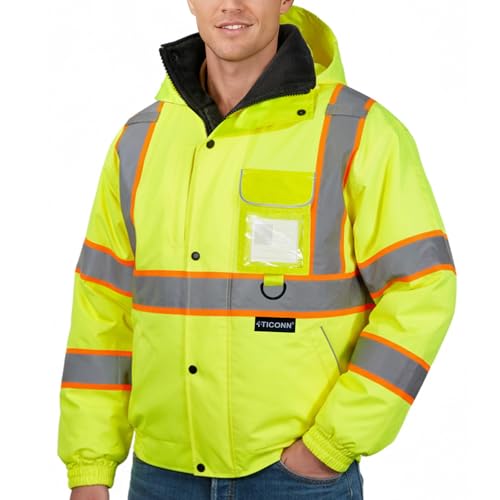
DPSAFETY describes 360-degree visibility and reflective material, while L&M specifies sewn-on reflective striping without providing the same level of layout detail. SKSAFETY identifies 2-inch heat-transfer tape across the shoulders, waist, and back. TICONN describes 360-degree reflective tape but does not provide a detailed placement diagram in the supplied evidence.
The multi-shirt Uno Mejor and TCCFCCT designs describe reflective placement across several body areas. Uno Mejor lists the front, back, shoulders, and waist. TCCFCCT describes the front, back, shoulders, and sleeves, along with a chest strip area. These details may be useful for work crews, but they do not replace checking the required garment class.
Choose fabric for the working conditions
Most of the selected shirts use birdseye or bird-eye polyester mesh. The listings commonly describe this construction as breathable, lightweight, moisture-wicking, or quick-drying. SKSAFETY provides a 125 GSM specification, while DPSAFETY identifies 100% bird-eye knitted polyester and describes the shirt as quick-dry. JKSafety, WEFEYUV, L&M, and TICONN also describe polyester fabric with breathability or moisture-handling characteristics.
A long-sleeve shirt may make sense when arm coverage is a priority. WEFEYUV is the clearest long-sleeve choice in this group because it documents elastic cuffs and a fast-drying material. L&M also identifies short- and long-sleeve availability in its feature information. Sleeve choice remains a work-condition decision: short sleeves may feel more suitable in heat, while long sleeves provide more fabric coverage.
Look for useful work details
A pocket can make a shirt more practical for small items. The L&M shirts, DPSAFETY, SKSAFETY, TICONN, and Uno Mejor listings identify a chest or left-chest pocket. L&M’s listings specifically mention a left chest pocket, while SKSAFETY and TICONN identify chest storage. Uno Mejor describes a pocket for a phone or small tools. The TCCFCCT listing instead highlights a chest strip area for hanging a walkie-talkie or ID card, which is a different feature from a conventional pocket.
Reinforced construction is another useful specification. DPSAFETY describes a machine-wash test claim. WEFEYUV identifies hand-sewn reflective tape and elastic cuffs. Besentinels and Uno Mejor mention reinforced stitching, and TCCFCCT describes reinforced sewing. These statements describe listed construction features; they should not be treated as a guarantee of service life in a particular job.
Care details vary. DPSAFETY, TICONN, and L&M provide machine-wash information in their listings. SKSAFETY gives a specific machine-wash claim, while WEFEYUV and Uno Mejor also mention machine washing in their supplied features.
Review the size chart before ordering. Several listings show a single selected size in the product data, while SKSAFETY specifically advises checking measurements and considering a larger size for a loose fit or borderline measurements. Do not assume that a size label is consistent across brands. If layering, movement, or job-specific clothing is important, compare the garment’s own chart and fit guidance.
Match the shirt to the job
For higher stated classification needs, begin with the Class 3 options and verify the applicable standard. For Class 2 tasks, SKSAFETY and TICONN offer clearer documented Class 2 choices. For a long-sleeve design, WEFEYUV is the most directly supported selection. For a multi-shirt rotation, Uno Mejor and TCCFCCT both list three-piece formats, but their class wording should be confirmed. A shirt with a pocket may suit workers carrying small items, while a strip-focused design may be preferable when visibility coverage is the main priority.
Final Recommendation
JKSafety TS400 Class 3 Reflective Shirt ranks first overall in this specification-based comparison under the published weighted criteria.
JKSafety TS400 Class 3 Reflective Shirt is the highest-scoring returned product and the first overall specification-based choice. Its listing combines ANSI/ISEA 107-2020 R-class Level 3 wording, eight 2-inch reflective strips, shoulder and arm coverage, and lightweight birdseye polyester. DPSAFETY is a close alternative for buyers who value a pocket, quick-dry mesh, and more detailed wash-test information. WEFEYUV is the better fit when long sleeves and elastic cuffs matter.
The top high-visibility safety shirts are not identical substitutes: classification, reflective layout, sleeve length, pockets, and care information differ. Before ordering, confirm the required ANSI class, inspect the size chart, and select the design that matches the work environment. The best high-visibility safety shirts are the ones whose documented specifications align with that specific requirement rather than those chosen from a generic appearance alone.
Frequently Asked Questions
What should I check first when choosing the best high-visibility safety shirts?
Check the required ANSI class first, then compare reflective coverage and garment type. The selected listings include Class 2 and Class 3 examples, so the correct choice depends on the requirements of your worksite or safety program. After that, review sleeve length, pocket placement, fabric description, and sizing information.
Are Class 3 shirts automatically the right choice for every job?
No. Class 3 is a stated classification on several selected products, but the required garment class depends on the work setting and applicable rules. SKSAFETY and TICONN are listed as Class 2 options. Uno Mejor and TCCFCCT contain conflicting class references between their titles and feature text, so their documentation should be verified before purchase.
Which selected shirts have long sleeves?
WEFEYUV is explicitly described as a long-sleeve shirt with elastic cuffs. The L&M B01GWVMZ44 listing identifies short- and long-sleeve availability in its features, although the supplied selected variant is presented as a lime shirt. The other selected products are primarily described as short-sleeve shirts.
Which shirts include a pocket?
The L&M selections, DPSAFETY, SKSAFETY, TICONN, and Uno Mejor listings identify a chest or left-chest pocket. TCCFCCT instead describes a chest strip area for carrying a walkie-talkie or ID card, which should not be assumed to be a pocket. WEFEYUV and Besentinels do not identify a pocket in the supplied evidence.
Are these shirts suitable for nighttime outdoor activity?
Several listings mention nighttime activities, low-light visibility, or reflective performance, including JKSafety, DPSAFETY, WEFEYUV, SKSAFETY, and TICONN. Those statements describe the listed design, not a hands-on performance test. Follow the visibility requirements for the activity and use any additional protective equipment required for the setting.