Buying Guide
The best ansi-compliant safety vests are not interchangeable simply because each listing uses high-visibility language. The useful differences are the stated ANSI class, the amount and placement of reflective material, the vest’s storage layout, the fabric construction, and how the closure or cut may work with other clothing. This comparison uses those documented specifications rather than hands-on tests, customer sentiment, or marketplace signals.
Start with the stated ANSI class
First identify the classification that matches the worksite’s written requirements. The Dib Safety Heavy Duty Class 3 Vest is the most specification-aligned classification-specific option in this group because its listing states ANSI/ISEA 107-2020 Class 3 compliance and describes use in complex backgrounds and extreme conditions. Class 3 should not be treated as a universal substitute for an employer’s safety program, but it is a meaningful distinction from the Class 2 options.
Most of the selected products are described as Class 2 or Class 2 Type R garments. These include the Kishigo Premium Black Series 1513, KwikSafety RoadBOSS Women’s Class 2 Vest, Shine Bright ANSI Class 2 Vest, XIAKE 9-Pocket Class 2 Vest, and SAFEGEAR Breakaway Vest 5-Pack. The listings also identify Class 2 positioning for the AdirPro, JKSafety, Uno Mejor, and JKSafety BX320 products. Match the garment’s stated class and type to your workplace policy rather than assuming that a bright color alone establishes compliance.
Compare reflective placement
Reflective tape is more useful when it is positioned to outline the wearer from multiple directions. Several selected products document tape across the shoulders, chest, waist, and back. The XIAKE 9-Pocket Class 2 Vest specifies 2-inch strips in those areas, while the JKSafety BX320 lists four 2-inch reflective tapes with shoulder and torso coverage. Shine Bright also documents 360-degree visibility and reflective silver trim.
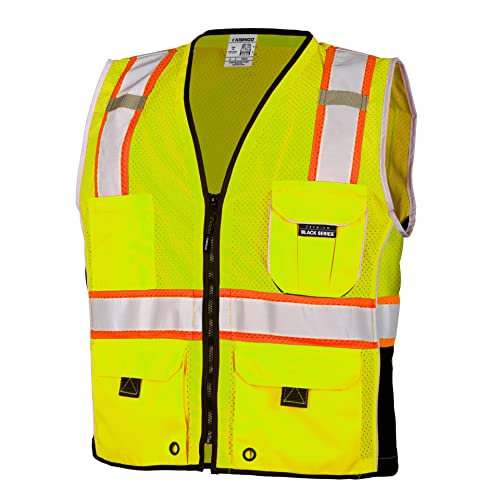
The Dib Safety vest adds reflective arm trim, side piping, and utility-pocket detailing. The Kishigo 1513 uses silver tape around the torso and shoulders with contrasting edging. These details do not prove real-world performance beyond the supplied claims, but they help distinguish a vest with a more comprehensive listed layout from one with only minimal striping.
Color and contrast are also part of the documented design. Yellow, orange, black-trimmed, and black-panel configurations appear in the selection. The AdirPro Surveyor Safety Vest uses fluorescent orange with contrasting reflective tape, while the Kishigo uses breathable black sides and a vibrant orange border. Choose the color scheme permitted by the jobsite and consider whether black panels or trim could be useful for a work environment where visible dirt is a concern; the supplied evidence does not establish cleaning performance.
Choose storage according to the job
Pocket count alone does not tell the whole story. The AdirPro Surveyor Safety Vest is particularly field-oriented because its listing identifies eight front pockets, five inside pockets, a two-way blueprint pocket, and a four-way split pencil pocket. The JKSafety JK188 similarly lists water-bottle or paint storage, a two-tier utility pocket, ID storage, lower utility pockets, and interior space. These designs make the most sense for surveyors, engineers, and supervisors who carry several small tools or documents.
For general daily carry, the Dib Safety vest, JKSafety BX320, and Uno Mejor Women’s 11-Pocket Vest offer varied compartments. The Dib Safety model lists cargo pockets, a gusseted chest pocket, pencil divisions, inside patch pockets, and microphone tabs. The BX320 lists eight utility compartments, including an ID window and expandable waist pockets. Uno Mejor documents 11 pockets covering interior, expandable, pen, and two-tier chest storage.
The Shine Bright vest has six pockets and specifically documents an interior load-bearing strap for a tablet or notebook. That is a more targeted feature than simply adding compartments. The SAFEGEAR five-pack has a simpler chest-and-lower-pocket layout, which may be adequate when a crew needs basic storage rather than a full surveyor vest.
Consider mesh, panels, and comfort details
Polyester mesh appears repeatedly in the selected products, including Dib Safety, Kishigo, Shine Bright, JKSafety, XIAKE, and Uno Mejor. Listings describe these materials as breathable, lightweight, or suitable for warm conditions. Treat those as construction claims, not independent test results. A mesh vest may be preferable when airflow matters, while a partially reinforced or woven front may offer a different balance of structure and coverage.
The JKSafety JK188 uses a 300D Oxford front and mesh elements, and the AdirPro combines nylon and polyester with mesh backing and a reinforced padded collar. Kishigo highlights breathable black sides, while Shine Bright specifies an ultra-padded neck. These details can influence how a vest feels over a work shirt, but actual comfort depends on sizing, layering, climate, and personal preference.
Check fit, closures, and limitations
Review the size chart before ordering. The Dib Safety listing recommends ordering one size larger over a jacket. XIAKE advises users who prefer a loose fit to size up one or two sizes. The BX320 also includes over-jacket guidance. These notes are important because a vest that fits over workwear may not have the same size requirement as one worn over a T-shirt.
Zipper fronts are common in this selection. Reinforced zippers are documented for Dib Safety, Shine Bright, and AdirPro, while KwikSafety and Uno Mejor emphasize zipper closures. Hook-and-loop pocket flaps can help secure small items, but they also add handling steps. The SAFEGEAR product is specifically described as a breakaway vest, a design distinction worth checking against site rules and the intended use.
Do not assume any selected vest provides flame resistance, anti-static protection, or other specialized PPE properties unless the listing says so. JKSafety’s BX320 and JK188 disclosures specifically state that those models are not designed for anti-static or FR standards. If your job requires additional protection, verify the required garment specification separately.
Final Recommendation
Dib Safety Heavy Duty Class 3 Vest ranks first overall in this specification-based comparison under the published weighted criteria.
The final choice among the best ansi-compliant safety vests depends on the documented features that match your intended use.
Dib Safety Heavy Duty Class 3 Vest is the highest-scoring returned product and the first overall specification-based choice for demanding visibility requirements. Its Class 3 designation, 3M reflective strips, arm detailing, reinforced construction, and extensive pockets give it the broadest documented safety-work feature set in this comparison.
For field organization, the AdirPro Surveyor Safety Vest is the more specialized alternative, while the JKSafety JK188 suits supervisors who want surveyor-focused storage and a structured front. Kishigo’s Premium Black Series 1513 is a balanced everyday Class 2 option with breathable mesh and six useful pockets. Workers prioritizing a women’s cut can compare the KwikSafety RoadBOSS and Uno Mejor designs, with the former emphasizing elastic shaping and the latter emphasizing 11-pocket capacity.
Among the top ansi-compliant safety vests, Shine Bright is notable for its tablet or notebook strap, JKSafety BX320 for its broad utility layout, and XIAKE for nine categorized front pockets. For teams, SAFEGEAR’s five-pack may simplify distribution. Confirm the required ANSI class, approved color, size, layering allowance, and any FR or anti-static needs before purchase. These recommendations are specification-based and do not represent hands-on testing.
Frequently Asked Questions
What should I look for in the best ansi-compliant safety vests?
Begin with the stated ANSI/ISEA class and type, then compare reflective coverage, color, pocket layout, material, closure, and fit guidance. The correct choice depends on the worksite requirement. A Class 3 listing, such as the Dib Safety Heavy Duty Class 3 Vest, should be evaluated differently from a general Class 2 mesh vest. Also verify whether your employer requires properties beyond visibility, such as flame resistance or anti-static protection.
Is Class 3 always better than Class 2?
Not automatically for every task. Class 3 is a higher stated visibility classification and may be relevant for complex backgrounds or conditions requiring maximum visibility, as described by Dib Safety. Class 2 may be appropriate for many other work environments, but the governing workplace policy should decide. Do not select a class based only on color, pocket count, or general high-visibility wording.
Are mesh safety vests suitable for warm conditions?
Several selected listings describe polyester mesh as breathable, lightweight, or suitable for warm conditions. Kishigo, Shine Bright, JKSafety, XIAKE, and Uno Mejor all document mesh-related construction. These descriptions indicate intended design characteristics, not independently measured airflow or temperature performance. Fit, layering, humidity, and workload will still affect comfort.
How should I size a vest worn over a jacket?
Use the manufacturer’s size chart and follow any layering instructions. The Dib Safety and JKSafety BX320 listings specifically address wearing the vest over a jacket, while XIAKE advises sizing up for a looser fit. A snug women’s design such as the KwikSafety RoadBOSS may require a different approach from a loose unisex mesh vest. The supplied listing size is not a substitute for checking your measurements.
Do these vests provide flame-resistant or anti-static protection?
Not based on the supplied evidence. JKSafety explicitly states that the BX320 and JK188 are not designed for anti-static or FR standards. ANSI visibility compliance does not by itself establish those additional properties. If your workplace requires FR, anti-static, or another specialized specification, confirm it in the product documentation before choosing a vest.